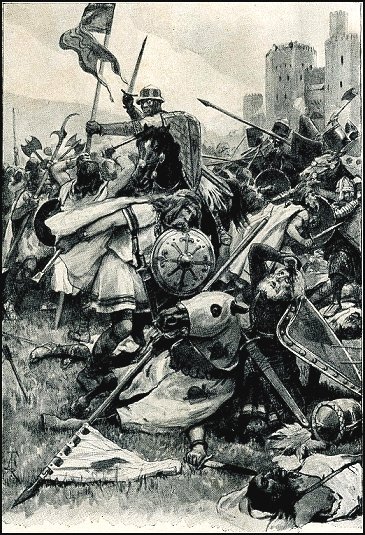
The Battle between Harold and Tostig
HAROLD,
THE LAST OF THE SAXON KINGS.
by
The right Hon. Lord Lytton
LONDON :
WARD LOCK AND CO., LIMITED
1849
The Battle between Harold and Tostig
This electronic edition
was prepared by
Michael A. Linton
----------
BOOK I.
THE NORMAN VISITOR, THE SAXON KING, AND THE DANISH PROPHETESS.
CHAPTER I.
Merry was the month of May in the year of our Lord 1052. Tew were the boys, and few the lasses, who overslept themselves on the first of that buxom month. Long ere the dawn, the crowds had sought mead and woodland, to cut poles and wreathe flowers. Many a mead then lay fair and green beyond the village of Charing, and behind the isle of Thorney, (amidst the brakes and briars of which were then rising fast and fair the Hall and Abbey of Westminster;) many a wood lay dark in the starlight, along the higher ground that sloped from the dank Strand, with its numerous canals or dykes;—and on either side of the great road into Kent:—flutes and horns sounded far and near through the green places, and laughter and song, and the crash of breaking boughs.
As the dawn came grey up the east, arch and blooming faces bowed down to bathe in the May dew. Patient oxen stood dozing by the hedge-rows, all fragrant with blossoms, till the gay spoilers of the May came forth from the woods with lusty poles, followed by girls with laps full of flowers, which they had caught asleep. The poles were pranked with nosegays, and a chaplet was hung round the horns of every ox. Then towards daybreak, the processions streamed back into the city, through all its gates; boys with their May-gads (peeled willow wands twined with cowslips) going before; and clear through the lively din of the horns and flutes, and amidst the moving grove of branches, choral voices, singing some early Saxon stave, precursor of the later song—
"We have brought the summer home."
Often in the good old days before the Monk-king reigned, kings and ealdermen had thus gone forth a-maying; but these merriments, savouring of heathenesse, that good prince misliked: nevertheless the song was as blithe, and the boughs were as green, as if king and ealderman had walked in the train.
On the great Kent road, the fairest meads for the cowslip, and the greenest woods for the bough, surrounded a large building that once had belonged to some voluptuous Roman, now all defaced and despoiled; but the boys and the lasses shunned those demesnes; and even in their mirth, as they passed homeward along the road, and saw near the ruined walls, and timbered outbuildings, grey Druid stones (that spoke of an age before either Saxon or Roman invader) gleaming through the dawn—the song was hushed—the very youngest crossed themselves; and the elder, in solemn whispers, suggested the precaution of changing the song into a psalm. For in that old building dwelt Hilda, of famous and dark repute; Hilda, who, despite all law and canon, was still believed to practise the dismal arts of the Wicca and Morthwyrtha (the witch and worshipper of the dead). But once out of sight of those fearful precincts, the psalm was forgotten, and again broke, loud, clear, and silvery, the joyous chorus.
So, entering London about sunrise, doors and windows were duly wreathed with garlands; and every village in the suburbs had its May-pole, which stood in its place all the year. On that happy day labour rested; ceorl and theowe had alike a holiday to dance, and tumble round the Maypole; and thus, on the first of May—Youth, and Mirth, and Music, "brought the summer home."
The next day you might still see where the buxom bands had been; you might track their way by fallen flowers, and green leaves, and the deep ruts made by oxen (yoked often in teams from twenty to forty, in the wains that carried home the poles); and fair and frequent throughout the land, from any eminence, you might behold the hamlet swards still crowned with the May trees, and air still seemed fragrant with their garlands.
It is on that second day of May, 1052, that my story opens, at the House of Hilda, the reputed Morthwyrtha. It stood upon a gentle and verdant height; and, even through all the barbarous mutilation it had undergone from barbarian hands, enough was left strikingly to contrast the ordinary abodes of the Saxon.
The remains of Roman art were indeed still numerous throughout England, but it happened rarely that the Saxon had chosen his home amidst the villas of those noble and primal conquerors. Our first forefathers were more inclined to destroy than to adapt.
By what chance this building became an exception to the ordinary rule, it is now impossible to conjecture, but from a very remote period it had sheltered successive races of Teuton lords.
The changes wrought in the edifice were mournful and grotesque. What was now the Hall, had evidently been the atrium; the round shield, with its pointed boss, the spear, sword, and small curved saex of the early Teuton, were suspended from the columns on which once had been wreathed the flowers; in the centre of the floor, where fragments of the old mosaic still glistened from the hard-pressed paving of clay and lime, what now was the fire-place had been the impluvium, and the smoke went sullenly through the aperture in the roof, made of old to receive the rains of heaven. Around the Hall were still left the old cubicula or dormitories, (small, high, and lighted but from the doors,) which now served for the sleeping-rooms of the humbler guest or the household servant; while at the farther end of the Hall, the wide space between the columns, which had once given ample vista from graceful awnings into tablinum and viridarium, was filled up with rude rubble and Roman bricks, leaving but a low, round, arched door, that still led into the tablinum. But that tablinum, formerly the gayest state-room of the Roman lord, was now filled with various lumber, piles of faggots, and farming utensils. On either side of this desecrated apartment, stretched, to the right, the old lararium, stripped of its ancient images of ancestor and god; to the left, what had been the gynoecium (women's apartment).
One side of the ancient peristyle, which was of vast extent, was now converted into stabling, sties for swine, and stalls for oxen. On the other side was constructed a Christian chapel, made of rough oak planks, fastened by plates at the top, and with a roof of thatched reeds. The columns and wall at the extreme end of the peristyle were a mass of ruins, through the gigantic rents of which loomed a grassy hillock, its sides partially covered with clumps of furze. On this hillock were the mutilated remains of an ancient Druidical crommel, in the centre of which (near a funeral mound, or barrow, with the bautastean, or gravestone, of some early Saxon chief at one end) had been sacrilegiously placed an altar to Thor, as was apparent both from the shape, from a rude, half-obliterated, sculptured relief of the god, with his lifted hammer, and a few Runic letters. Amidst the temple of the Briton the Saxon had reared the shrine of his triumphant war-god.
Now still, amidst the ruins of that extreme side of the peristyle which opened to this hillock were left, first, an ancient Roman fountain, that now served to water the swine, and next, a small sacellum, or fane to Bacchus (as relief and frieze, yet spared, betokened): thus the eye, at one survey beheld the shrines of four creeds: the Druid, mystical and symbolical; the Roman, sensual, but humane; the Teutonic, ruthless and destroying; and, latest risen and surviving all, though as yet with but little of its gentler influence over the deeds of men, the edifice of the Faith of Peace.
Across the peristyle, theowes and swineherds passed to and fro:—in the atrium, men of a higher class, half-armed, were, some drinking, some at dice, some playing with huge hounds, or caressing the hawks that stood grave and solemn on their perches.
The lararium was deserted; the gynoacium was still, as in the Roman time, the favoured apartment of the female portion of the household, and indeed bore the same name, ["The apartment in which the Anglo-Saxon women lived, was called Gynecium."—Fosbrooke, vol. ii., p. 570.] —and with the group there assembled we have now to do.
The appliances of the chamber showed the rank and wealth of the owner. At that period the domestic luxury of the rich was infinitely greater than has been generally supposed. The industry of the women decorated wall and furniture with needlework and hangings: and as a thegn forfeited his rank if he lost his lands, so the higher orders of an aristocracy rather of wealth than birth had, usually, a certain portion of superfluous riches, which served to flow towards the bazaars of the East and the nearer markets of Flanders and Saracenic Spain.
In this room the walls were draped with silken hangings richly embroidered. The single window was glazed with a dull grey glass. [Glass, introduced about the time of Bede, was more common then in the houses of the wealthy, whether for vessels or windows, than in the much later age of the gorgeous Plantagenets. Alfred, in one of his poems, introduces glass as a familiar illustration:
" So oft the mild sea
With south wind
As grey glass clear
Becomes grimly troubled."
Sharon
Turner.]
On a beaufet were ranged horns tipped with silver, and a few vessels of pure gold. A small circular table in the centre was supported by symbolical monsters quaintly carved. At one side of the wall, on a long settle, some half-a-dozen handmaids were employed in spinning; remote from them, and near the window, sat a woman advanced in years, and of a mien and aspect singularly majestic. Upon a small tripod before her was a Runic manuscript, and an inkstand of elegant form, with a silver graphium, or pen. At her feet reclined a girl somewhat about the age of sixteen, her long hair parted across her forehead and falling far down her shoulders. Her dress was a linen under-tunic, with long sleeves, rising high to the throat, and without one of the modern artificial restraints of the shape, the simple belt sufficed to show the slender proportions and delicate outline of the wearer. The colour of the dress was of the purest white, but its hems, or borders, were richly embroidered. This girl's beauty was something marvellous. In a land proverbial for fair women, it had already obtained her the name of "the fair." In that beauty were blended, not as yet without a struggle for mastery, the two expressions seldom united in one countenance, the soft and the noble; indeed in the whole aspect there was the evidence of some internal struggle; the intelligence was not yet complete; the soul and heart were not yet united: and Edith the Christian maid dwelt in the home of Hilda the heathen prophetess. The girl's blue eyes, rendered dark by the shade of their long lashes, were fixed intently upon the stern and troubled countenance which was bent upon her own, but bent with that abstract gaze which shows that the soul is absent from the sight. So sate Hilda, and so reclined her grandchild Edith.
"Grandam," said the girl in a low voice and after a long pause; and the sound of her voice so startled the handmaids, that every spindle stopped for a moment and then plied with renewed activity; "Grandam, what troubles you—are you not thinking of the great Earl and his fair sons, now outlawed far over the wide seas?"
As the girl spoke, Hilda started slightly, like one awakened from a dream; and when Edith had concluded her question, she rose slowly to the height of a statue, unbowed by her years, and far towering above even the ordinary standard of men; and turning from the child, her eye fell upon the row of silent maids, each at her rapid, noiseless, stealthy work. "Ho!" said she; her cold and haughty eye gleaming as she spoke; "yesterday they brought home the Suinmer—to-day, ye aid to bring home the winter. Weave well—heed well warf and woof; Skulda [Skulda, the Norna, or Fate, that presided over the future.] is amongst ye, and her pale fingers guide the web!"
The maidens lifted not their eyes, though in every cheek the colour paled at the words of the mistress. The spindles revolved, the thread shot, and again there was silence more freezing than before.
"Askest thou," said Hilda at length, passing to the child, as if the question so long addressed to her ear had only just reached her mind; "askest thou if I thought of the Earl and his fair sons?—yea, I heard the smith welding arms on the anvil, and the hammer of the shipwright shaping strong ribs for the horses of the sea. Ere the reaper has bound his sheaves, Earl Godwin will scare the Normans in the halls of the Monk-king, as the hawk scares the brood in the dovecot. Weave well, heed well warf and woof, nimble maidens—strong be the texture, for biting is the worm."
" What weave they, then, good grandmother?" asked the girl, with wonder and awe in her soft mild eyes.
"The winding-sheet of the great!"
Hilda's lips closed, but her eyes, yet brighter than before, gazed upon space, and her pale hand seemed tracing letters, like runes, in the air.
Then slowly she turned, and looked forth through the dull window. " Give me my coverchief and my staff," said she quickly.
Every one of the handmaids, blithe for excuse to quit a task which seemed recently commenced, and was certainly not endeared to them by the knowledge of its purpose communicated to them by the lady, rose to obey.
Unheeding the hands that vied with each other, Hilda took the hood, and drew it partially over her brow. Leaning lightly on a long staff, the head of which formed a raven, carved from some wood stained black, she passed into the hall, and thence through the desecrated tablinum, into the mighty court formed by the shattered peristyle; there she stopped, mused a moment, and called on Edith. The girl was soon by her side.
" Come with me.—There is a face you shall see but twice in life;—this day, "—and Hilda paused, and the rigid and almost colossal beauty of her countenance softened.
" And when again, my grandmother?"
" Child, put thy warm hand in mine. So! the vision darkens from me.—when again, saidst thou, Edith?—alas, I know not."
While thus speaking, Hilda passed slowly by the Roman fountain and the heathen fane, and ascended the little hillock. There on the opposite side of the summit, backed by the Druid crommel and the Teuton altar, she seated herself deliberately on the sward.
A few daisies, primroses, and cowslips, grew around; these Edith began to pluck. Singing, as she wove, a simple song, that, not more by the dialect than the sentiment, betrayed its origin in the ballad of the Norse, [ The historians of our literature have not done justice to the great influence which the poetry of the Danes has had upon our early national muse. I have little doubt but that to that source may be traced the minstrelsy of our borders, and the Scottish Lowlands; while, even in the central counties, the example and exertions of Canute must have had considerable effect on the taste and spirit of our Scops. That great prince afforded the amplest encouragement to Scandinavian poetry, and Olaus names eight Danish poets, who flourished at his court.] which had, in its more careless composition, a character quite distinct from the artificial poetry of the Saxons. The song may be thus imperfectly rendered:
"Merrily the throstle sings
Amid the merry May;
The throstle signs but to my ear;
My heart is far away !
" Blithely bloometh mead and bank;
And blithely buds the tree;
And hark !—they bring the Summer home;
It has no home with me!
" They have outlawed him—my Summer!
An outlaw far away!—
The birds may sing, the flowers may bloom,—
O, give me back my May!"
As she came to the last line, her soft low voice seemed to awaken a chorus of sprightly horns and trumpets, and certain other wind instruments peculiar to the music of that day. The hillock bordered the high road to London—which then wound through wastes of forest land—and now emerging from the trees to the left appeared a goodly company. First came two riders abreast, each holding a banner. On the one was depicted the cross and five martlets, the device of Edward, afterwards surnamed the Confessor: on the other, a plain broad cross with a deep border round it, and the streamer shaped into sharp points.
The first was familiar to Edith, who dropped her garland to gaze on the approaching pageant; the last was strange to her. She had been accustomed to see the banner of the great Earl Godwin by the side of the Saxon king; and she said, almost indignantly,—
"Who dares, sweet grandam, to place banner or pennon where Earl Godwin's ought to float?"
"Peace," said Hilda, "peace and look."
Immediately behind the standard-bearers came two figures—strangely dissimilar indeed in mien, in years, in bearing: each bore on his left wrist a hawk. The one was mounted on a milk-white palfrey, with housings inlaid with gold and uncut jewels. Though not really old—for he was much on this side of sixty—both his countenance and carriage evinced age. His complexion, indeed, was extremely fair, and his cheeks ruddy; but the visage was long and deeply furrowed, and from beneath a bonnet not dissimilar to those in use among the Scotch, streamed hair long and white as snow, mingling witn a large and forked beard. White seemed his chosen colour. White was the upper tunic clasped on his shoulder with a broad ouche or brooch; white the woollen leggings fitted to somewhat emaciated limbs; and white the mantle, though broidered with a broad hem of gold and purple. The fashion of his dress was that which well became a noble person, but it suited ill the somewhat frail and graceless figure of the rider. Nevertheless, as Edith saw him, she rose, with an expression of deep reverence on her countenance, and saying, "It is our lord the King," advanced some steps down the hillock, and there stood, her arms folded on her breast, and quite forgetful, in her innocence and youth, that she had left the house without the cloak and coverchief which were deemed indispensable to the fitting appearance of maid and matron when they were seen abroad.
"Fair sir, and brother mine," said the deep voice of the younger rider, in the Romance or Norman tongue, "I have heard that the small people of whom my neighbours, the Breton tell us much, abound greatly in this fair land of yours; and if I were not by the side of one whom no creature unassoilzed and unbaptised dare approach, by sweet St. Valery I should say—yonder stands one of those same gentilles fees!"
King Edward's eye followed the direction of his companion's outstretched hand, and his quiet brow slightly contracted as he beheld the young form of Edith standing motionless a few yards before him, with the warm May wind lifting and playing with her long golden locks. He checked his palfrey, and murmured some Latin words which the knight beside him recognised as a prayer, and to which, doffing his cap, he added an Amen, in a tone of such unctuous gravity, that the royal saint rewarded him with a faint approving smile, and an affectionate "Bene bene, piosissime."
Then inclining his palfrey's head towards the knoll, he motioned to the girl to approach him. Edith, with a heightened colour, obeyed, and came to the roadside. The standard-bearers halted, as did the king and his comrade—the procession behind halted—thirty knights, two bishops, eight abbots, all on fiery steeds and in Norman garb—squires and attendants on foot—a long and pompous retinue—they halted all. Only a stray hound or two broke from the rest, and wandered into the forest land with heads trailing.
"Edith, my child," said Edward, still in Norman-French, for he spoke his own language with hesitation, and the Romance tongue, which had long been familiar to the higher classes in England, had, since his accession, become the only language in use at court, and as such every one of 'Eorl-kind' was supposed to speak it;—"Edith, my child, thou hast not forgotten my lessons, I trow; thou singest the hymns I gave thee, and neglectest not to wear the relic round thy neck."
The girl hung her head, and spoke not.
" How comes it, then," continued the King, with a voice to.which he in vain endeavoured to impart an accent of severity, "how comes it, O little one, that thou, whose thoughts should be lifted already above this carnal world, and eager for the service of Mary the chaste and blessed, standest thus hoodless and alone on the waysides, a mark for the eyes of men? go to, it is naught."
Thus reproved, and in presence of so large and brilliant a company, the girl's colour went and came, her breast heaved high, but with an effort beyond her age she checked her tears, and said meekly, "My grandmother, Hilda, bade me come with her, and I came."
" Hilda!" said the King, backing his palfrey with apparent perturbation, "but Hilda is not with thee; I see her not."
As he spoke, Hilda rose, and so suddenly did her tall form appear on the brow of the hill, that it seemed as if she had emerged from the earth. With a light and rapid stride she gained the side of her grandchild; and after a slight and haughty reverence, said, "Hilda is here; what wants Edward the King with his servant Hilda?"
" Nought, nought," said the King, hastily; and something like fear passed over his placid countenance; "save, indeed," he added, with a reluctant tone, as that of a man who obeys his conscience against his inclination, "that I would pray thee to keep this child pure to threshold and altar, as is meet for one whom our Lady, the Virgin, in due time, will elect to her service."
"Not so, son of Etheldred, son of Woden, the last descendant of Penda
should live, not to glide a ghost amidst cloisters, but to rock children for
war in their father's shield. Few men are there yet like the men of old; and
while the foot of the foreigner is on the Saxon soil no branch of the stem of
Woden should be
nipped in the leaf."
" Per la resplendar De, [" By the splendour of God."] bold dame," cried the knight by the side of Edward, while a lurid flush passed over his cheek of bronze; "but thou art too glib of tongue for a subject, and pratest overmuch of Woden, the Paynim, for the lips of a Christian matron."
Hilda met the flashing eye of the knight with a brow of lofty scorn, on which
still a certain terror was visible.
"Child," she said, putting her hand upon Edith's fair locks; "this
is the man thou shalt see but twice in thy life;—look up, and mark well!"
Edith instinctively raised her eyes, and, once fixed upon the knight, they seemed chained as by a spell. His vest, of a cramoisay so dark, that it seemed black beside the snowy garb of the Confessor, was edged by a deep band of embroidered gold; leaving perfectly bare his firm, full throat—firm and full as a column of granite,—a short jacket or manteline of fur, pendant from the shoulders, left developed in all its breadth a breast, that seemed meet to stay the march of an army; and on the left arm, curved to support the falcon, the vast muscles rose, round and gnarled, through the close sleeve.
In height, he was really but little above the stature of many of those present; nevertheless, so did his port, [ There are various accounts in the Chroniclers as to the stature of William the First; some represent him as a giant, others as of just or middle height. Considering the vulgar inclination to attribute to a hero's stature the qualities of the mind (and putting out of all question the arguments that rest on the pretended size of the disburied bones—for which the authorities are really less respectable than those on which we are called upon to believe that the skeleton of the mythical Gawaine measured eight feet), we prefer that supposition, as to the physical proportions, which is most in harmony with the usual laws of Nature. It is rare, indeed, that a great intellect is found in the form of a giant.] his air, the nobility of his large proportions, fill the eye, that he seemed to tower immeasurably above the rest.
His countenance was yet more remarkable than his form; still in the prime of youth, he seemed at the first glance younger, at the second older, than he was. At the first glance younger; for his face was perfectly shaven, without even the moustache which the Saxon courtier, in imitating the Norman, still declined to surrender; and the smooth visage and bare throat sufficed in themselves to give the air of youth to that dominant and imperious presence. His small skull-cap left unconcealed his forehead, shaded with short thick hair, uncurled, but black and glossy as the wings of a raven. It was on that forehead that time had set its trace; it was knit into a frown over the eyebrows; lines deep as furrows crossed its broad, but not elevated expanse. That frown spoke of hasty ire and the habit of stern command; those furrows spoke of deep thought and plotting scheme; the one betrayed but temper and circumstance; the other, more noble, spoke of the character and the intellect. The face was square, and the regard lion-like; the mouth—small, and even beautiful in outline—had a sinister expression in its exceeding firmness; and the jaw—vast, solid, as if bound in iron—showed obstinate, ruthless, determined will; such a jaw as belongs to the tiger amongst beasts, and the conqueror amongst men; such as it is seen in the effigies of Caesar, of Cortes, of Napoleon.
That presence was well calculated to command the admiration of women, not less than the awe of men. But no admiration mingled with the terror that seized the girl as she gazed long and wistful upon the knight. The fascination of the serpent on the bird held her mute and frozen. Never was that face forgotten; often in after-life it haunted her in the noon-day, it frowned upon her dreams.
"Fair child," said the knight, fatigued at length by the obstinacy of the gaze, while that smile peculiar to those who have commanded men relaxed his brow, and restored the native beauty to his lip, "fair child, learn not from thy peevish grandam so uncourteous a lesson as hate of the foreigner. As thou growest into womanhood, know that Norman knight is sworn slave to lady fair;" and, doffing his cap, he took from it an uncut jewel, ret in Byzantine filigree work. "Hold out thy lap, my child; and when thou nearest the foreigner scoffed, set this bauble in thy locks, and think kindly of William, Count of the Normans." [ It is noticeable that the Norman dukes did not call themselves Counts or Dukes of Normandy, but of the Normans; and the first Anglo-Norman kings, till Richard the First, styled themselves Kings of the English, not of England. In both Saxon and Norman chronicles, William usually bears the title of Count (Comes), but in this tale he will be generally called Duke, as a title more familial to us.]
He dropped the jewel on the ground as he spoke; for Edith, shrinking and unsoftened towards him, held no lap to receive it; and Hilda, to whom Edward had been speaking in a low voice, advanced to the spot and struck the jewel with her staff under the hoofs of the king's palfrey.
" Son of Emma, the Norman woman, who sent thy youth into exile, trample on the gifts of thy Norman kinsman. And if, as men say, thou art of such gifted holiness that Heaven grants thy hand the power to heal, and thy voice the power to curse, heal thy country, and curse the stranger!"
She extended her right arm to William as she spoke, and such was the dignity of her passion, and such its force, that an awe fell upon all. Then dropping her hood over her face, she slowly turned away, regained the summit of the knoll, and stood erect beside the altar of the Northern god, her face invisible through the hood drawn completely over it, and her form motionless as a statue.
" Ride on," said Edward, crossing himself.
" Now by the bones of St. Valery," said William, after a pause, in which his dark keen eye noted the gloom upon the King's gentle face, "it moves much my simple wonder how even presence so saintly can hear without wrath words so unleal and foul. Gramercy, an the proudest dame in Normandy (and I take her to be wife, to my stoutest baron, William Fitzosborne) had spoken thus to me—"
" Thou wouldst have done as I, my brother," interrupted Edward; "prayed to our Lord to pardon her, and rode on pitying."
William's lip quivered with ire, yet he curbed the reply that sprang to it, and he looked with affection genuinely more akin to admiration than scorn, upon his fellow-prince. For, fierce and relentless as the Duke's deeds were, his faith was notably sincere; and while this made, indeed, the prince's chief attraction to the pious Edward, so, on the other hand, this bowed the Duke in a kind of involuntary and superstitious homage to the man who sought to square deeds to faith. It is ever the case with stern and stormy spirits, that the meek ones which contrast them steal strangely into their affections. This principle of human nature can alone account for the enthusiastic devotion which the mild sufferings of the Saviour awoke in the fiercest exterminators of the North. In proportion, often, to the warrior's ferocity, was his love to that Divine model, at whose sufferings he wept, to whose tomb he wandered barefoot, and whose example of compassionate forgiveness he would have thought himself the basest of men to follow!
" Now, by my halidame, I honour and love thee, Edward," cried the Duke, with a heartiness more frank than was usual to him: "and were I thy subject, woe to man or woman that wagged tongue to wound thee by a breath. But who and what is this same Hilda? one of thy kith and kin?—surely not less than kingly blood runs so bold?"
"William, bien aime," [ The few expressions borrowed occasionally from the Romance tongue, to give individuality to the speaker, will generally be translated into modern French; for the same reason as Saxon is rendered into modern English, viz., that the words may be intelligible to the reader.] said the King, "it is true that Hilda, whom the saints assoil, is of kingly blood, though not of our kingly line. It is feared," added Edward, in a timid whisper, as he cast a hurried glance around him, "that this unhappy woman has ever been more addicted to the rites of her pagan ancestors than to those of Holy Church; and men do say that she hath thus acquired from fiend or charm secrets devoutly to be eschewed by the righteous. Nathless, let us rather hope that her mind is somewhat distraught with her misfortunes."
The King sighed, and the Duke sighed too, but the Duke's sigh spoke impatience. He swept behind him a stern and withering look towards the proud figure of Hilda, still seen through the glades, and said in a sinister voice: "Of kingly blood; but this witch of Woden hath no sons or kinsmen, I trust, who pretend to the throne of the Saxon?"
"She is sibbe to Githa, wife of Godwin," answered the King, "and that is her most perilous connection; for the banished Earl, as thou knowest, did not pretend to fill the throne, but he was content with nought less than governing our people."
The King then proceeded to sketch an outline of the history of Hilda, but his narrative was so deformed both by his superstitions and prejudices, and his imperfect information in all the leading events and characters in his own kingdom, that we will venture to take upon ourselves his task; and while the train ride on through glade and mead, we will briefly narrate, from our own special sources of knowledge, the chronicle of Hilda, the Scandinavian Vala.
CHAPTER II.
A magnificent race of men were those war sons of the old North, whom our popular histories, so superficial in their accounts of this age, include in the common name of the "Danes." They replunged into barbarism the nations over which they-swept; but from that barbarism they reproduced the noblest elements of civilisation. Swede, Norwegian, and Dane, differing in some minor points, when closely examined, had yet one common character viewed at a distance. They had the same prodigious energy, the same passion for freedom, individual and civil, the same splendid errors in the thirst for fame and the "point of honour;" and above all, as a main cause of civilisation, they were wonderfully pliant and malleable in their admixtures with the peoples they overran. This is their true distinction from the stubborn Celt, who refuses to mingle, and disdains to improve.
Frankes, the archbishop, baptised Rolf-ganger: [ "Roman de Rou," part i., v. 1914.] am within a little more than a century afterwards, the descend ants of those terrible heathens who had spared neithei priest nor altar, were the most redoubtable defenders of the Christian Church; their old language forgotten (save by a few in the town of Bayeux), their ancestral names [ The reason why the Normans lost their old names is to be found in their conversion to Christianity. They were baptised; and Franks, as their godfathers, gave them new appellations. Thus, Charles the Simple insists that Rolf-ganger shall change his law (creed) and his name, and Rolf or Rou is christened Robert. A few of those who retained Scandinavian names at the time of the Conquest will be cited hereafter.] (save among a few of the noblest) changed into French titles, and little else but the indomitable valour of the Scandinavian remained unaltered amongst the arts and manners of the Frankish-Norman.
In like manner their kindred tribes, who had poured into Saxon England to ravage and lay desolate, had no sooner obtained from Alfred the Great permanent homes, than they became perhaps the most powerful, and in a short time not the least patriotic, part of the Anglo-Saxon population. [Thus in 991, about a century after the first settlement, the Danea of East Anglia gave the only efficient resistance to the host of the Vikings under Justin and Gurthmund; and Brithnoth, celebrated by the Saxon poet, as a Saxon par excellence, the heroic defender of his native soil, was, in all probability, of Danish descent. Mr. Laing, in his preface to his translation of the Heimskringla, truly observes, "that the rebellions Against William the Conqueror, and his successors, appear to have been almost always raised, or mainly supported, in the counties of recent Danish descent, not in those peopled by the old Anglo-Saxon race."
The portion of Mercia, consisting of the burghs of Lancaster, Lincoln, Nottingham, Stamford, and Derby, became a Danish state in A.D. 877;—East Anglia, consisting of Cambridge, Suffolk, Norfolk, and the Isle of Ely, in A.D. 879-80; and the vast territory of Northumbria, extending all north the Humber, into all that part of Scotland south of the Frith, in A.D. 876.—See Palgrave's Commonwealth. But besides their more allotted settlements, the Danes were interspersed as landowners all over England.] At the time our story opens, these Northmen, under the common name of Danes, were peaceably settled in no less than fifteen [Bromton Chron.—viz., Essex, Middlesex, Suffolk, Norfolk, Herts, Cambridgeshire, Hants, Lincoln, Notts, Derby, Northampton, Leicestershire, Bucks, Beds, and the vast territory called Northumbria.] counties in England; their nobles abounded in towns and cities beyond the boundaries of those counties which bore the distinct appellation of Danelagh. They were numerous in London: in the precincts of which they had their own burial-place, to the chief municipal court of which they gave their own appellation—the Hustings. [Palgrave's History of England, p. 315.] Their power in the national assembly of the Witan had decided the choice of kings. Thus, with some differences of law and dialect, these once turbulent invaders had amalgamated amicably with the native race. [The laws collected by Edward the Confessor, and in later times so often and so fondly referred to, contained many introduced by the Danes, which had grown popular with the Saxon people. Much which we ascribe to the Norman Conqueror, pre-existed in the Anglo-Danish, and may be found both in Normandy, and parts of Scandinavia, to this day.—See Hakewell's Treatise on the Antiquity of Laws in this Island, in Hearne's Curious Discourses.] And to this day, the gentry, traders, and farmers of more than one-third of England, and in those counties most confessed to be in the van of improvement, descend from Saxon mothers indeed, but from Viking fathers. There was in reality little difference in race between the Norman knight of the time of Henry I. and the Saxon franklin of Norfolk and York. Both on the mother's side would most probably have been Saxon, both on the father's would have traced to the Scandinavian.
But though this character of adaptability was general, exceptions in some points were necessarily found, and these were obstinate in proportion to the adherence to the old pagan faith, or the sincere conversion to Christianity. The Norwegian chronicles, and passages in our own history, show how false and hollow was the assumed Christianity of many of these fierce Odin-worshippers. They willingly enough accepted the outward sign of baptism, but the holy water changed little of the inner man. Even Harold, the son of Canute, scarce seventeen years before the date we have now entered, being unable to obtain from the Archbishop of Canterbury—who had espoused the cause of his brother Hardicanute—the consecrating benediction, lived and reigned as one who had abjured Christianity." [Palgrave's History of England, p. 322.]
The priests, especially on the Scandinavian continent, were often forced to compound with their grim converts, by indulgence to certain habits, such as indiscriminate polygamy. To eat horse-flesh in honour of Odin, and to marry wives ad libitum, were the main stipulations of the neophytes. And the puzzled monks, often driven to a choice, yielded the point of the wives, but stood firm on the graver article of the horse-flesh.
With their new religion, very imperfectly understood, even when genuinely received, they retained all that host of heathen superstition which knits itself with the most obstinate instincts in the human breast. Not many years before the reign of the Confessor, the laws of the great Canute against witchcraft and charms, the worship of stones, fountains, runes by ash and elm, and the incantations that do homage to the dead, were obviously rather intended to apply to the recent Danish converts, than to the Anglo-Saxons, already subjugated for centuries, body and soul, to the domination of the Christian monks.
Hilda, a daughter of the royalty of Denmark, and cousin to Githa (niece to Canute, whom that king had bestowed in second spousals upon Godwin), had come over to England with a fierce Jarl, her husband, a year after Canute's accession to the throne—both converted nominally, both secret believers in Thor and Odin.
Hilda's husband had fallen in one of the actions in the Northern seas, between Canute and St. Olave, King of Norway (that saint himself, by the bye, a most ruthless persecutor of his forefathers' faith, and a most unqualified assertor of his heathen privilege to extend his domestic affections beyond the severe pale which should have confined them to a single wife. His natural son Magnus then sat on the Danish throne). The Jarl died as he had wished to die, the last man on board his ship, with the soothing conviction that the Valkyrs would bear him to Valhalla.
Hilda was left with an only daughter, whom Canute bestowed on Ethelwolf, a Saxon Earl of large domains, and tracing his descent from Penda, that old King of Mercia who refused to be converted, but said so discreetly, that he had no objection to his neighbours being Christians, if they would practise that peace and forgiveness which the monks told him were the elements of the faith."
Ethelwolf fell under the displeasure of Hardicanute, perhaps because he was
more Saxon than Danish; and though that savage king did not dare openly to arraign
him before the Witan, he gave secret orders by which he was butchered on his
own hearthstone, in the arms of his wife, who died shortly afterwards of grief
and terror. The only orphan of this unhappy pair, Edith, was thus consigned
to the charge of Hilda.
It was a necessary and invaluable characteristic of that "adaptability"
which distinguished the Danes, that they transferred to the land in which they
settled all the love they had borne to that of their ancestors; and so far as
attachment to soil was concerned, Hilda had grown no less in heart an Englishwoman
than if she had been born and reared amidst the glades and knolls from which
the smoke of her hearth rose through the old Roman compluvium.
But in all else she was a Dane. Dane in her creed and her habits—Dane in her intense and brooding imagination—in the poetry that filled her soul, peopled the air with spectres, and covered the leaves of the trees with charms. Living in austere seclusion after the death of her lord, to whom she had borne a Scandinavian woman's devoted but heroic love,—sorrowing, indeed, for his death, but rejoicing that he fell amidst the feast of ravens,—her mind settled more and more year by year, and day by day, upon those visions of the unknown world, which in every faith conjure up the companions of solitude and grief.
Witchcraft in the Scandinavian North assumed many forms, and was connected by many degrees. There was the old and withered hag, on whom, in our later mediaeval ages the character was mainly bestowed; there was the terrific witch-wife, or wolf-witch, who seems wholly apart from human birth and attributes, like the weird sisters of Macbeth—creatures who entered the house at night and seized warriors to devour them, who might be seen gliding over the sea, with the carcase of the wolf dripping blood from their giant jaws: and there was the more serene, classical, and awful vala, or sibyl, who, honoured by chiefs and revered by nations, foretold the future, and advised the deeds of heroes. Of these last, the Norse chronicles tell us much. They were often of rank and wealth, they were accompanied by trains of handmaids and servants—kings led them (when their counsel was sought) to the place of honour in the hall, and their heads were sacred, as those of ministers to the gods.
This last state in the grisly realm of the "Wig-laer (wizard-lore) was the one naturally appertaining to the high rank, and the soul, lofty though blind and perverted, of the daughter of warrior-kings. All practice of the art to which now for long years she had devoted herself, that touched upon the humble destinies of the vulgar, the child of Odin [ The name of this god is spelt Odin, when referred to as the olijcot of Scandinavian worship; Woden, when applied directly to the deity of the Saxons.] haughtily disdained. Her reveries were upon the fate of kings and kingdoms; she aspired to save or to rear the dynasties which should rule the races yet unborn. In youth proud and ambitious,—common faults with her countrywomen,—on her entrance into the darker world, she carried with her the prejudices and passions that she had known in that coloured by the external sun.
All her human affections were centred in her grandchild Edith, the last of a race royal on either side. Her researches into the future had assured her, that the life and death of this fair child were entwined with the fates of a king, and the same oracles had intimated a mysterious and inseparable connection between her own shattered house and the nourishing one of Earl Godwin, the spouse of her kinswoman Githa: so that with this great family she was as intimately bound by the links of superstition as by the ties of blood. The eldest born of Godwin, Sweyn, had been at first especially her care and her favourite; and he, of more poetic temperament than his brothers, had willingly submitted to her influence. But of all the brethren, as will be seen hereafter, the career of Sweyn had been most noxious and ill-omened; and at that moment, while the rest of the house carried with it into exile the deep and indignant sympathy of England, no man said of Sweyn, "God bless him!"
But as the second son, Harold, had grown from childhood into youth, Hilda had singled him out with a preference even more marked than that she had bestowed upon Sweyn. The stars and the runes assured her of his future greatness, and the qualities and talents of the young Earl had, at the very onset of his career, confirmed the accuracy of their predictions. Her interest in Harold became the more intense, partly because whenever she consulted the future for the lot of her grandchild Edith, she invariably found it associated with the fate of Harold—partly because all her arts had failed to pentrate beyond a certain point in their joint destinies, and left her mind agitated and perplexed between hope and terror. As yet, however, she had wholly failed in gaining any ascendancy over the young Earl's vigorous and healthful mind: and though, before his exile, he came more often than any of Godwin's sons to the old Roman house, he had smiled with proud incredulity at her vague prophecies, and rejected all her offers of aid from invisible agencies with the calm reply—"The brave man wants no charms to encourage him to his duty, and the good man scorns all warnings that would deter him from fulfilling it."
Indeed, though Hilda's magic was not of the malevolent kind, and sought the source of its oracles not in fiends but gods, (at least the gods in whom she believed,) it was noticeable that all over whom her influence had prevailed had come to miserable and untimely ends;—not alone her husband and her son-in-law, (both of whom had been as wax to her counsel,) but such other chiefs as rank or ambition permitted to appeal to her lore. Nevertheless, such was the ascendancy she had gained over the popular mind, that it would have been dangerous in the highest degree to put into execution against her the laws condemnatory of witchcraft. In her, all the more powerful Danish families reverenced, and would have protected, the blood of their ancient kings, and the widow of one of their most renowned heroes.
Hospitable, liberal, and beneficent to the poor, and an easy mistress over numerous ceorls, while the vulgar dreaded, they would yet have defended her. Proofs of her art it would have been hard to establish; hosts of compurgators to attest her innocence would have sprung up. Even if subjected to the ordeal, her gold could easily have bribed the priests with whom the power of evading its dangers rested. And with that worldly wisdom which persons of genius in their wildest chimeras rarely lack, she had already freed herself from the chance of active persecution from the Church, by ample donations to all the neighbouring monasteries.
Hilda, in fine, was a woman of sublime desires and extraordinary gifts; terrible, indeed, but as the passive agent of the Fates she invoked, and rather commanding for herself a certain troubled admiration and mysterious pity; no fiend-hag, beyond humanity in malice and in power, but essentially human, even when aspiring most to the secrets of a god. Assuming, for the moment, that by the aid of intense imagination, persons of a peculiar idiosyncrasy of nerves and temperament might attain to such dim affinities with a world beyond our ordinary senses, as forbid entire rejection of the magnetism and magic of old times—it was on no foul and mephitic pool, overhung with the poisonous nightshade, and excluded from the beams of heaven, but on the living stream on which the star trembled, and beside whose banks the green herbage waved, that the demon shadows fell dark and dread.
Thus safe and thus awful, lived Hilda; and under her care, a rose beneath the funeral cedar, bloomed her grandchild Edith, goddaughter of the Lady of England.
It was the anxious wish, both of Edward and his virgin wife, pious as himself, to save this orphan from the contamination of a house more-than suspected of heathen faith, and give to her youth the refuge of the convent. But this, without her guardian's consent or her own expressed will, could not be legally done; and Edith as yet had expressed no desire to disobey her grandmother, who treated the idea of the convent with lofty scorn.
This beautiful child grew up under the influence, as it were, of two contending creeds; all her nations on both were necessarily confused and vague. But her heart was so genuinely mild, simple, tender, and devoted,—there was in her so much of the inborn excellence of the sex, that in every impulse of that heart struggled for clearer light and for purer air the unquiet soul. In manner, in thought, and in person as yet almost an infant, deep in her heart lay yet one woman's secret, known scarcely to herself, but which taught her, more powerfully than Hilda's proud and scoffing tongue, to shudder at the thought of the barren cloister and the eternal vow.
CHAPTER III.
While King Edward was narrating to the Norman Duke all that he knew, and all that he knew not, of Hilda's history and secret arts, the road wound through lands as wild and wold-like as if the metropolis of England lay a hundred miles distant. Even to this day patches of such land, in the neighbourhood of Norwood, may betray what the country was in the old time:—when a mighty forest, "abounding with wild beasts"—" the bull and the boar"—skirted the suburbs of London, and afforded pastime to king and thegn. For the Norman kings have been maligned by the popular notion that assigns to them all the odium of the forest laws. Harsh and severe were those laws in the reign of the Anglo-Saxon; as harsh and severe, perhaps, against the ceorl and the poor man, as in the days of Rufus, though more mild unquestionably to the nobles. To all beneath the rank of abbot and thegn, the king's woods were made, even by the mild Confessor, as sacred as the groves of the Druids: and no less penalty than that of life was incurred by the lowborn huntsman who violated their recesses. [Game Laws before the Conquest : Under the Saxon kings a man might, it is true, hunt in his own grounds, but that was a privilege that could benefit few but thegns; and over cultivated ground or shire-land there was not the same sport to be found as in the vast wastes called forest-land, and which mainly belonged to the kings.
Edward declares, in a law recorded in a volume of the Exchequer, "I will that all men do abstain from hunting in my woods, and that my will shall be obeyed under penalty of life."[ Thomson's Essay on Magna Charta.]
Edgar, the darling monarch of the monks, and, indeed, one of the most popular of the Anglo-Saxon kings, was so rigorous in his forest-laws that the thegns murmured as well as the lower husbandmen, who had been accustomed to use the woods for pasturage and boscage. Canute's forest-laws were meant as a liberal concession to public feeling on the subject; they are more definite than Edgar's, but terribly stringent; if a freeman killed one of the king's deer, or struck his forester, he lost his freedom and became a penal serf (white theowe)—that is, he ranked with felons. Nevertheless, Canute allowed bishops, abbots, and thegns to hunt in his woods—a privilege restored by Henry III. The nobility, after the Conquest, being excluded from the royal chases, petitioned to enclose parks, as early even as the reign of William I.; and by the time of his son, Henry I., parks became so common as to be at once a ridicule and a grievance.]
Edward's only mundane passion was the chase; and a day rarely passed, but what after mass he went forth with hawk or hound. So that, though the regular season for hawking did not commence till October, he had ever on his wrist some young falcon to essay, or some old favourite to exercise. And now, just as William was beginning to grow weary of his good cousin's prolix recitals, the hounds suddenly gave tongue, and from a sedge-grown pool by the way-side, with solemn wing and harsh boom, rose a bittern.
"Holy St. Peter!" exclaimed the Saint-king, spurring his palfrey, and loosing his famous Peregrine falcon. [The Peregrine hawk built on the rocks of Llandudno, and this breed was celebrated, even to the days of Elizabeth. Burleigh thanks one of the Mostyns for a cast of hawks from Llandudno.] William was not slow in following that animated example, and the whole company rode at half speed across the rough forest-land, straining their eyes upon the soaring quarry, and the large wheels of the falcons. Biding thus, with his eyes in the air, Edward was nearly pitched over his palfrey's head, as the animal stopped suddenly, checked by a high gate, set deep in a half embattled wall of brick and rubble. Upon this gate sate, quite unmoved and apathetic, a tall ceorl, or labourer, while behind it was a gazing curious group of men of the same rank, clad in those blue tunics of which our peasant's smock is the successor, and leaning on scythes and flails. Sour and ominous were the looks they bent upon that Norman cavalcade. The men were at least as well clad as those of the same condition are now; and their robust limbs and ruddy cheeks showed no lack of the fare that supports labour. Indeed, the working man of that day, if not one of the absolute theowes or slaves, was, physically speaking, better off, perhaps, than he has ever since been in England, more especially if he appertained to some wealthy thegn of pure Saxon lineage, whose very title of lord came to him in his quality of dispenser of bread; [Hlaf, loaf,—Hlaford, lord, giver of bread; Hleafdian, lady, Server of bread.—Verstegan.] and these men had been ceorls under Harold, son of Godwin, now banished from the land.
"Open the gate, open quick, my merry men," said the gentle Edward (speaking in Saxon, though with a strong foreign accent), after he had recovered his seat, murmured a benediction, and crossed himself three times. The men stirred not.
"No horse tramps the seeds we have sown for Harold the Earl to reap;" said the ceorl, doggedly, still seated on the gate. And the group behind him gave a shout of applause.
Moved more than ever he had been known to be before, Edward spurred his steed up to the boor, and lifted his hand. At that signal twenty swords flashed in the air behind, as the Norman nobles spurred to the place. Putting back with one hand his fierce attendants, Edward shook the other at the Saxon. "Knave, knave," he cried, "I would hurt you, if I could!"
There was something in these words, fated to drift down into history, at once ludicrous and touching. The Normans saw them only in the former light, and turned aside to conceal their laughter; the Saxon felt them in the latter and truer sense, and stood rebuked. That great king, whom he now recognised, with all those drawn swords at his back, could not do him hurt; that king had not the heart to hurt him. The ceorl sprang from the gate, and opened it, bending low.
"Ride first, Count William, my cousin," said the King, calmly.
The Saxon ceorl's eyes glared as he heard the Norman's name uttered in the Norman tongue, but he kept open the gate, and the train passed through, Edward lingering last. Then said the King, in a low voice,—
"Bold man, thou spokest of Harold the Earl and his harvests; knowest thou not that his lands have passed from him, and that he is outlawed, and that his harvests are not for the scythes of his ceorls to reap?"
"May it please you, dread Lord and King," replied the Saxon simply, "these lands that were Harold the Earl's, are now Clapa's, the sixhaendman's."
"How is that?" quoth Edward, hastily; "we gave them neither to sixhaendman nor to Saxon. All the lands of Harold hereabout were divided amongst sacred abbots and noble chevaliers—Normans all."
"Fulke the Norman had these fair fields, yon orchards and tynen; Eulke sold them to Clapa, the Earl's sixhaendman, and what in mancusses and pence Clapa lacked of the price, we, the ceorls of the Earl, made up from our own earnings in the Earl's noble service. And this very day, in token thereof, have we quaffed the bedden-ale. [ Bedden-ale. When any man was set up in his estate hy the contributions of his friends, those friends were bid to a feast, and the ale so drunk was called the bedden-ale, from bedden, to pray, or to bid. (See Brand's Pop. Antiq.}] Wherefore, please God and our Lady, we hold these lands part and parcel with Clapa; and when Earl Harold comes again, as come he will, here at least he will have his own."
Edward, who, despite a singular simplicity of character, which at times seemed to border on imbecility, was by no means wanting in penetration when his attention was fairly roused, changed countenance at this proof of rough and homely affection on the part of these men to his banished earl and brother-in-law. He mused a little while in grave thought, and then said, kindly—
"Well, man, I think not the worse of you for loyal love to your thegn, but there are those who would do so, and I advise you, brotherlike, that ears and nose are in peril if thou talkest thus indiscreetly."
"Steel to steel, and hand to hand," said the Saxon, bluntly, touching the long knife in his leathern belt, "and he who sets gripe on Sexwolf son of Elfhelm, shall pay his weregeld twice over."
"Forewarned, foolish man, thou are forewarned, peace," said the King; and, shaking his head, he rode on to join the Normans, who now, in a broad field, where the corn sprang green, and which they seemed to delight in wantonly trampling, as they curvetted their steeds to and fro, watched the movements of the bittern and the pursuit of the two falcons.
"A wager, Lord King!" said a prelate, whose strong family likeness to William proclaimed him to be the Duke's bold and haughty brother, Odo, [ Herleve (Arlotta), William's mother, married Herluin de Monteville, after the death of Duke Robert, and had by him two sons, Robert, Count of Mortain, and Odo, Bishop of Bayeux—Ord. Vital, lib. vii.] Bishop of Bayeux;—"a wager. My steed to your palfrey that the Duke's falcon first fixes the bittern."
"Holy father," answered Edward, in that slight change of voice which alone showed his displeasure, "these wagers all savour of heathenesse, and our canons forbid them to mone [ Mone, monk.] and priest. Go to, it is naught."
The bishop, who brooked no rebuke, even from his terrible brother, knit his brows, and was about to make no gentle rejoinder, when William, whose profound craft or sagacity was always at watch, lest his followers should displease the King, interposed, and taking the word out of the prelate's mouth, said:
"Thou repvovest us well, Sir and King; we Normans are too inclined to such levities. And see, your falcon is first in pride of place. By the bones of St. Valery, how nobly he towers! See him cover the bittern!—see him rest on the wing!—Down he swoops! Gallant bird!"
"With his heart split in two on the bittern's bill," said the bishop; and down, rolling one over the other, fell bittern and hawk, while William's Norway falcon, smaller of size than the King's, descended rapidly, and hovered over the two. Both were dead.
"I accept the omen," muttered the gazing Duke; "let the natives destroy each other!" He placed his whistle to his lips, and his falcon flew back to his wrist.
"Now home," said King Edward.
CHAPTER IV.
THE royal party entered London by the great bridge which divided Southwark from the capital; and we must pause to gaze a moment on the animated scene which the immemorial thoroughfare presented.
The whole suburb before entering Southwark was rich in orchards and gardens, lying round the detached houses of the wealthier merchants and citizens. Approaching the river-side, to the left, the eye might see the two circular spaces set apart, the one for bear, the other for bull-baiting. To the right, upon a green mound of waste, within sight of the populous bridge, the gleemen were exercising their art. Here one dexterous juggler threw three balls and three knives alternately in the air, catching them one by one as they fell. [ Strutt's Horda.] There, another was gravely leading a great bear to dance on its hind legs, while his coadjutor kept time with a sort of flute or flageolet. The lazy bystanders, in great concourse, stared and laughed; but the laugh was hushed at the tramp of the Norman steeds; and the famous Count by the King's side, as, with a smiling lip, but observant eye, he rode along, drew all attention from the bear.
On now approaching that bridge which, not many years before, had been the scene of terrible contest between the invading Danes and Ethelred's ally, Olave of Norway, [There is au animated description of this "Battle of London Bridge," which gave ample theme to the Scandinavian scalds, in Snorro Sturleson:
"London Bridge is broken down;
Gold is won and bright renown;
Shields resounding,
War-horns sounding,
Hildur shouting in the din,
Arrows singing,
Mail-coats ringing,
Odin makes our Olaf win."
Laing's Heimskringla, vol. ii. p. 10.]
you might still see, though neglected and already in decay, the double fortifications that had wisely guarded that vista into the city. On both sides of the bridge, which was of wood, were forts, partly of timber, partly of stone, and breastworks, and by the forts a little chapel. The bridge, broad enough to admit two vehicles abreast, [Sharon Turner.] was crowded with passengers, and lively with stalls and booths. Here was the favourite spot of the popular ballad-singer. [Hawkins, vol. ii. p. 94.] Here, too, might be seen the swarthy Saracen, with wares from Spain and Afric. [Doomsday makes mention of the Moors, and the Germans (the Emperor's merchants) that were sojourners or settlers in London. The Saracens at that time were among the great merchants of the world; Marseilles, Aries, Avignon, Montpellier, Toulouse, were the wonted etapes of their active traders. What civilisers, what teachers they were—those same Saracens! How much in arms and in arts we owe them! Fathers of the Provencal poetry they, far more than even the Scandinavian scalds, have influenced the literature of Christian Europe. The most ancient chronicle of the Cid was written in Arabic, a little before the Cid's death, by two of his pages, Who were Mussulmans. The medical science of the Moors for six centuries enlightened Europe, nnd their metaphysics were adopted in nearly all the Christian universities.] Here, the German merchant from the Steel-yard swept along on his way to his suburban home. Here, on some holy office, went quick the muffled monk. Here, the city gallant paused to laugh with the country girl, her basket full of May-boughs and cowslips. In short, all bespoke that activity, whether in business or pastime, which was destined to render that city the mart of the world, and which had already knit the trade of the Anglo-Saxon to the remoter corners of commercial Europe. The deep dark eye of William dwelt admiringly on the bustling groups, on the broad river, and the forest of masts which rose by the indented marge near Belin's gate. [Belin's Gate : Verstegan combats the Welsh antiquaries who would appropriate this gate to the British deity Bal or Beli; and says, if so, it would not have been called by a name half Saxon, half British, gate (geat) being Saxon; but rather Belinsport than Belinsgate. This is no very strong argument; for, in the Norman time, many compound words were half Norman, half Saxon. But, in truth, Belin was a Teuton deity, whose worship pervaded all Gaul; and the Saxons might either have continued, therefore, the name they found, or given it themselves from their own god. I am not inclined, however, to contend that any deity, Saxon or British, gave the name, or that Billing is not, after all, the right orthography. Billing, like all words ending in ing, has something very Danish in its sound; and the name is quite as likely to have been given by the Danes as by the Saxons.] And he to whom, whatever his faults, or rather crimes, to the unfortunate people he not only oppressed but deceived—London at least may yet be grateful, not only for chartered franchise, [London received a charter from William at the instigation of the Norman Bishop of London; but it probably only confirmed the previous municipal constitution, since it says briefly, "I grant you all to be as law-worthy as ye were in the days of King Edward." The rapid increase, however, of the commercial prosperity and political importance of London after the Conquest, is attested in many chronicles, and becomes strikingly evident even on the surface of history.] but for advancing, in one short vigorous reign, her commerce and wealth, beyond what centuries of Anglo-Saxon domination, with its inherent feebleness, had effected, exclaimed aloud:
"By rood and mass, O dear king, thy lot hath fallen on a goodly heritage."
"Hem!" said Edward, lazily; "thou knowest not how troublesome these Saxons are. And while thou speakest, lo, in yon shattered walls, built first, they say, by Alfred of holy memory, are the evidences of the Danes. Bethink thee how often they have sailed up this river. How know I but what the next year the raven flag may stream over these waters? Magnus of Denmark hath already claimed my crown as heir to the royalties of Canute, and" (here Edward hesitated), "Godwin and Harold, whom alone of my thegns Dane and Northman fear, are far away."
"Miss not them, Edward, my cousin," cried the Duke, in haste. "Send for me if danger threat thee. Ships enow await thy hest in my new port of Cherbourg. And I tell thee this for thy comfort, that were I king of the English, and lord of this river, the citizens of London might sleep from vespers to prime, without fear of the Dane. Never again should the raven flag be seen by this bridge! Never, I swear, by the Splendour Divine."
Not without purpose spoke William thus stoutly; and he turned on the King those glittering eyes (micantes oculos), which the chroniclers have praised and noted. For it was his hope and his aim in this visit, that his cousin Edward should formally promise him that goodly heritage of England. But the King made no rejoinder, and they now neared the end of the bridge.
"What old ruin looms yonder?" [There seems good reason for believing that a keep did stand where the Tower stands, before the Conquest, and that William's edifice spared some of its remains. In the very interesting letter from John Bayford relating to the city of London (Lel. Collect. lviii.), the writer, a thorough master of his subject, states that "the Romans made a public military way, that of Watling Street, from the Tower to Ludgate, in a straight line, at the end of which they built stations or citadels, one of which was where the White Tower now stands." Bayford adds that "when the White Tower was fitted up for the reception of records, there remained many Saxon inscriptions."] asked William, hiding his disappointment at Edward's silence; "it seemeth the remains of some stately keape, which, by its fashion, I should pronounce Roman."
"Ay!" said Edward, "and it is said to have been built by the Romans; and one of the old Lombard freemasons employed on my new palace of Westminster, giveth that, and some others in my domain, the name of the Juillet Tower."
"Those Romans were our masters in all things gallant and wise," said William; "and I predict that, some day or other, on that site, a King of England will re-erect palace and tower. And yon castle towards the west?"
"Is the Tower Palatine, where our predecessors have lodged, and ourself sometimes; but the sweet loneliness of Thorney Isle pleaseth me more now."
Thus talking, they entered London, a rude, dark city, built mainly of timbered houses; streets narrow and winding; windows rarely glazed, but protected chiefly by linen blinds; vistas opening, however, at times into broad spaces, round the various convents, where green trees grew up behind low palisades. Tall roods, and holy images, to which we owe the names of existing thoroughfares (Rood-lane and Lady-lane [Rude-lane. Lad-lane.—Bayford.] ), where the ways crossed, attracted the curious and detained the pious. Spires there were not then, but blunt, cone-headed turrets, pyramidal, denoting the Houses of God, rose often from the low, thatched, and reeded roofs. But every now and then, a scholar's, if not an ordinary, eye could behold the relics of Roman splendour, traces of that elder city which now lies buried under our thoroughfares, and of which, year by year, are dug up the stately skeletons.
Along the Thames still rose, though much mutilated, the wall of Constantine. [ Fitzstephen.] Round the humble and barbarous Church of St. Paul's (wherein lay the dust of Sebba, that king of the East Saxons who quitted his throne for the sake of Christ, and of Edward's feeble and luckless father, Ethelred) might be seen, still gigantic in decay, the ruins of the last temple of Diana. [Camden.] Many a church, and many a convent, pierced their mingled brick and timber work with Roman capital and shaft. Still by the tower, to which was afterwards given the Saracen name of Barbican, were the wrecks of the Roman station, where cohorts watched night and day, in case of fire within or foe without. [Bayford, Leland's Collectanea, p. lviii.]
In a niche, near the Aldersgate, stood the headless statue of Fortitude, which monks and pilgrims deemed some unknown saint in the old time, and halted to honour. And in the midst of Bishopsgate-street, sate on his desecrated throne a mangled Jupiter, his eagle at his feet. Many a half-converted Dane there lingered, and mistook the Thunderer and the bird for Odin and his hawk. By Leod-gate (the People's gate [Ludgate (Leod-gate).—Verstegan.] ) still too were seen the arches of one of those mighty aqueducts which the Roman learned from the Etrurian. And close by the Still-yard, occupied by "the Emperor's cheap men" (the German merchants), stood, almost entire, the Roman temple, extant in the time of Geoffrey of Monmouth. Without the walls, the old Roman vineyards [Vineyards in England : The question whether or not real vineyards were grown, or real wine made from them, in England has been a very vexed question among the antiquaries. But it is scarcely possible to read Pegge's dispute with Daines Barrington in the Arehaologia without deciding both questions in the affirmative.—See Archaeol. vol. iii. p. 53. An engraving of the Saxon wine-press is given in Strutt's Horda. Vineyards fell into disuse, either by treaty with France, or Gascony falling into the hands of the English. But vineyards were cultivated by private gentlemen as late as 1621. Our first wines from Bordeaux—the true country of Bacchus—appear to have been imported about 1154, by the marriage of Henry II. with Eleanor of Aquitaine.] still put forth their green leaves and crude clusters, in the plains of East Smithfield, in the fields of St. Giles's, and on the site where now stands Hatton Garden. Still massere [Massere, merchant, mercer.] and cheapmen chaffered and bargained, at booth and stall, in Mart-lane, where the Romans had bartered before them. With every encroachment on new soil, within the walls and without, urn, vase, weapon, human bones, were shovelled out, and lay disregarded amidst heaps of rubbish.
Not on such evidences of the past civilisation looked the practical eye of the Norman Count; not on things, but on men, looked he; and as silently he rode on from street to street, out of those men, stalwart and tall, busy, active, toiling, the Man-Ruler saw the Civilisation that was to come.
So, gravely through the small city, and over the bridge that spanned the little river of the Fleet, rode the train along the Strand; to the left, smooth sands; to the right, fair pastures below green holts, thinly studded with houses; over numerous cuts and inlets running into the river, rodo they on. The hour and the season were those in which youth enjoyed its holiday, and gay groups resorted to the then [Fitzstephen.] fashionable haunts of the Fountain of Holy well, "streaming forth among glistening pebbles."
So they gained at length the village of Charing, which Edward had lately bestowed on his Abbey of Westminster, and which was now filled with workmen, native and foreign, employed on that edifice and the contiguous palace. Here they loitered awhile at the Mews [Meuse. Apparently rather a hawk hospital, from Muta, (Camden). Du Fresne, in his Glossary, says, Muta is in French Le Meue, and a disease to which the hawk was subject on changing its feathers.] (where the hawks were kept), passed by the rude palace of stone and rubble, appropriated to the tributary kings of Scotland [Scotland-yard.—Strype.]—a gift from Edgar to Kenneth—and finally, reaching the inlet of the river, which, winding round the Isle of Thorney (now Westminster), separated the rising church, abbey, and palace of the Saint-king from the main-land, dismounted—and were ferried across [The first bridge that connected Thorney Isle with the mainland is said to have been built by Matilda, wife of Henry I.] the narrow stream to the broad space round the royal residence.
CHAPTER V.
The new palace of Edward the Confessor, the palace of Westminster, opened its gates, to receive the Saxon King and the Norman Duke, remounting on the margin of the isle, and now riding side by side. And as the Duke glanced, from brows habitually knit, first over the pile, stately, though not yet completed, with its long rows of round arched windows, cased by indented fringes and fraet (or tooth) work, its sweep of solid columns with circling cloisters, and its ponderous towers of simple grandeur; then over the groups of courtiers, with close vests, and short mantles, and beardless cheeks, that filled up the wide space, to gaze in homage on the renowned guest, his heart swelled within him, and, checking his rein, he drew near to his brother of Bayeux, and whispered,—
"Is not this already the court of the Norman? Behold yon nobles and earls, how they mimic our garb! behold the very stones in yon gate, how they range themselves, as if carved by the hand of the Norman mason! Verily and indeed, Brother, the shadow of the rising sun rests already on these halls."
"Had England no people," said the bishop, "England were yours already. But saw you not, as we rode along, the lowering brows? and heard you not the angry murmurs? The villeins are many, and their hate is strong."
"Strong is the roan I bestride," said the Duke; "but a bold rider curbs it with the steel of the bit, and guides it with the goad of the heel."
And now, as they neared the gate, a band of minstrels in the pay of the Norman touched their instruments, and woke their song—the household song of the Norman—the battle hymn of Roland, the Paladin of Charles the Great. At the first word of the song, the Norman knights and youths profusely scattered amongst the Normanised Saxons caught up the lay, and with sparkling eyes, and choral voices, they welcomed the mighty Duke into the palace of the last meek successor of Woden.
By the porch of the inner court the Duke flung himself from his saddle, and held the stirrup for Edward to dismount. The King placed his hand gently on his guest's broad shoulder, and, having somewhat slowly reached the ground, embraced and kissed him in the sight of the gorgeous assemblage; then led him by the hand towards the fair chamber which was set apart for the Duke, and so left him to his attendants.
William, lost in thought, suffered himself to be disrobed in silence; but when Fitzosborne, his favourite confidant and haughtiest baron, who yet deemed himself but honoured by personal attendance on his chief, conducted him towards the bath, which adjoined the chamber, he drew back, and wrapping round him more closely the gown of fur that had been thrown over his shoulders, he muttered low,—"Nay, if there be on me yet one speck of English dust, let it rest there!—seizin, Fitzosborne, seizin, of the English land." Then, waving his hand, he dismissed all his attendants except Fitzosborne, and Rolf, Earl of Hereford, [We give him that title, which this Norman noble generally bears in the Chronicles, though Palgrave observes that he is rather to be Styled Earl of the Magesetan (the Welch Marches).] nephew to Edward, but French on the father's side, and thoroughly in the Duke's councils. Twice the Duke paced the chamber without vouchsafing a word to either, then paused by the round window that overlooked the Thames. The scene was fair; the sun, towards its decline, glittered on numerous small pleasure-boats, which shot to and fro between Westminster and London or towards the opposite shores of Lambeth. His eye sought eagerly, along the curves of the river, the grey remains of the fabled Tower of Julius, and the walls, gates, and turrets, that rose by the stream, or above the dense mass of silent roofs; then it strained hard to descry the tops of the more distant masts of the infant navy, fostered under Alfred, the far-seeing, for the future civilisation of wastes unknown, and the empire of seas untracked.
The Duke breathed hard, and opened and closed the hand which he stretched forth into space as if to grasp the city he beheld. "Rolf," said he, abruptly, "thou knowest, no doubt, the wealth of the London traders, one and all; for, foi de Guillaume, my gentil chevalier, thou art a true Norman, and scentest the smell of gold as a hound the boar!"
Rolf smiled, as if pleased with a compliment which simpler men might have deemed, at the best, equivocal, and replied:
"It is true, my liege; and gramercy, the air of England sharpens the scent; for in this villein and motley country, made up of all races,—Saxon and Fin, Dane and Fleming, Pict and Walloon,—it is not as with us, where the brave man and the pure descent are held chief in honour: here, gold and land are, in truth, name and lordship; even their popular name for their national assembly of the Witan is, 'The Wealthy.' [Eadigan.—S. Turner, vol. i. p. 274.] He who is but a ceorl to-day, let him be rich, and he may be earl to-morrow, marry in king's blood, and rule armies under a gonfanon statelier than a king's; while he whose fathers were ealdermen and princes, if, by force or by fraud, by waste or by largess, he become poor, falls at once into contempt, and out of his state,—sinks into a class they call 'six-hundred men,' in their barbarous tongue, and his children will probably sink still lower, into ceorls. Wherefore gold is the thing here most coveted; and by St. Michael, the sin is infectious."
William listened to the speech with close attention.
"Good," said he, rubbing slowly the palm of his right hand over the back of the left; "a land all compact with the power of one" race, a race of conquering men, as our fathers were, whom nought but cowardice or treason can degrade,—such a land, O Rolf of Hereford, it were hard indeed to subjugate, or decoy, or tame—"
"So has my lord the Duke found the Bretons; and so also do I find the Welch upon my marches of Hereford."
"But," continued William, not heeding the interruption, "where wealth is more than blood and race, chiefs may be bribed or menaced; and the multitude—by'r Lady, the multitude are the same in all lands, mighty under valiant and faithful leaders, powerless as sheep without them. But to my question, my gentle Rolf; this London must be rich?" [The comparative wealth of London was indeed considerable. When, in 1018, all the rest of England was taxed to an amount considered stupendous, viz., 71,000 Saxon pounds, London contributed 11,000 pounds besides.]
"Rich enow," answered Rolf, "to coin into armed men, that should stretch from Rouen to Flanders on the one hand, and Paris on the other."
"In the veins of Matilda, whom thou wooest for wife," said Fitzosborne, abruptly, "flows the blood of Charlemagne. God grant his empire to the children she shall bear thee!"
The Duke bowed his head, and kissed a relic suspended from his throat. Farther sign of approval of his counsellor's words he gave not, but after a pause, he said:
"When I depart, Rolf, thouwendest back to thy marches. These Welch are brave and fierce, and shape work enow for thy hands."
"Ay, by my halidame! poor sleep by the side of the beehive you have stricken down."
"Marry, then," said William, "let the Welch prey on Saxon, Saxon on Welch; let neither win too easily. Remember our omens to-day, Welch hawk and Saxon bittern, and over their corpses, Duke William's Norway falcon! Now dress we for the complin [Complin, the second vespers.] and the banquet."