THE NORMAN CONQUEST
from the
ROMAN DE ROU
TRANSLATED BY EDGAR TAYLOR ESQ. F. S. A.
LONDON,
WILLIAM PICKERING, 1837
This electronic edition
was prepared by
Michael A. Linton, 2004
www.1066.co.nz

TO HUDSON GURNEY, ESQ.
THIS CHRONICLE OF THE NORMAN CONQUEST
IS DEDICATED, IN TESTIMONY OF THE
TRANSLATOR'S RESPECT
AND REGARD.
DETAILED narrative of events so interesting as those which preceded and attended the conquest of England by William, duke of Normandy, needs little apology for its introduction, for the first time, to the english reader. If his feelings are at all in unison with those of the translator, he will welcome the easy access thus afforded to this remarkable chronicle;—by far the most minute, graphic, and animated account of the transactions in question, written by one who lived among the immediate children of the principal actors. The historian will find some value in such a memorial of this great epoch in english affairs;—the genealogist will meet in it some interesting materials applicable to his peculiar pursuits;—and the general reader will hardly fail to take a lively interest in such an illustration of the history of the singular men, who emerged in so short a time from the condition of roving barbarians into that of the conquerors, ennoblers, and munificent adorners of every land in which they settled, and to whom the proudest families of succeeding ages have been eager to trace the honours of their pedigree.
MASTER WACE, the author of the ROMAN DE ROU and chronicle of the dukes of Normandy, from which the ensuing pages are extracted, tells concerning himself, in his prologue, all that is known with any degree of certainty. His name, with several variations of orthography, is not an unusual one in early norman history, though he has not claimed an identification with any known family distinguished by it. The name of Robert, which has been usually assigned to him as an addition, has no sufficient warranty. It certainly occurs in connection with that of Wace in the charters of the abbey of Plessis-Grimoult; (see the Memoires des antiquaires de Norm, viii.); but Richard Wace, a priest whose name occurs in the chartulary of the abbey of St. Sauveur le Vicomte, has been speculated upon by the Abbe dela Rue as having a more probable claim of identification.
In speaking of the numbers which composed William's invading fleet, Wace says,
—jo oi dire a mon pere,
Bien m'en sovint, mais varlet ere;
and it has been in consequence supposed that he intended to represent his father as a cotemporary and even an eye witness of the expedition. It will, however, be easily seen that this is extremely improbable. Wace lived and wrote as late as at least 1173, and could hardly have been born earlier than the commencement of the eleventh century. The assumption that his father was adult in 1066 would give to the latter an improbable age at his son's birth, and a very great one at the time when the 'varlet' could have listened to the tale of his parent's experience. The probability, therefore, is, that Wace only meant to refer to his father as a suitable authority, conveying information which he might easily have derived from living among those who actually shared in the expedition. It is clear, however, that in another place, p. 115, he directly asserts his own communication with persons adult at the conquest; for, in speaking of the comet that preceded it, he refers to the report of eye-witnesses as his personal authority:
Asez vi homes ki la virent,
Ki ainz e poiz lunges veskirent.
Master Wace tells us that he was born in Jersey;—probably soon after 1100. He was taken young to be educated at Caen, and proceeded thence to the proper dominions of the king of France; returning eventually to Caen, where he betook himself to writing 'romanz.' He says that he finished his 'Roman de Brut' (now in course of publication at Rouen) in 1155; and that he lived under three Henries; namely Henry I. and II. of England, and the latter's son Henry, who died young. His principal patron was Henry II. who gave him a prebend of the cathedral of Bayeux. It appears, we are told, from the archives oi that church, that he held the office nineteen years. We learn from him, however, that he did not consider his reward equal to his desert; and he dwells on further promises, which would have been more acceptable if followed by performance.
His chronicle (which he says he wrote in 1160) continues down to 1106; and ends in apparent ill humour at Benoit de Sainte-More's being employed upon a similar task. His concluding words are,
Ci faut li livre maistre Wace,
Qu'in velt avant fere—s'in face!
He is reported to have died in England as late as 1184. He certainly wrote after 1173, for his ascending chronicle of the dukes of Normandy speaks of events which occurred in that year.
The earlier portions of his chronicle, like the pages of Ordericus Vitalis, teem with wonders. His principal sources of these materials were Dudo de St. Quintin, and William of Jumieges. But, as M. Guizot observes in vindication of the latter, the reproach is certainly not, that having truth and error within his reach he selected the latter, but that with no choice about the matter he used the only materials that were in his power. When he reached the era of the conqueror, more complete and authentic information was within his reach; and the perusal of this later portion of his work will perhaps leave no unfavorable impression as to the judgment and fidelity with which he has used his materials, especially with regard to the narrative of the great english expedition. There is an obvious desire to represent the truth, and to state the doubt when certainty was not attainable; and it may not escape the reader, that though Wace is far from wanting in poetic spirit, he sometimes rejects precisely those ornaments of his story which were most attractive for a poet's purpose, and for the use of which grave example might be pleaded.
He is particularly interesting whenever his subject leads to local description applicable to his more immediate neighbourhood. From that part of Normandy in particular his list of the chiefs present at the battle of Hastings has its principal materials, The allusions, in which he abounds, to the personal history and conduct of many of these leaders give great value to this portion of his chronicle. Anachronisms no doubt are easily to be discovered, from which none of the chroniclers of the day were or could be expected to be exempt. His Christian names are sometimes incorrect; an error which he certainly might have avoided had he followed the safer policy of Brompton, who covers his inability to enter upon that branch of his work, by roundly asserting that truth was unattainable.
If Wace is followed on the map, it will readily be seen to what extent the fiefs in his own district of Normandy predominate in his catalogue. He even commemorates the communes of neigh- bouring towns; and the arrangement throughout is determined by circumstances of propinquity, by rhyme, or other casual association. But with all the drawbacks which may be claimed, W ace's roll, partial and confined in extent as it is, must always be considered an interesting and valuable document. Even if it be taken as the mere gossip and tradition of the neighbourhood, it belongs to a period so little removed from that of the immediate actors, that it cannot be read with indifference. It bears a character of general probability in the main, of simplicity and of absence of any purpose of deception. It puts together much local and family information, gathered by an intelligent associate of those whose means of knowledge was recent and direct; and it may be read, so far as it goes, with far less distrust, and is in fact supported by more external authority both positive and negative, than those lists which were once of high pretension, but are now universally abandoned as fabricated or corrupt.[2]
The narrative of the english expedition is the main object of the present volume: but it seemed desirable to prefix the leading passages of William's early history; not only for the purpose of introducing many of the persons with whom the reader is afterwards to become better acquainted, but with the view of exhibiting a lively picture of the difficulties attending William's opening career—of the energy with which he triumphed over his enemies, and directed his turbulent subjects to useful purposes—and of the hazards he incurred, in attempting so bold an expedition in the presence of such dangerous neighbours. The narratives of the revolt quelled at Valdesdunes, and of the affairs of Arques, Mortemer, and Varaville, are among the most picturesque and graphic portions of Wace's chronicle, and derive much interest from their bearing upon local history and description.
The division into chapters, it may be proper to observe, is a liberty taken with the original by the translator; and his further liberties are those of omitting portions of the duke's early adventures, and of restoring, in one or two cases, the proper chronological arrangement, which Wace does not always observe.
It may be asked, why the version is prose? The answer may be, that the translator's wish was to place before the english reader a literal narrative, and not to attempt the representation of a poetical curiosity; if conscious of the power of so doing, to which however he makes no pretension. To those, who wish to judge of the style and diction of the original chronicle, it is easily accessible in the Rouen edition; and occasional extracts will be given, which may answer the purpose of most readers. It was considered to be an idle attempt to pretend to represent such a work in modern english verse. In so doing, the fidelity of the narrative must have been more or less sacrificed, especially if rhyme had been attempted; and without rhyme there could hardly have been much resemblance.
The object in view has been to represent the author's narrative simply and correctly; but the printed text is obviously inaccurate, and its want of precision in grammar often creates difficulty in translation. The lapse of words, and even of lines, defects in the rhymes, and other circumstances noticed in M. Raynouard's observations, betray the inaccuracy of the MS. from which it was taken. Nevertheless, this MS.—the one of the British Museum, MS. Reg. 4. C. xi.,—appears to be, on the whole, the best of the existing transcripts. It is of the date of about 1200; its style is anglicized, the grammar loose, and parts of it are lost. It has one peculiar interest, that of having belonged to the library of Battle abbey, for which it was no doubt made; it bears the inscription, 'LIBER ABBATIAE SANCTl MARTINI DE BELLO.'
The plan and extent of this volume did not admit of discussions concerning the many disputed historical questions as to the respective rights, wrongs, pretensions or grievances of the great rivals, whose fates were decided by the expedition. Abundant materials are now open for the english reader's judgment, in the historical works adapted to such inquiries. Wace's account, published at a norman court, and under the patronage of the conqueror's family, may be expected to represent the leading facts in a light favourable to norman pretensions; but on the whole, the impression left on a perusal of his report will probably be, that it is fair, and creditable to the author's general judgment and fidelity as an historian.
Notes are appended to the text, directed mainly to local and genealogical illustrations, and particularly to that species of information which is, in a great degree, new to the english reader,—the pointing out the cradles of great norman families, whose representatives are stated to have been present at the expedition. Much of the material for this purpose was supplied in the truly valuable and interesting notes to the Rouen edition, written by M. Auguste Le Prevost, a resident antiquary of great and deserved reputation, who has also obliged the translator by additional illustrations in MS. Further information has been sought in various other quarters. The translator's wish has been to keep the branch of his work within reasonable limits; though the result may after all be, that he will be thought too diffuse on these points for the general reader, and too brief for the satisfaction of those whose pursuits lie in the direction of such inquiries. Wherever notes, borrowed substantially from M. Le Prevost, may be considered as turning on his personal or local information, his authority is cited by adding his initials, A.L.P. It was believed that all were likely to attach importance on doubtful subjects to the testimony or opinion of an active and intelligent local inquirer. But, on the other hand, the translator has not scrupled on all occasions to use his own judgment, and the assistance derived from other sources; and these have sometimes led him to different conclusions from those of his predecessors. He has particularly to acknowledge his great obligations to Mr. Stapleton, for supervision of his notes on chapters 22 and 23. Those who know the extent and accuracy of that gentleman's acquaintance with these subjects, will appreciate the great value of his assistance.
In the notes on those chapters, the translator's design has mainly been to trace the locality of the fiefs in question, and to refer to other evidence, such as that of Domesday, with regard to each holder's share in the expedition; adding, where it could be done, the state and ownership of such fiefs at the time of the compilation of the roll of Hen. II. copied into the Red book of our exchequer. The english history of these families has not been dwelt upon. Those who wish to follow up that branch of the subject, can at once refer to Dugdale's Baronage, and other authorities easily accessible. In the references to Domesday book, the obviously convenient method has been to have recourse to the very useful Introduction to that record, published in 1833, under the direction of the Record-commissioners.
In the orthography of the proper names, that of Wace has been strictly observed in the translator's text; his notes generally giving what is conceived to be the proper or more modern version of each. The necessity for this precaution is abundantly shown by the confusion and mistakes that have arisen from modernizing names, (of the true relation or derivation of which a translator is sometimes scantily informed,) without supplying at the same time the opportunity of correction, by a faithful quotation of the original. The translator here begs to express his fear lest he has in one respect violated his own rule, by the use he has made of FITZ as a prefix. It is right the reader should bear in mind, that throughout the original the term used is filz,—such as 'le filz Osber de Bretuil,' &c.; and it might have been better, by a literal translation, to have avoided the appearance of an anachronous use of the patronymic form afterwards so common.
The proper completion of the notes would consist in tracing the identity and possession of the fiefs, from the Red book roll of the exchequer downwards, to the lists formed, after the general confiscation of the estates of king John's adherents, by Philip Augustus. The translator has only had access to the former, as to which a few words may be said. It is a beautiful transcript from a roll, a portion of which still exists, according to the report of Mr. Stapleton, in the Hotel Soubise at Paris. Ducarel has printed, though very incorrectly, a transcript from our exchequer record.[3] The roll itself was probably completed between the twentieth and thirtieth years of Hen. II.; but that part of it which relates to the fees of the cathedral church of Bayeux is an abstract of an inquest of an earlier date, namely, of about 1133, taken on the death of Richard Fitz- Samson the bishop, and lately printed in the 8th vol. of the 'Memoires des antiquaires de Normandie,' This circumstance creates anachronisms in the roll, that are still more apparent in the one published—also incorrectly—in Duchesne's Scriptores, from a MS. now in the King's library at Paris. The roll of Hen. II. is only the basis of Duchesne's; which was obviously compiled after the confiscations of Philip Augustus; to whose era, and the then existing state of things, the entries are made to conform. Some who have not examined into the minutiae of these records, have supposed that the list, with which they close, of men who neither appeared nor made any return, refers to those who adhered to John; instead of its being, as the fact is, a mere record of defaulters under Hen. II.
There are historical traces of attempts under that monarch, to form a sort of norman Domesday, for purposes, no doubt, of revenue. It would seem that this design was resisted, and perhaps was only imperfectly executed in the form we find the existing roll. Philip Augustus afterwards caused much more complete registers of the Foeda Normannorum to be formed. Transcripts of these are in the King's library, and at the Hotel Soubise, and partially in the Liber-niger of Coutances which M. de Gerville quotes. The 'Fceda Normannorum' in Duchesne seems part of a document of this later period.
While this volume was in progress, and after the notes had been prepared, the 7th and 8th vols. of the 'Memoires des antiquaires de Normandie' reached the translator. They contain a calendar and analysis of a vast number of charters to religious houses within the department of Calvados, and furnish a perpetual recurrence of the names of the early owners of the principal fiefs in that district.
Another great addition has at the same time been made to the stock of materials for the illustration of Wace, in the publication at Rouen of the first vol. of the 'Chroniques Anglo-Normandes,' comprising such portions of Gaimar, of the Estoire de Seint AEdward le Rei, of the continuation of Wace's Brut d'Angleterre, and of Benoit de Sainte-More, as relate to the norman conquest. They had all been previously resorted to in MS. and more copious extracts would have been added, if they had not been made so accessible by the publication referred to. Its continuation will add other valuable historic documents relative to the period in question.
For the graphic illustrations of the volume recourse has been had to a few of the illuminations of the beautiful Cambridge MS. of the Estoire de Seint .ZEdward le Rei. Several other subjects, that appeared appropriate, have been added from various sources. But the principal storehouse of the illustrations has been that noble and exquisite relic of antiquity, the tapestry of the cathedral of Bayeux. To this series of pictures the chronicle of Wace, (a prebend of that church, as already observed,) would almost seem to have been intended as what, in modern times, would be called the letter press. The controversies long carried on, as to the age of this interesting piece of workmanship, and as to the identity of the Matilda to whom it may owe its origin, need not be reviewed here. The reader will find in Ducarel, in the observations of M. H. F. Delauney annexed to the French translation of Ducarel, in the Archseologia, in Mr. Dawson Turner's Letters, Dr. Dibdin's Tour, and other modern works, ingenious and ample discussions upon what is known or conjectured on the subject.
Speculations have been hazarded, with the view of testing the era of the tapestry by Wace's supposed want of agreement with the story of the former. It seems assumed that this variance would not have occurred, had the tapestry been in existence when he wrote. It is not clear, however, that there is any material variance; but if there be, it is surely somewhat hasty to assume on that account, either that Wace preceded, or that he was unacquainted with the worsted chronicle. He obviously sought his authorities in various quarters; and he might very well have known and rejected the testimony of the tapestry, on any matter of fact regarding which there were conflicting accounts. It is very curious that two such monuments of antiquity should be connected with the same church; but it is left to others to speculate whether this was accidental, or what influence, if any, the work of either party had on that of the other.
Lastly, a small map of Normandy has been added, for the illustration of Wace's work and of the accompanying notes. With the exception of the leading monastic establishments, (which were considered a convenient addition, though many of them were founded at a later period), little is shown upon the map beyond the towns and fiefs introduced by Wace; and these are laid down so far as the means of knowledge or probable conjecture presented themselves. In the execution of this little map, no pretension is made to strict geographical or even chronological accuracy; neither has uniformity been preserved in the language of the names; but such as it is, it will probably be found sufficiently full and precise to answer the general purpose for which it is designed.
PROLOGUE CONCERNING THE AUTHOR OF THIS BOOK,
SETTING FORTH HIS INTENT AND DEGREE.
TO commemorate the deeds, the sayings, and manners of our ancestors, to tell the felonies of felons and the baronage of barons[4] , men should read aloud at feasts the gests and histories of other times; and therefore they did well, and should be highly prized and rewarded who first wrote books, and recorded therein concerning the noble deeds and good words which the barons and lords did and said in days of old. Long since would those things have been forgotten, were it not that the tale thereof has been told, and their history duly recorded and put in remembrance.
Many a city hath once been, and many a noble state, whereof we should now have known nothing; and many a deed has been done of old, which would have passed away, if such things had not been written down, and read and rehearsed by clerks.
The fame of Thebes was great, and Babylon had once a mighty name; Troy also was of great power, and Nineveh was a city broad and long; but whoso should now seek them would scarce find their place.
Nebuchadnezzar was a great king; he made an image of gold, sixty cubits in height, and six cubits in breadth; but he who should seek ever so carefully would not, I ween, find out where his bones were laid: yet thanks to the good clerks, who have written for us in books the tales of times past, we know and can recount the marvellous works done in the days that are gone by.
Alexander was a mighty king; he conquered twelve kingdoms in twelve years: he had many lands and much wealth, and was a king of great power; but his conquests availed him little, he was poisoned and died. Caesar, whose deeds were so many and bold, who conquered and possessed more of the world than any man before or since could do, was at last, as we read, slain by treason, and fell in the capitol. Both these mighty men, the lords of so many lands, who vanquished so many kings, after their deaths held of all their possessions nought but their bodies' length. What availed them, or how are they the better for their rich booty and wide conquests? It is only from what they have read, that men learn that Alexander and Csesar were. Their names have endured many years; yet they would have been utterly forgotten long ago, if their story had not been written down.
All things hasten to decay; all fall; all perish; all come to an end. Man dieth, iron consumeth, wood decayeth; towers crumble, strong walls fall down, the rose withereth away; the war-horse waxeth feeble, gay trappings grow old; all the works of men's hands perish.[5] Thus we are taught that all die, both clerk and lay; and short would be the fame of any after death, if their history did not endure by being written in the book of the clerk.
The story of the Normans is long and hard to put into romanz. If any one ask who it is that tells it and writes this history, let him know that I am Wace, of the isle of Jersey, which is in the western sea, appendant to the fief of Normandy. I was born in the island of Jersey, but was taken to Caen when young; and, being there taught, went afterwards to France, where I remained for a long time. When I returned thence, I dwelt long at Caen, and there turned myself to making romances, of which I wrote many.
In former times, they who wrote gests and his- tories of other days used to be beloved, and much prized and honoured. They had rich gifts from the barons and noble ladies; but now I may pon- der long, and write and translate books, and may make many a romance and sirvente, ere I find any one, how courteous soever he may be, who will do me any honour, or give me enough even to pay a scribe. I talk to rich men who have rents and money; it is for them that the book is made, that the tale well told and written down; but noblesse now is dead, and largesse hath perished with it[6]; so that I have found none, let me travel where I will, who will bestow ought upon me, save king Henry the second. He gave me, so God reward him, a prebend at Bayeux[7] , and many other good gifts. He was grandson of the first king Henry, and father of the third[8] . Three kings—dukes and kings—dukes of Normandy, and kings of England—all three have I known, being a readingclerk in their days.
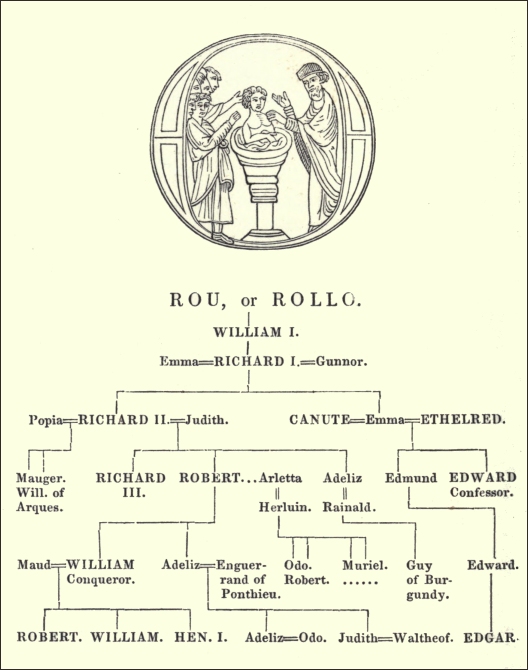
In honour of the second Henry, of the line of Roul, I have told the tale of Roul, of his noble parentage, of Normandy that he conquered, and the prowess that he showed. I have recounted the history of William Lunge-espee, till the Flemings killed him by felony and treason; of Richard his son, whom he left a child; [of the second Richard, who succeeded him; of his son the third Richard; who was soon followed by Duke Robert his brother, who went to Jerusalem, and died by poison; and now the tale will be of William his son, who was born to him of the 'meschine, Arlot of Faleise[9].']
HOW WILLIAM BECAME DUKE, AND HOW HIS BARONS REVOLTED AGAINST HIM.
The mourning for Duke Robert was great and lasted long; and William his son, who was yet very young, sorrowed much. The feuds against him were many, and his friends few; for he found that most were ill inclined towards him; those even whom his father held dear he found haughty and evil disposed. The barons warred upon each other; the strong oppressed the weak; and he could not prevent it, for he could not do justice upon them all. So they burned and pillaged the villages, and robbed and plundered the villains, injuring them in many ways.
A mighty feud broke out between Walkelin de Ferrieres[10], and Hugh Lord of Montfort[11]; I know not which was right and which wrong; but they waged fierce war with each other, and were not to be reconciled; neither by bishop nor lord could peace or love be established between them. Both were good knights, bold and brave. Once upon a time they met, and the rage of each against the other was so great that they fought to the death. I know not which carried himself most gallantly, or who fell the first, but the issue of the affray was that Hugh was slain, and Walkelin fell also; both lost their lives in the same affray, and on the same day.
William meantime grew, and strengthened himself as his years advanced; yet still he was forced to hear and see many a deed which went against his heart, though he could do nothing to prevent it. The barons' feuds continued; they had no regard for him. Every one according to his means made castles and fortresses. On account of the castles wars arose, and destruction of the lands; great affrays and jealousies; maraudings and challengings; while the duke could give no redress[12] to those who suffered such wrongs.
Still as he advanced in age and stature he waxed strong; for he was prudent, and took care to strengthen himself on many sides. He had now held the land twelve years, when the country was involved in war, and suffered greatly through Neel de Costentin[13] and Renouf de Beessin, two viscounts of great power, who had the means of working much mischief.
William had about his person Gui, a son of Regnald the Burgundian[14], who had married Aeliz, the daughter of Duke Richard, and had two sons by her. Gui was brought up with William. When he was a young varlet, and first began to ride and to know how to feed and dress himself, he was taken into Normandy and brought up with William, who was very fond of him, and when he had made him a knight, gave him Briune[15] and Vernun, and other lands round about. When Gui had got possession, and had strengthened them till they had become good and fair castles, he became very envious of William, who had seigniory over him, and began to annoy him, and to challenge Normandy itself as his own right, reproaching William for his bastardy, and feloniously stirring up war against him; but it fell out ill for him, for in trying to seize all he lost the whole. He assembled and talked with Neel and Renouf, and Hamon-as-dens[16], and Grimoult del Plesseiz[17], who served William grudgingly. "There was not," he said, "any heir who had a better right to Normandy than himself. Richard was father to his mother; he was no bastard, but born in wedlock; and if right was done, Normandy would belong to him. If they would support him in his claim, he would divide it with them." So, at length, he said so much, and promised so largely, that they swore to support him according to their power in making war on William, and to seek his disherison by force or treason. Then they stored their castles, dug fosses, and erected barricades, William knowing nothing of their preparations.
He was at that time sojourning at Valognes, for his pleasure as well as on business; and had been engaged for several days hunting and shooting in the woods. One evening late his train had left his court, and all had gone to rest at the hostels where they lodged, except those who were of his housebold; and he himself was laid down. Whether he slept or not I do not know, but in the season of the first sleep, a fool named Golet[18] came, with a staff slung at his neck, crying out at the chamber door, and beating the wall with the staff; "Ovrez!" said he, "Ovrez! ovrez! ye are dead men: levez! levez! Where art thou laid, William? Wherefore dost thou sleep? If thou art found here thou wilt die; thy enemies are arming around; if they find thee here, thou wilt never quit the Cotentin, nor live till the morning!"
Then William was greatly alarmed; he rose up and stood as a man sorely dismayed. He asked no further news, for it seemed unlikely to bring him any good. He was in his breeches and shirt, and putting a cloak around his neck, he seized his horse quickly, and was soon on the road. I know not whether he even stopped to seek for his spurs, or whether he took any companion of his flight, but he hasted on till he came to the fords nearest at hand, which were those of Vire, and crossed them by night in great fear and anger. From thence he bent his way to the church of St. Clement[19], and prayed God heartily, if it were his will, to be his safe conduct, and let him pass in safety. He dared not turn towards Bayeux, for he knew not whom to trust, so he took the way which passes between Bayeux and the sea. And as he rode through Rie before the sun rose, Hubert de Rie[20] stood at his gate, between the church and his castle[21], and saw William pass in disorder, and that his horse was all in a sweat. "How is that you travel so, fair sire?" cried he. "Hubert," said William, "dare I tell you?" Then Hubert said, "Of a truth, most surely! say on boldly!" "I will have no secrets with you; my enemies follow seeking me, and menace my life. I know that they have sworn my death." Then Hubert led him into his hostel, and gave him his good horse, and called forth his three sons. "Fair sons," said he, "muntez! muntez! Behold your lord, conduct him till ye have lodged him in Falaise. This way ye shall pass, and that; it will be ill for you to touch upon any town." So Hubert taught them well the ways and turnings; and his sons understood all rightly, and followed his instructions exactly. They crossed all the country, passed Folpendant[22] at the ford, and lodged William in Falaise[Note 1]. If he were in bad plight, what matters so that he got safe?
Hubert remained standing on his bridge; he looked out over valley, and over hill, and listened anxiously for news, when they who were pursuing William came spurring by. They called him on one side, and conjured him with fair words to tell if he had seen the bastard, and whither and by what road he was gone. And he said to them, "He passed this way, and is not far off; you will have him soon; but wait, I will lead you myself, for I should like to give him the first blow. By my faith, I pledge you my word, that if I find him, I will strike him the first if I can." But Hubert only led them out of their way till he had no fear for William, who was gone by another route. So when he had talked to them enough of this thing and that, he returned back to his hostel.
The Cotentin and the Bessin were in great dismay that day, for the alarming news soon went through the country of William's being betrayed, and how he was to have been murdered by night. Some said he was killed; others that he was taken; many said that he had fled: "May God protect him," said all. Between Bayeux and the fords[23] the roads were to be seen covered with those who came from Valognes, holding themselves as dead or disgraced men, for having lost their lord, whom they had safe overnight. They know not where to seek their lord, who had been among them but last evening: they go enquiring tidings of him around, without knowing whither to repair. And heavily do they curse Grimoult del Plesseiz, and those who trust in him; for they vehemently suspect that he has done foul treason by his lord. Thus all Normandy was frightened and troubled at what had happened.
The viscounts hated the duke; they seized his lands, and omitted to lay hold of nothing which they could reach. They plundered him so completely, that he was unable to do any thing, either for right or wrong. He could not enter the Bessin, neither demand rent or service; so he went to France, to King Henry[24], whom his father Robert served, and complained against Neel, that he had injured him, and had seized his rents. He complained also of Hamon-as-dens, and of Guion le Burgenion; of Grimoult, who would have betrayed him, and whom he might well hate more than any other; and of Renouf de Briquesart, who took and spent his rents; and of the other barons of the country who had risen up against him.


HOW THE KING OF FRANCE CAME; AND OF THE BATTLE THAT WAS FOUGHT AT VAL DES DUNES.
The King of France, upon hearing the words that William spoke, and the complaints he made, sent forth and summoned his army, and came quickly into Normandy. And William called together the Cauchois, and the men of Roem, and of Roumoiz[25], and the people of Auge, and of the Lievin[26], and those of Evreux, and of the Evrecin. In Oismeiz also they quickly assembled when the summons reached them.
Between Argences and Mezodon[27], upon the river Lison[28], the men of France pitched their tents; and those of the Normans, who held fast to William, and came in his cause, made their camp near the river Meance, which runs by Argences[29].
When the Viscount of the Costentin, and the Viscount of the Bessin knew that William was coming, and was determined to fight, and had brought with him the King of France, in order to conquer them with his aid, they gave heed to evil counsel; and in the pride of their hearts, disdained to restore to him his own, or to seek peace or accept it. They sent for their people, their friends and relations, from all quarters; the vavassors and the barons, who were bound by oath to obey their commandment, were all sent for and summoned. They passed by various rivers and fords, and assembled at Valedune.
Valedune is in Oismeiz, between Argences and Cingueleiz[30]; about three leagues from Caen, according to my reckoning. The plain is long and broad, without either hill or valley of any size. It is near the ford of Berangier, and the land is without either wood or rock, but slopes towards the rising sun. A river bounds it towards the south and west.
At Saint Brigun de Valmerei[31], mass was sung before the king on the day of that battle, and the clerks were in great alarm. The French armed and arranged their troops at Valmerei, and then entered Valedune. There the communes[32] assembled well equipped, and occupied the river's bank. William advanced from Argences, and passing at the ford of Berangier, followed the river's course till he joined the French. His men were on the right, and the French on the left hand, with their faces towards the west, for their enemies came from that quarter.
Raol Tesson de Cingueleiz[33] saw the Normans and French advancing, and beheld William's force increasing. He stood on one side afar off, having six score knights and six in his troop; all with their lances raised, and trimmed with silk tokens[34]. The king and Duke William spoke together; each armed, and with helmet laced. They divided their troops, and arranged their order of battle, each holding in his hand a baston; and when the king saw Raol Tesson with his people standing far off from the others, he was unable to discover on whose side he was, or what he intended to do. "Sire," said William, "I believe those men will aid me; for the name of their lord is Raol Tesson, and he has no cause of quarrel or anger against me." Much was thereupon said and done, the whole of which I never heard; and Raol Tesson still stood hesitating whether he should hold with William.
On the one hand the viscounts besought him, and made him great promises; and he had before pledged himself, and sworn upon the saints at Bayeux, to smite William wherever he should find him. But all his men besought and advised him for his good, not to make war upon his lawful lord, whatever he did; nor to fail of his duty to him in any manner. They said William was his natural lord; that he could not deny being his man; that he should remember having done him homage before his father and his barons; and that the man who would fight against his lord had no right to fief or barony.
"That I cannot dispute," said Raol; "you say well, and we will do even so." So he spurred his horse forth from among the people with whom he stood, crying TUR AIE[35]; and ordering his men to rest where they were, went to speak with Duke William. He came spurring over the plain, and struck his lord with his glove, and said laughingly to him, "What I have sworn to do that I perform; I had sworn to smite you as soon as I should find you; and as I would not perjure myself, I have now struck you to acquit myself of my oath, and henceforth I will do you no further wrong or felony." Then the duke said, "Thanks to thee!" and Raol thereupon went on his way back to his men.
William passed along the plain, leading a great company of Normans, seeking the two viscounts, and calling out on the perjured men to stand forth. Those who knew them pointed them out on the other side among their people.
Then the troops were to be seen moving with their captains; and there was no rich man or baron there who had not by his side his gonfanon, or other enseigne, round which his men might rally; and cognizances or tokens, and shields painted in various guises[36]. There was great stir over the field; horses were to be seen curvetting, the pikes were raised, the lances brandished, and shields and helmets glistened. As they gallop, they cry their various war cries: those of France cry, MONTJOIE! the sound whereof is pleasant to them. William cries, DEX AIE! which is the signal of Normandy; and Renouf cries loudly, SAINT SEVER, SIRE SAINT SEVOIR[37]; and Dam as-denz goes crying Out, SAINT AMANT! SIRE SAINT AMANT[38]! Great clamour arose in their onset; all the earth quaked and trembled; knights were pricking along, some retiring, others coming up; the bold spurring forward, the cowards shrinking and trembling.
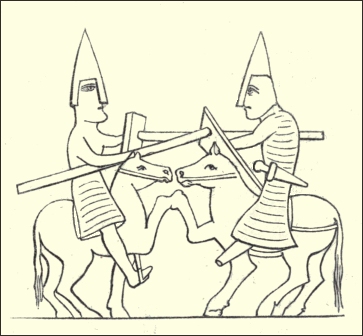
Against the King of France and the Frenchmen came up the body of the Costentinese; each party closing with the other, and clashing with levelled lances. When the lances broke and failed, then they assailed each other with swords. Hand to hand they fight, as champions in the lists, when two knights are matched; striking and beating each other down in many ways; wrestling and pushing and triumphing whenever any one yields. Each would be ashamed to flee, each tries to keep the field, each one boasts of his prowess with his fellow; Costentinese[39] and French thus contending with each other.
Great is the clamour and hard the strife; the swords are drawn, the lances clash. Many were the vassals to be seen there fighting, serjeants and knights overthrowing one another. The king himself was struck and beat down off his horse. A Norman whom no one knew had come up among them; he thought that if the king should fall, his army would soon be dispersed; so he struck at him 'de travers,' and overthrew him, and if his hauberk had not been very good, in my opinion he would have been killed. On this account the men of that country said, and yet say, jeering,
From Costentin came the lance
That struck down the King of France.[40]
and if their knight had got clear away, they might well pass with their jeer. But when he tried to go off, and his horse had begun its course, a knight came pricking, and hit him, striking him with such violence as to stretch him out at full length. And he soon fared still worse than even that; for as he recovered himself, and would have mounted his horse, and had laid his hand on the saddle bow, the throng increased around, and bore him from the saddle, throwing him down; and the horses trod him underfoot, so that they left him there for dead.
There was great press to raise the king up, and they soon remounted him. He had fallen among his men, and was no way hurt nor injured: so he arose up nimbly and boldly; never more so. As soon as he was on horseback, many were the vassals who were again to be seen striking with lance and sword; Frenchmen assaulting Normans, and Normans turning, dispersing, and moving off the field: and the king shewed himself every where in order to encourage his men, as he had been seen to fall. [Then Hamon-as-denz was beaten down, and I know not how many of his kindred with him, who never returned home thence, save as they might be borne home on their biers. Dan as-denz was a Norman, very powerful in his fief, and in his men. He was Lord of Thorigny, of Mezi[41], and of Croillie[42]. He had fought on all day, striking down the Frenchmen, and crying out SAINT AMANT! but a Frenchman marked him carrying himself thus proudly; so he stood still on one side, and watched him until he came near; and when he saw him turn and strike the king[43], the Frenchman charged forward with great force, and struck him gallantly, so that he fell upon his shield. I know not exactly how he was wounded, but only that he was carried away on his shield dead; and was borne thence to Esquai[44], and buried before the church. Many were the people who saw this feat done; how Hamon struck the king, and beat him off his horse, and how the French killed him for it, taking vengeance for their king.]
Raol Tesson stood by and looked on, till he saw the two hosts meeting, and the knights jousting; then he rode forward, and his course was easy to be marked. I know not how to recount his high deeds, nor how many he overthrew on that day.
Renouf the Viscount (I will not dwell long on the story) had with him a vassal named Harde[45], born and bred at Bayeux, who rode in the front of all, and gloried much in his prowess; William rushed against him, sword in hand, and aiming his blow aright, drove the trenchant steel into his body below the chin, between the throat and the chest, his armour not saving him. The body fell backward to the earth, and the soul passed away therefrom.
Renouf saw how the combat raged; he heard the clamour, the cry of war, and the clashing of lances; and he stood still, and was astounded, like one whose heart is faint. He feared much lest he were betrayed, and lest Neel had fled; and he was greatly afraid of William, and of the people who were with him. Evil betide him, he thought, if he were taken, and worse still would it he to be killed. He repented of having put on his armour, and was eager to get out of the battle; so he wandered in front and in rear, and at last, separating himself from his companions, determined to flee. Accordingly he threw away his lance and shield, and took to flight, running off with outstretched neck. Those about him who were cowards accompanied his flight, complaining much more than they had any occasion.
But Neel fought on gallantly; and if all had been like him, the French king would have come in an evil hour, for his men would have been discomfited and conquered. He was called on account of his valour and skill, his bravery and noble bearing, CHIEF DE FAUCON;—NOBLE CHIEF DE FAUCON was his title. He gave and received many a blow, and did all that lay in his power; but his strength began to fail; he saw that many of his men were lying dead, and that the French force increased on all sides, while the Normans fell away. Some fell wounded around him; some took fright and fled; and Neel at length quitted the field with more regret than he had ever before felt.
I will not tell, and in truth I do not know, (for I was not there to see, and I have not found it written) which of those present fought best; but this I know, that the king conquered, and that Renouf fled from the field. The crowd of fugitives was great, and the press of the pursuers was great also. Horses were to be seen running loose, and knights spurring across the plain. They sought to escape into the Bessin, but feared to cross the Osgne[46]. All fled in confusion between Alemaigne and Fontenai[47]; by fives, by sixes, and by threes, while the pursuers followed, pressing hard upon and destroying them. So many of them were driven into the Osgne, and killed or drowned there, as that the mills of Borbillon[48], they say, were stopped by the dead bodies.
And the king then gathered together his men, to return each into his own land. The sick and wounded were carried away, and the dead were buried in the cemeteries of the country.
William remained in his own land, and for a long while there was no more war. The barons came to accord with him, and paid such fines, and made him such fair promises, that he granted them peace, and acquittance of all their offences. But Neel could not come to an arrangement with him, and dare not stay in the land; so he remained long in Brittany before any accord was come to. Gui retreated from Valedune and fled to Brione; and William followed hard after him, and shut him up in a strong castle. In those days there was a fortress standing on an island of the river Risle[49], which surrounds the fortress and the mansion. And there, in Brione, Gui was shut up; but he had neither peace nor rest, and was in great bodily fear. The duke built up two castles near; so that provisions failing, and the besiegers pressing him hard, Gui surrendered up Brione and Vernun, when he could get no better terms. He might have remained with the duke, who would have provided for him; but he did not stay long; there was no friendship between them; so he went away to Burguine[50], to the country where he was born.
When the other Norman barons saw that the duke had obtained the upper hand of them all, they delivered hostages to keep the peace, and did fealty and homage to him. They obeyed him as their lord, and pulled down the new castles, and willingly or unwillingly rendered their service. He seized Grimoult del Plesseiz, and put him in prison at Rouen; and he had very good cause for so doing; for Grimoult would have murdered him traitorously, as we have said, at Valognes, had not Golet the fool given him warning. Grimoult confessed the felony, and accused of fellowship in it a knight called Salle[51], who had Huon for his father. Salle offered to defend himself from the charge, and a single combat was thereupon arranged between them; but when the appointed day came, Grimoult was found dead in the prison. It occasioned great talk; and he was buried, chained as he was, with the irons on his legs. At Bayeux, when the church was dedicated, part of Grimoult's lands was granted to Our Lady the Blessed Mary; and part divided in the abbey, to each his share.[52]

HOW CANUTE DIED, AND ALFRED FELL BY TREASON; AND HOW EDWARD AFTERWARDS BECAME KING.
He who made the history of the Normans, tells us that in those days[53] Kenut, who was father of Hardekenut, and had married Emma, the wife of Alred[54], the mother of Edward and of Alfred, died at Winchester. Hardekenut, during the lifetime of his father, by the advice of his mother Emma, had gone to Denmark, and became king there, and was much honoured. On account of Hardekenut's absence, and by an understanding with her, England fell to Herout[55], a bastard son of Kenut.
Edward and Alfred heard of Kenut's death, and were much rejoiced; for they expected to have the kingdom, seeing that they were the nearest heirs. So they provided knights and ships, and equipped their fleet; and Edward, having sailed from Barbeflo[56], with forty ships, soon arrived at the port of Hantone, hoping to win the land. But the Englishmen, who were aware that the brothers were coming, would not receive them, nor suffer them to abide in the country. Whether it was that they feared Herout the son of Kenut, or that they liked him best; at any rate they defended the country against Edward; and the Normans on the other hand fought them, taking and killing many, and seizing several of their ships. But the English force increased; men hastened up from all sides, and Edward saw that he could not win his inheritance without a great loss.He beheld the enemy's force fast growing in numbers, and that he should only sacrifice his own men; so fearing that, if taken, he himself might be killed without ransom, he ordered all his people to return to the ships, and took on board the harness. He could do no more this time, so he made his retreat to Barbeflo.
Alfred meantime sailed with a great navy from Wincant[57]; and arriving safely at Dovre, proceeded thence into Kent. Against him came the earl Godwin[58], who was a man of a very low origin. His wife was born in Denmark, and well related among the Danes, and he had Heraut, Guert, and Tosti for his sons. On account of these children, who thus came by a Dane, and were beloved by their countrymen, Godwin loved the Danes, much better in fact than he did the English.
Hearken to the devilry that was now played; to the great treason and felony that were committed! Godwin was a traitor, and he did foul treason; a Judas did he show himself, deceiving and betraying the son of his natural lord,—the heir to the honor (lordship),—even as Judas sold our Lord. He had saluted and kissed him; he had eaten too out of his dish, and had pledged himself to bear faith and loyalty. But at midnight, when Alfred had laid down to rest and slept, Godwin surprised and bound him; and sent him to London to king Herout, who expected him, knowing of the treason.From thence he sent him to Eli, and there put out his eyes and murdered him dishonourably, and by treachery which he dared not to avow. Those too who came with Alfred (hearken to the foul cruelty!) were bound fast and guarded; and taken to Gedefort[59], where all, except every tenth man, lost their heads and died miserably. When the English had numbered them, setting them in rows, they then decimated them, making every tenth man stand on one side, and striking off the heads of the other nine; and when the tithe so set apart amounted to a considerable number, it was again decimated, and all that was at last saved was this second tithe.

Herout soon after died, and went the way he deserved; whereupon the men of England assembled to consider about making a king in his place. They feared Edward who was the right heir, on account of the decimation of the Normans, and the murder of his brother Alvred; and at last they agreed to make Hardekenut king of England. So they sent for Hardekenut, the son of Emma and Kenut, and he repaired thither from Denmark, and the clergy crowned him: but he sent for Edward his brother, the son of Emma his mother, and kept him in great honour at his court, and was king over him only in name. Hardekenut was king twelve years, and then fell ill. He did not languish long, but soon died. His mother lamented over him exceedingly; but it was a great comfort to her that her son Edward was come; and he obtained the kingdom[60], the English finding no other heir who was entitled to the crown.
Edward was gentle and courteous, and established peace and good laws. He took to wife Godwin's daughter, Edif[61] by name. She was a fair lady, but they had no children between them, and people said that he never consorted with her; but no man saw that there was ever any disagreement between them[62]. He loved the Normans very much, and held them dear, keeping them on familiar terms about him; and loved duke William as a brother or child. Thus peace lasted, and long will last, never I hope to have an end.[63]
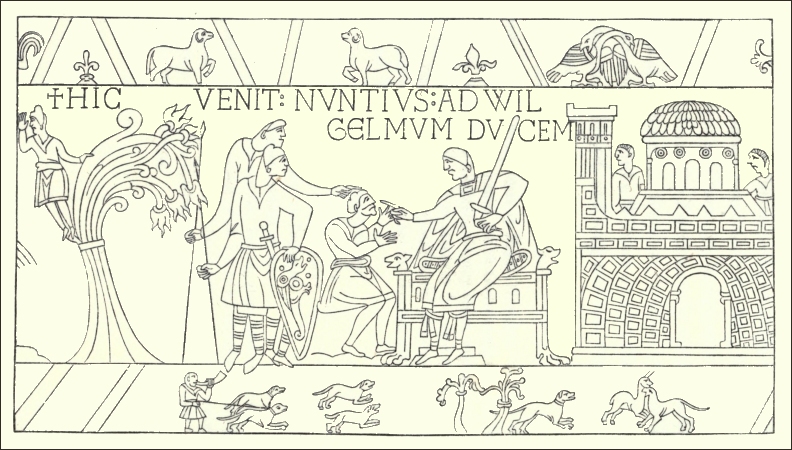
THE REVOLT OF WILLIAM OF ARQUES; AND HOW HE AND THE KING OF FRANCE WERE FOILED BY DUKE WILLIAM.
William of Arches was a brave and gallant knight[64], brother to the archbishop Maugier, who loved him well. He was also brother on one side to duke Robert, being the son of Richard and Papie, and uncle of William the bastard. He was versed in many a trick and subtlety, and plotted mischief against the duke, claiming a right of inheritance, inasmuch as he was born in wedlock. On account of his relationship, and to secure his fealty, the duke had given him, as a fief, Arches and Taillou[65]; and he received them and became the duke's man; promising fealty, though he observed it but for a very brief space of time. To enable him the better to work mischief to his lord, he built a tower above Arches, setting it on the top of the hill[66], with a deep trench around on every side. Then confiding in the strength of his castle, and in his birth in wedlock, and knowing that the king of France had promised to succour him in case of need, he told William he should hold his castle free from all service to him; that he was in wrongful possession of Normandy, being a bastard and without any title of right.
But the duke had now great power; for he was very prudent, and no man is weak who possesses wisdom. He sent for William of Arches, and summoned him to attend, and do his service: but he altogether refused, and defied the bastard, relying on aid from the king of France. He plundered the country round of provisions and stores of every sort, heeding little whence it came, and thus supplied his castle and tower.
The duke bore with this behaviour but a very little while, and without further 'parlement' sent for his people from all sides. Then with ditches and stakes and palisades he quickly formed a fort[67], at the foot of the hill in the valley, so as to command all the country round, and prevent those in the castle from obtaining either ox, or cow, or calf: and the fort was so strong, and was garrisoned by so many knights, the best of the chivalry of all Normandy, that no effort of either king or earl to take it, was likely to be of any avail. So the duke, having thus completed his work, went his way to attend to his affairs elsewhere.
The king of France soon knew that the duke had fortified his post, and blockaded the tower, so that no provisions could enter therein. Then he assembled a great chivalry, and got together much store of provisions and arms, intending to relieve the tower of Arches, where the supply of corn began to fail. Having reached Saint-Albin[68], with an ample store both of corn and wine, the king made a halt, ordering sumpter horses to be made ready to carry the stores onward, and providing a troop of knights to form the convoy.
Those in the besiegers' fort soon heard of the great preparations waiting at Saint-Albin to provision and relieve Arches. Then they selected their strongest and best fighting men, and privily formed an ambuscade in the direction of Saint-Albin. Having done this, they sent out another party with orders to charge the king's force, and then to turn back, making as if they would flee. But when they had passed the spot where the ambuscade lay, they turned quickly round on those who were pursuing, and fiercely attacked the French; those also who were lying in ambuscade riding forth, and joining in the assault.
The Frenchmen were thus grievously taken in; and being separated from the rest of their army, the Normans charged them boldly, and took and killed many. Hue Bardous[69] was taken early in the affray; Engerrens count of Abevile[70], was killed, and all suffered greatly. The king of France was in great grief; he mourned heavily, and was sorely vexed for the knights that had been thus surprised, and for his brave barons who had fallen. He made ready the baggage horses, and carried the stores to the town of Arches[Note 2]; and when he had so done, he returned back to Saint-Denis with no small shame and disgrace, as it seems to me.
The duke was sojourning at Valognes, for the sake of the woods and rivers which abound there, and on other affairs and business of his own, when a messenger came spurring on with pressing speed, and hastening unto him, cried out and said, "Better would it be for thee to be elsewhere! they who guard the frontiers have need of thy aid; for thy uncle William of Arches hath linked himself by oath and affiance to king Henry of France. The king hasteth to relieve and store Arches, and William will do him service for it in return."
Then the duke tarried not till the varlet should speak further, nor indeed till he had well said his say; but called for his good horse. "Now I shall see," said he, "who of you is ready, now I shall see who will follow me." And he made no other preparation, but forthwith crossed the fords[71], passed Baieues and then Caen, and feigned as though he would go to Rouen. But when he came to Punt-Audumer, he crossed over to Chaudebec, and from Chaudebec rode on to Bans-le-Cunte. What need of many words? He halted and galloped on till he joined his people before Arches; but none of those who took horse at the same time at Valognes kept up with him; and all wondered how he had come so soon from such a distance, when no one else had been able to do as much[72].
Then he rejoiced greatly to learn what had happened; how the French had been discomfited, and their people routed and taken prisoners. William of Arches however kept close, defending his castle bravely and long; and he would have held it longer still, had not provisions failed him. So at length he abandoned land, and castle, and tower; and surrendering all up to duke William, fled to the king of France.

HOW THE KING OF FRANCE INVADED NORMANDY, AND WAS BEATEN AT MORTEMER.
The French had often insulted the Normans by injurious deeds and words, on account of the great dislike and jealousy which they bore to Normandy. They continually spoke scornfully, and called the Normans BIGOZ and DRASCHIERS[73]; and often remonstrated with their king, and said, "Sire, why do you not chase the Bigoz out of the country? Their ancestors were robbers, who came by sea, and stole the land from our forefathers and us." By the persuasion of these felons, who talked thus because they hated the duke, the king undertook the enterprise[74]; though it was disliked by many of his men. He said he would go into Normandy, and would conquer it; he would divide his army into two parts, and invade in two directions. And what he said, he endeavoured to execute; summoning his people from all sides.
He collected them in two positions, according as the river Seine divided them; those of Reins and those of Seissons, of Leun[75], and of Noions; those of Melant[76], and of Vermandeiz; of Pontif[77] and of Amineiz; those of Flanders and of Belmont[78]; of Brie and of Provens. All these, who are beyond Seine he assembled by twenties, by hundreds, and by thousands, in Belveisin, meaning to enter the pays de Caux from that side. To the Conestable and Guion[79], he sent his brother Odo[80], and directed them to enter by Caux, and ravage all the land around.
And he summoned all the rest of his people, according as the river Seine divides them from the others, to meet him at Meante[81]; those of Toroigne and of Bleis; of Orlianz and of Vastineis; of the Perche and of the Chartrain; of the bocage and of the plain; those of Boorges[82], of Berri; of Estampes and of Montlheri; of Grez and of Chasteillun; of Senz and of Chastel-Landun, the king ordered to come to Meante. And he menaced the Normans, and boasted much that he would destroy Evrecin, Rosmeis, and Lievin[83], and would ride even as far as the sea, returning by Auge.
William was in great alarm, for he was much afraid of the king's power; and he also formed his men into two companies. About Caux, he placed Galtier Gifart[84], and the men of that country; Robert, count d'Ou, and old Huon de Gornai; and with these he ranged William Crespin[85], who had much land in Velquessin[86]. These had under them the people of the country around them, their relations and friends. The duke retained the other company under his own command, to oppose the king. He assembled the men of the Beessin, and the barons of the Costentin, and those of the valley of Moretoing[87]; and of Avranehes, which is beyond it; Raol Tesson of Cingueleis, and the knights of Auge and of Wismeis[88]; all these the duke summoned to meet him. He would, he said, be close upon the king, and encamp hard by him, looking keenly after the foragers, that they should not stray far without having some damage, if he could help it; and he caused all provisions to be removed from the way by which the king must pass; and drove the beasts into the woods, and made the villains keep watch over them there.
The barons who were stationed in Caux, to defend that part of the country, kept themselves to the woods and forests till the people of the country could be got together; and passed from wood to wood, concealing themselves in the thickets. But the men of France marched on, and encamped at Mortemer. They remained there one night for the convenience of the hostels; expecting that they could roam as they pleased over the whole country, without meeting any knights who would dare to encounter, or bear arms against them; for they believed that all the Norman knights were gone towards Evreues with their lord, and that he had retreated thither from fear of the king.
The Frenchmen demeaned themselves insolently, and with great cruelty. Wherever they had passed, they destroyed all they found, ravaging the villages and manors, burning houses, and plundering them of the furniture; seizing the villains, violating the women, and keeping whatever they pleased; till they had come to Mortemer, where they found fair quarters in the hostels. By day they delivered the country up to pillage, and devoted the night to revelry, searching out the wine and killing the cattle, eating and drinking their fill.
The Normans knew well from their spies where the French lay, and what their plans were; so they assembled their men together during the night, summoning their friends and companions; and in the morning before day-break, while the French were yet sleeping, behold! they surrounded Mortemer, and set fire to the town. The flames spread from one hostel to another, till the fire raged through all the streets. Then the Frenchmen were to be seen in consternation: the whole town was in confusion, and the melee became fierce; they rushed from the hostels, seizing such arms as they could find, and were grievously discomfited, for the Normans stopt them at the barriers. One man endeavours to mount his horse, but cannot find the bridle; and another would quit his hostel, but is unable to reach the door. The Normans guard all the issues, and the heads of the streets; and there the encounters are rudest, and the feats of arms the fairest.

From the rising of the morning's sun, till three in the afternoon, the assault lasted in its full force, and the battle continued to be hot and fierce. The French could not escape, for the Normans would let no one pass. The first who quitted the field and fled was Odes; and the Normans took Guion, the count of Pontif, alive and in arms; but they killed Valeran his brother, a very brave and valiant knight. There was no varlet, let him be ever so mean, or of ever so low degree, but took some Frenchman prisoner, and seized two or three horses with all their harness; nor was there a prison in all Normandy, which was not full of Frenchmen. They were to be seen fleeing around, skulking in the woods and bushes; and the dead and wounded lay amidst the burning ruins, and upon the dung-hills, about the fields, and in the by-paths.
That same night, the news passed quickly to where the duke lay with his army; how that the French were discomfited, and the invasion stayed. News travels fast, and is swift; and whoso bears good tidings may safely knock at the gate[89]. The duke rejoiced greatly at the discomfiture of his enemies; and he sent a man, whether varlet or esquire I know not, to the place where the king was encamped, and had retired to his bed. He ordered the man to climb up into a tree, and all night to cry aloud, "Frenchmen, Frenchmen, arise! arise! make ready for your flight, ye sleep too long! Go forth at once to bury your friends, who lie dead at Mortemer[90]."
As the king heard the cry, he marvelled much, and was sorely dismayed. So he sent out for his friends, and besought and conjured them to tell him if they had heard any such tidings as the man proclaimed from the tree. And whilst they yet talked and conversed with the king, concerning what had happened, behold the news came and spread all around, how that the best of their friends lay dead at Mortemer, and how they who had escaped alive were made captive, and were in chains and in prison in Normandy.
The French were greatly moved and troubled at the news, and went crying out that they tarried too long. They seized the palfreys and war-horses, harnessed and loaded the baggage horses, set fire to the tents and huts, emptied them of every thing, and sent all on forward; and the king went off on his way homeward, looking cautiously around him. Had the duke wished to pursue, he might have injured him much, but he did not desire to annoy him more. "He has had quite enough," said he, "to trouble and cross him;" and he would not add more to his annoyance.
The king returned to Paris, the barons to their homes, and the great people whom he had led forth returned to their own countries. But his wrath against the Normans was very great, on account of those whom they had taken prisoners, and still more for those who were killed. The dead he could not recover, but he wished to redeem those who were prisoners; so he sent word to the duke, that if he would release his prisoners, he would make truce and peace with him till other cause of difference should arise; and that whatever the duke had taken or might take from Giffrei Martel, should never be a cause of war between them, or be alleged as a grievance against him.
And thereupon accordingly was done as I tell you; the duke restored the Frenchmen who were prisoners, but the harness was left to those who had won it; and the prisoners repaid to their captors the charges they had occasioned to them.

HOW THE KING OF FRANCE CAME AGAIN AGAINST DUKE WILLIAM, AND WAS DEFEATED AT VARAVILLE.
Duke William carried himself gallantly, and triumphed over all his enemies; he was loved for his liberality, and feared for his bravery. He conquered many and won over many, lavishing his gifts around, and spending much; till the French became very jealous of his chivalry; of the troops that he had, and of the lands he conquered. Their king could never be reconciled to the Normans; but said that he would sooner perjure himself, than not have his revenge for the battle of Mortemer.
Then under the advice of Giffrei Martel[91], before August, when the corn was on the ground, he summoned together all his barons, and the knights who held fiefs of him, and owed him service, and entered Normandy, passing by Oismes[92], which they assaulted without tarrying before it long. From thence they traversed all Oismes, and through the Beessin as far as the sea coast; burning the villages and bourgs; and ruining and plundering both men and women, till at length they came to St. Pierre-sor-Dive. The town was completely garrisoned by them, and the king lay at the abbey[93].
The duke was with his people at Faleise, when the news came, concerning the wrong the king was doing him; and it grieved him sorely. So he sent out and assembled his knights, and strengthened his castles, cleansing the fosses, and repairing the walls; being determined to let the open country be laid waste, if he could maintain his strong places. He could easily, he said, recover the open lands, and repair the injury done to them. So he did not shew himself at all to the French, but let them wander over the country, intending to give them scurvy usage on their return back from their expedition.
The king meantime went on with his project. He would go, he said, towards Bayeux, and ravage the whole of the Beessin, and on his return thence would pass by Varavile[94], and lay waste Auge and Lievin. Accordingly the French overran the Beessin, as far as the river Seule[95]; and returned from thence to Caen, where they passed the Ogne[96]. Caen was then without a castle, and had neither wall nor fence to protect it[97]. When the king left Caen, he proceeded homeward by Varavile, as he had proposed.
His train was great and long, so that it could not all be kept together; and the press was great to pass the bridge, every one wanting to be the foremost.
The duke, knowing some how or another all that was going on, and by what route the king would pass, hastened upon his track with the great body of troops that he led, and conducted his people in close order along the valley below Bavent[98]. All over the country he sent out word, and summoned the villains to come to his aid as quickly as they could, with whatever arms they could get. Then from all round the villains were to be seen flocking in, with pikes and clubs in their hands.
The king had passed the river Dive, which runs through that country, together with all those of his host who had taken care to move quickly forward. But the baggage train was altogether, and far behind, extending over a great length. The duke, seeing that all who were thus in the rear were certain to fall into his hands, pressed on his men from village to village; and when he reached Varavile, he found those of the French there who remained to form the rear guard. Then began a fierce melee, and many a stroke of lance and sword. The knights struck with their lances, the archers shot from their bows, and the villains attacked with their pikes; charging and driving them along the chaussee, overwhelming and bearing down numbers. The Normans kept continually increasing in numbers, till they became a great force, and the French pressed forwards, one pushing the other on. The chaussee incommoded them very much, being long and in bad repair, and they were encumbered by their plunder. Many were to be seen breaking the line, and getting out of the track, who could not retrace their steps, nor reach the main road again.
The great press was at the bridge, every one being eager to reach it. But the bridge was old, the boards bent under the throng, the water rose[Note 3], and the stream was strong; the weight was heavy, the bridge shook and at length fell, and all who were upon it perished. Many fell in close by the bridge foot where the water was deep; all about harness was to be seen floating, and men plunging and sinking; and none had any chance of life save skilful swimmers.
The cry arose that the bridge was broken. Grievous and fearful was that cry, and no one was so brave or bold as not to tremble for his life when he heard what had happened, and to see that his hour of exultation was gone by. They see the Normans meanwhile pressing on from behind, but there was no escape; they go along the banks of the river, seeking for fords and crossings, throwing away their arms and plunder, and cursing their having brought so much. They go straggling and stumbling over the ditches, helping each other forward, the Normans pursuing and sparing no one, till all those who had not crossed the bridge were either taken prisoners, killed, or drowned. Never, they say, were so many prisoners taken, or such great slaughter made in all Normandy. And William glorified God for his success.
The river and the sea also swept away numbers, the king looking on in sorrow and dismay. From the height of Basteborc, he looked down and saw Varavile and Caborc; he beheld the marshes and the valleys, which lay long and broad before him, the wide stream, and the broken bridge; he gazed upon his numerous troops thus fallen into trouble; some he saw seized and bound, others struggling in the deep waters; and to those who were drowning he could bring no succour, neither could he rescue the prisoners. In sorrow and indignation he groaned and sighed, and could say nothing; all his limbs trembled, and his face burned with rage. Willingly, he cried, would he turn back, and endeavour to find a passage, if his barons would so counsel, but no one would give such advice. "Sire," said they, "you shall not go; you shall return another time and destroy all the land, taking captive all their richest men."
Then the king went back into France, full of rage and heaviness of heart, and never after bore shield or lance; whether as a penance or not I know not. He never again entered Normandy: nor did he live long, but did as all men must do; from dust became, to dust he returned. At his death he was greatly lamented, and his eldest son Philip[99] was crowned king in his stead.

HOW WILLIAM PROSPERED, AND HOW HE WENT TO ENGLAND TO VISIT KING EDWARD; AND WHO GODWIN WAS.
THE story will be long ere it close, how William became a king, what honour he reached, and who held his lands after him. His acts, his sayings and adventures that we find written, are all worthy to be recounted; but we cannot tell the whole. In his land he set good laws; he maintained justice and peace firmly, wherever he could, for the poor people's sake, and he never loved the knave nor the company of the felon.
By advice of his baronage he took a wife[100] of high lineage in Flanders, the daughter of count Baldwin, and the granddaughter of Robert king of France, being the daughter of his daughter Constance. Her name was Mahelt[101], related to many a noble man, and very fair and graceful. The count gave her joyfully, with very rich appareillement, and brought her to the castle of Ou[102], where the duke espoused her. From thence he took her to Roem, where she was greatly served and honoured.
At Caem the duke built two abbeys, endowing them richly. In the one, which was called Saint Stephen, he placed monks; Mahelt his wife took charge of the other, which is that of The Holy Trinity; she placed nuns there, and was buried in it as she had directed in her life, from the love which she had always used to bear towards it[103].
And the duke did what, I believe, no one before or after did. He sent[104] for all his bishops to assemble, with his earls, abbots, and priors, barons and rich vavassors, at Caem, there to hear his commandment; and caused the holy bodies, wherever he could find them, to be brought thither, whether from bishopric or abbey, over which he had seigniory. He had the body of St. Oain[105] taken from Roem to Caem in a chest; and when the clergy, and the holy relics, and the barons, of whom there were many, were assembled on the appointed day, he made all swear on the relics to hold peace and maintain it from sunset on Wednesday to sunrise on Monday. This was called 'The Truce', and the like of it I believe is not in any country. If any man should beat another meantime, or do him any mischief, or take any of his goods, he was to be excommunicated, and amerced nine livres to the bishop. This the duke established, and swore aloud to observe, and all the barons did the same; they swore to keep the peace and maintain the truce faithfully.
To commemorate this peace through all time, that it might endure for ever, they forthwith built a minater of hewed stone[106] and mortar, on the spot where they swore upon the relics which had been brought to the council. Many who had assisted at founding the minster called it Toz-sainz[107], on account of so many holy relics having been there; but it pleased many men to call it Sainte-paiz, on account of the peace sworn to when it was built: at least I have heard it called both Sainte-paiz and Toz-sainz. Close by they built a chapel called Saint-Oain's, on the spot where his bones had rested while the council sat.
William was generous, and the strangers who knew him, cherished him much. He was very gentle and courteous, therefore king Edward loved him well; great indeed was their love, each holding the other his lord. The duke went to see Edward and know his mind; and having crossed over into England[108], Edward received him with great honour, and gave him many dogs and birds, and whatever other good and fair gifts he could find, that became a man of high degree. He did not tarry, but returned into Normandy; for he was engaged with the Bretons, who were at that time disturbing him.
Godwin had great wealth in England; he was rich in lands, and carried himself proudly. Edward had his daughter to wife; but Godwin was fell and false, and brought many evils on the land; and Edward feared and hated him on account of his brother whom he had betrayed, and of the Normans whom he had decimated, and many other mischiefs plotted by him. And thus, both in words and deeds, great discord arose between them, which was never thoroughly healed. Edward feared Godwin much, and banished him from the land; swearing that he should never come back, or abide in his kingdom, unless he swore fealty to him, and delivered him hostages, and pledges for keeping the peace during his life. Godwin dared not refuse, and as well to satisfy the king, as for the sake of his relations, and the protection of his men, he delivered one of his nephews and one of his sons[109] as hostages to the king. Edward sent them to Duke William in Normandy, as to one in whom he placed great trust, and desired him to keep them safe till he should himself demand them. This looked, people said, as if he wished William always to keep them, for the purpose of securing the kingdom to himself in case of Edward's death. On these terms the king suffered Godwin to remain at home in peace. I do not know how long this lasted, but I know that Godwin in the end choked himself, while eating at the king's table during a feast.
King Edward was debonaire; he neither wished nor did ill to any man; he was without pride or avarice, and desired strict justice to be done to all[110]. He endowed abbeys with fiefs, and divers goodly gifts, and Westminster in particular. Ye shall hear the reason why. On some occasion, whether of sickness or on the recovery of his kingdom, or on some escape from peril at sea, he had vowed a pilgrimage to Rome, there to say his prayers, and crave pardon for his sins; to speak with the apostle, and receive penance from him. So at the time he had appointed, he prepared for his journey; but the barons met together, and the bishops and the abbots conferred with each other, and they counselled him by no means to go. They said they feared he could not bear so great a labour; that the pilgrimage was too long, seeing his great age; that if he should go to Rome, and death or any other mischance should prevent his return, the loss of their king would be a great misfortune to them; and that they would send to the apostle, and get him to grant absolution from the vow, so that he might be quit of it, even if some other penance should be imposed instead. Accordingly they sent to the apostle[111], and he absolved the king of his vow, but enjoined him by way of acquittance of it, to select some poor abbey dedicated to St. Peter, honoring and endowing it with so many goods and rents, that it might for all time to come be resorted to, and the name of St. Peter thereby exalted.

Edward received the injunction of the apostle in good part. On the western side of London, as still may be seen, there was an abbey of St. Peter, which had for a long time been greatly impoverished; it is situate on an island of the Thames called Zonee (Thorn-ee)[112], so named because there were plenty of thorns upon it, and water around it; for the English call an island 'ee,' and what the French call 'espine' they call 'zon' (thorn); so that 'Zon-ee' (Thorn-ee) in English means 'isle d'espine' in French. The name of Westminster[Note 4] was given to it afterwards, when the minster was built. King Edward perceived that there was much to improve at Westminster; he saw that the brotherhood were poor; and the minster decayed; and by counsel of clerks and laymen, while the country was in prosperity, he with great labour and attention, restored and amply endowed it with lands and other wealth. He gave indeed so much of his own, of fair villages, rich manors and lands, crosses and other goodly gifts, that the place will never know want, if things are managed honestly. But when each monk wants much service, is greedy of money, and makes a purse; the common stock soon wastes accordingly. Thus, however, the king restored Westminster, and held the spot dear, and loved it well. He also afterwards gave so much to St. Edmund (Bury), that the monks who dwell there are very rich.
King Edward was now of a good age; his reign had been long, and to his sorrow he had no child, and no near relation to take his kingdom after him, and maintain it. He considered with himself who should inherit it when he died; and often bethought him, and said he would give his inheritance to duke William his relation, as the best of his lineage. Robert his father had brought him up, and William himself had been of much service to him; and, in fact, all the good he had received had come from that line, and he had loved none so well, however kindly he might behave to any one else. For the honor thereof of his good kinsman, with whom he had been brought up, and on account of the great worth of William himself, he determined to make him heir to the realm.

OF HAROLD'S JOURNEY TO NORMANDY, AND WHAT HE DID THERE.
Now in that country of England there was a seneschal[113], Heraut[114] by name, a noble vassal, who on account of his worth and merits, had great influence, and was in truth the most powerful man in all the land. He was strong in his own men, and strong in his friends, and managed all England as a man does land of which he has the seneschalsy. On his father's side he was English, and on his mother's Danish; Gite[115] his mother being a Danish woman, born and brought up in great wealth, a very gentle lady, the sister of King Kenut. She was wife to Godwin, mother to Harold, and her daughter Edif[[116]] was queen. Harold himself was the favourite of his lord, who had his sister to wife. When his father had died (being choked at the feast), Harold, pitying the hostages, was desirous to cross over into Normandy, to bring them home. So he went to take leave[117] of the king. But Edward strictly forbade him, and charged and conjured him not to go to Normandy, nor to speak with duke William; for he might soon be drawn into some snare, as the duke was very shrewd; and he told him, that if he wished to have the hostages home, he would choose some messenger for the purpose. So at least I have found the story written[118]. But another book tells me that the king ordered him to go, for the purpose of assuring duke William, his cousin, that he should have the realm after his death. How the matter really was I never knew, and I find it written both the one way and the other.
Whatever was the business he went upon, or whatever it was that he meant to do, Harold set out on his way, taking the risk of what might fall out. What is fated to happen no man can prevent, let him be who he will. What must be will come to pass, and no one can make it nought.

He made ready two ships, and took the sea at Bodeham[119]. I know not how the mischief was occasioned; whether the steersman erred, or whether it was that a storm arose; but this I know, that he missed the right course, and touched the coast of Pontif[120], where he could neither get away, nor conceal himself. A fisherman of that country, who had been in England and had often seen Harold, watched him; and knew him, both by his face; and his speech; and went privily to Guy, the count of Pontif, and would speak to no other; and he told the count how he could put a great prize in his way, if he would go with him; and that if he would give him only twenty livres[Note 5], he should gain a hundred by it, for he would deliver him such a prisoner, as would pay a hundred livres or more for ranson. The count agreed to his terms, and then the fisherman showed him Harold. They seized and took him to Abbeville; but Harold contrived to send off a message privily to duke William in Normandy, and told him of his journey; how he had set out from England to visit him, but had missed the right port; and how the count of Pontif had seized him, and without any cause of offence had put him in prison: and he promised that if the duke would deliver him from his captivity, he would do whatever he wished in return.

Guy guarded Harold mean time with great care; fearing some mischance, he sent him to Belrem[121], that he might be further from the duke. But William thought that if he could get Harold into his keeping, he might turn it to good account; so he made so many fair promises and offers to the earl, and so coaxed and flattered him, that he at last gave up his prisoner[122]; and the duke thus got possession of him, and gave in return to the count Guy a fair manor lying along the river Alne.[123]

William entertained Harold many days in great honour, as was his due. He took him to many rich tournaments, arrayed him nobly, gave him horses and arms, and led him with him into Britanny—I am not certain whether three or four times—when he had to fight with the Bretons[124]. And in the meantime he bespoke Harold so fairly, that he agreed to deliver up England to him, as soon as king Edward should die; and he was to have Ele[125], one of William's daughters, for his wife if he would; and to swear to all this if required, William also binding himself to those terms.

To receive the oath[Note 6], he caused a parliament to be called. It is commonly said that it was at Bayeux[126] that he had his great council assembled. He sent for all the holy bodies thither, and put so many of them together as to fill a whole chest, and then covered them with a pall; but Harold neither saw them, nor knew of their being there; for nought was shewn or told to him about it; and over all was a philactery, the best that he could select; OIL DE BOEF[127], I have heard it called. When Harold placed his hand upon it, the hand trembled, and the flesh quivered; but he swore, and promised upon his oath, to take Ele to wife, and to deliver up England to the duke: and thereunto to do all in his power, according to his might and wit, after the death of Edward, if he should live, so help him God and the holy relics there! Many cried "God grant it[128]!" and when Harold had kissed the saints, and had risen upon his feet, the duke led him up to the chest, and made him stand near it; and took off the chest the pall that had covered it, and shewed Harold upon what holy relics he had sworn; and he was sorely alarmed at the sight.

Then when all was ready for his journey homeward; he took his leave; and William exhorted him to be true to his word, and kissed him in the name of good faith and friendship. And Harold passed freely homeward, and arrived safely in England.


HOW KING EDWARD DIED, AND HAROLD WAS CROWNED IN HIS STEAD; AND HOW DUKE WILLIAM TOOK COUNSEL AGAINST HIM.
The day came that no man can escape, and king Edward drew near to die. He had it much at heart, that William should have his kingdom, if possible; but he was too far off, and it was too long to tarry for him, and Edward could not defer his hour. He lay in heavy sickness, in the illness whereof he was to die; and he was very weak, for death pressed hard upon him.[129]
Then Harold assembled his kindred, and sent for his friends and other people, and entered into the king's chamber, taking with him whomsoever he pleased. An Englishman began to speak first, as Harold had directed him, and said; "Sire, we sorrow greatly that we are about to lose thee; and we are much alarmed, and fear that great trouble may come upon us: yet we cannot lengthen thy life, nor alter thy fate. Each one must die for himself, and none for another; neither can we cure thee; so that thou canst not escape death; but dust must return to dust. No heir of thine remains who may comfort us after thy death. Thou hast lived long, and art now old, but thou hast had no child, son or daughter; nor hast thou other heir, who may remain instead of thee to protect and guard us, and to become king by lineage. On this account the people weep and cry aloud, and say they are ruined, and that they shall never have peace again if thou failest them. And in this, I trow, they say truly; for without a king they will have no peace, and a king they cannot have, save through thee. Give then thy kingdom in thy lifetime to some one who is strong enough to maintain us in peace. God grant that none other than such may be our king! Wretched is a realm, and little worth, when justice and peace fail; and he who doth not or cannot maintain them, has little right to the kingdom he hath. Well hast thou lived, well hast thou done, and well wilt thou do; thou hast ever served God, and wilt be rewarded of him. Behold the best of thy people, the noblest of thy friends; all are come to beseech thee, and thou must grant their prayer before thou goest hence, or thou wilt not see God. All come to implore thee that Harold may be king of this land. We can give thee no better advice, and no better canst thou do."
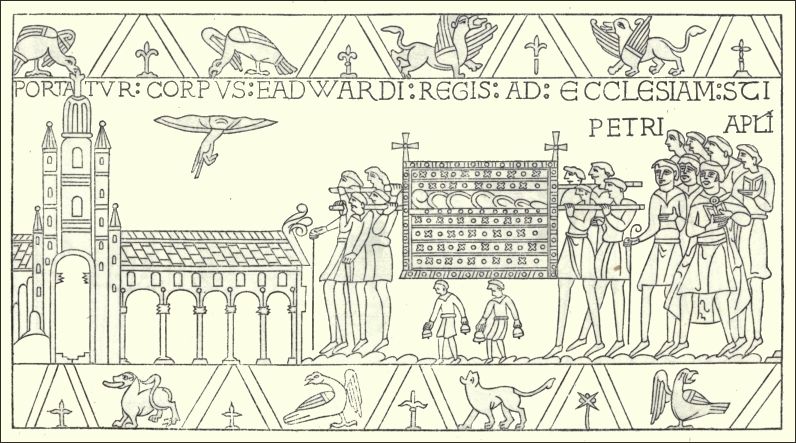
As soon as he had named Harold, all the English in the chamber cried out that he said well, and that the king ought to give heed to him. "Sire," they said, "if thou dost it not, we shall never in our lives have peace."

Then the king sat up in his bed, and turned his face to the English there, and said, "Seignors, you well know, and have ofttimes heard, that I have given my realm at my death to the duke of Normandy; and as I have given it, so have some among you sworn that it shall go."
But Harold, who stood by, said, "Whatever thou hast heretofore done, sire, consent now that I shall be king, and that your land be mine; I wish for no other title, and want no one to do any thing more for me." "Harold," said the king, "thou shalt have it, but I know full well that it will cost thee thy life. If I know any thing of the duke, and the barons that are with him, and the multitude of people that he can command, none but God can avail to save thee."
Then Harold said that he would stand the hazard, and that if the king would do what he asked, he feared no one, be he Norman or other. So the king turned round and said,—whether of his ownfree will I know not,—"Let the English make either the duke or Harold king as they please, I consent." Thus he made Harold heir to his kingdom, as William could not have it. A kingdom must have a king; without one, in fact, it would be no kingdom; so he let his barons have their own will.
And now he could abide no longer. He died, and the English lamented much over him. His body was greatly honoured, and was buried at Westminster; and the tomb which was made for him was rich, and endureth still. As soon as king Edward was dead, Harold, who was rich and powerful, had himself anointed and crowned, and said nought of it to the duke, but took the homage and fealty of the richest, and best born of the land.[130]
The duke was in his park at Rouen[131]. He held in his hand a bow, which he had strung and bent, making it ready for the arrow; and he had given it into the hands of a page, for he was going forth, I believe, to the chace, and had with him many knights and pages and esquires[132], when behold! at the gate appeared a serjeant, who came journeying from England, and went straight to the duke and saluted him, and drew him on one side, and told him privily that king Edward was dead, and that Harold was raised to be king.
When the duke had listened to him, and learnt all the truth, how that Edward was dead, and Harold was made king, he became as a man enraged, and left the craft of the woods. Oft he tied his mantle, and oft he untied it again; and spoke to no man, neither dared any man speak to him. Then he crossed the Seine in his boat, and came to his hall, and entered therein; and sat down at the end of a bench, shifting his place from time to time, covering his face with his mantle, and resting his head against a pillar. Thus he remained long, in deep thought, for no one dared speak to him; but many asked aside, "What ails the duke, why makes he such bad cheer?" Then behold in came his seneschal[133], who rode from the park on horseback; and he passed close by the duke, humming a tune as he went along the hall; and many came round him, asking how it came to pass that the duke was in such plight. And he said to them, "Ye will hear news, but press not for it out of season; news will always spread some time or another, and he who gets it not fresh, has it old."
Then the duke raised himself up, and the seneschal said to him, "Sire, sire, why do you conceal the news you have heard? If men hear it not at one time, they will at another; concealment will do you no good, nor will the telling of it do harm. What you keep so close, is by this time known all over the city; for men go through the streets telling, and all know, both great and small, that king Edward is dead, and that Harold is become king in his stead, and possesses the realm."
"That indeed is the cause of my sorrow," said the duke, "but I know no help for it. I sorrow for Edward, and for his death, and for the wrong that Harold has done me. He has wronged me in taking the kingdom that was granted and promised to me, as he himself had sworn."
To these words Fitz Osber, the bold of heart, replied, "Sire, do not vex yourself, but bestir yourself for your redress; that you may be revenged on Harold, who hath been so disloyal to you. If your courage fail not, the land shall not abide with him. Call together all that you can call; cross the sea, and take the kingdom from him. A bold man should begin nothing unless he pursue it to the end; what he begins he should carry through, or abandon it without more ado."
Thus the fame of king Harold's act went through the country. William sent to him often, and reminded him of his oath; and Harold replied injuriously, that he would do nought for him, neither take his daughter, nor yield up the land. Then William sent him his defiance, but Harold always answered that he feared him nought[134]. The Normans who dwelt in England, who had wives and children there, men whom Edward had invited and endowed with castles and fiefs, Harold chased out of the country, nor would he leave one there; he drove out fathers and mothers, sons and daughters, brothers and sisters.[135]
Harold received the crown at Easter[Note 7]; but it would have been better for him if he had done otherwise, for he brought nought but evil on his heirs, and on all the land. He perjured himself for a kingdom, and that kingdom endured but little space; to him it was a great loss, and it brought all his lineage to sorrow. He refused to take the duke's daughter to wife, he would neither give nor take according to his covenant, and heavily will he suffer for it; he, and all he loves most.

When William found that Harold would do nothing towards performing his covenant, he considered and took counsel, how to cross the sea, and fight him, and by our Lord's leave, take vengeance for his perjury. He pondered much on the wrongs Harold had done him, and on his not deigning even to speak with him before he got himself crowned, and thus robbed him of what Edward had given him, and Harold himself had sworn to observe. If, he said, he could attack and punish him without crossing the sea, he would willingly have done so; but he would rather cross the sea than not revenge himself, and pursue his right. So he determined to go over sea, and take his revenge.


HOW THE BARONS MET AT LILLEBONNE, AND WHAT AID THEY AGREED TO GIVE.[Note8]
To consult on this matter before he opened his mind to any other, he sent for Robert, the count d'Ou[136], who dwelt by the men of Vimou[137], and Rogier de Montgomeri, whom he accounted a great friend, and Fitz Osber of Bretuil, William by name, the proud of spirit; and for Gautier Giffart, a man of great worth; and for his brother Odun, the bishop, and Robert of Moretoin[138], who was his brother also, and loved him much. Both these were his brothers, but only on the mother's side. He sent moreover for Rogier de Vilers[139], who was much honoured and esteemed for his wisdom, and was now of considerable age, having sons who were already noble and brave knights. He was lord of Belmont-le-Rogier[140], and possessed much land. And he sent also for Iwun al Chapel, who had Muriel to wife, sister of the duke on the mother's side, Herluin being her father[141]. I know not if children were born to them; I never heard speak of any.
To these barons he told his design, before he made any great preparation. He told them how he had lost his right, which Harold had seized; and that if they approved, he would cross the sea to avenge himself. If they were willing, he could easily recover his right by the aid of the people he could summon, and by God's permission. And they said they were all ready to go with him, if need were; and to pledge their lands, and even sell them, if necessary; that he need lose nothing of his right, but might rely on his men and his clerks. "You have," said they, "a great baronage, many valiant and wise men, who have very great power, and are as able as we to whom you speak: shew these things to them; all should be taken into counsel who have to share the labour."
So the barons were all summoned, and being assembled at a set day[142], the duke shewed to them that Harold had cheated him, and had stolen the realm whereof Edward had made him heir; that he wished to avenge himself if he could, but that great aid was wanted; and that he could not, without their help, have many men and many ships, as he needed; let each say what he would do, how many men and ships he would bring. And they said they would speak together about it, and that after holding counsel, they would answer him; and he consented thereto.
They remained long in council; and the debate lasted a great while; for they hesitated long among themselves what they should say, what answer they should give, and what aid they would afford. They complained much to each other, saying that they had often been aggrieved; and they murmured much, conferring together in small parties; here five, there fifteen, here forty, there thirty, sixty, a hundred. Some said they were willing to bring ships and cross the sea with the duke; others said they would not go, for they owed much and were poor. Some would, others would not, and there was great contention amongst them.
Then Fitz Osber came forward and said, "Why do you go on wrangling with your natural lord, who seeks to gain honour? You ought never to be wanting. You owe him service for your fiefs, and what you owe him you ought to render with all your might. Wait not for him to beseech you; ask him for no respite; but go forward at once, and offer him even more than you can perform. Let him not have cause to complain, nor miss his undertaking on your account. If he fail, he will perchance soon say (for he is of a jealous temper) that you are the cause of his loss. Take care that he has not to say, that his expedition failed through you."
"Sire," said they, "we fear the sea, and we are not bound to serve beyond it; speak for us, we pray you, we put the speech upon you. You shall say what you will, and we will do accordingly." "Do you put it upon me?" said he. "Yes," said each, "I agree, let us go to the duke; speak for us, for you know our minds."
Then Fitz Osber went at their head, and spoke for them. "Sire, sire, look, around; there is no people under Heaven that so love their lord, or that will do so much for his honour, as the people you have; and much should you love and protect them." "They say that to advance you, they would swim through the sea, or throw themselves into the raging fire; you may trust them much, for they have served you long, and followed you at great cost, and they will willingly continue to serve you. If they have hitherto done well, they will hereafter do yet better. They will pass with you over sea, and double their service. He who should bring twenty knights, will cheerfully bring forty; he who should serve with thirty, will now serve you with sixty; and he who owes a hundred will willingly bring two hundred. For myself, I will in good love bring to my lord, in his need, sixty ships, well furnished and charged with fighting men."
At these words the barons marvelled and murmured much, grumbling loudly at the great promises he made, for which he had no warranty. Many began to disavow him, and the court became much troubled; great noise arose, and the barons stormed. They feared that doubling their service would be turned into a charge on their fiefs, that it would grow to a custom, and would thenceforth become permanently due. The assembly was greatly troubled, the noise was great, and the clamour loud. No one could hear another speak; no one could either listen to reason, or render it for himself.
Then the duke, being greatly disturbed by the noise, drew on one side, and sent for the barons one by one; and spoke with and entreated each, telling them what need he had; how much they stood in his love and grace; and that if they doubled their service, and did of their own accord more than they were bound in this undertaking, they would do well; but he pledged himself that they should not be called on in future for service beyond what was the custom of the land, and such as their ancestors were wont to do for their lord[143]. Each said what he would do, and how many ships he could bring; and the duke had it all recorded at once, numbering the ships and knights which the barons agreed to find; thus each named how many knights he would provide, and how many ships he could bring. Of his brother Odo, the bishop, he received forty ships as a gift. The bishop of Mans furnished thirty ships with their crews; for he desired much to advance the duke. Each of the barons in like manner promised ships, but how many each one said he would bring I do not know.[144]
Then the duke called on his good neighbours, the Bretons, Mansels, and
Angevins, and those of Pontif and Boloigne, to come with him in his need.
To those who wished he promised lands, if he should conquer England. To
many he promised other rewards, good pay, and rich gifts. From all sides he
summoned soldiers who would serve for hire. He shewed to the king of France his lord, how for good cause and for his
honour's sake he was about to cross the sea against Harold, who had broken
faith and defrauded him. The duke went to speak with the king at St. Girmer[145] in Belveisen. He sought and found him there, and told him his situation,
and that if he would aid him, and if by his help he should have his right,
he would hold England of him, and would willingly serve him for it. But the king of France said he would not do it, and that with his consent
William should not go. For the French had besought their king, and
counselled him not to advance the duke, or suffer him to strengthen
himself. They said he was too strong already, and that it would be foolish
to let him become still stronger; for if he were allowed to add the great
power beyond sea, the wealth and great force of England, to the good
chivalry and pride of Normandy, the king would never have peace in his
life; he therefore ought rather to think of disturbing William, and
preventing his rising higher, or passing into England. "You cannot aid the
duke if you would," they said, "without means and money; all France would
thereby be injured and impoverished, and therefore no Frenchman will follow
you; no one will pass the sea, and if mischance befall you, you will be
brought to great shame. The duke seeks your aid only for his own interest,
for no good can come of it to you. When he shall have conquered England,
you will have no more service from him; he serves you but little now, and
he will then serve you still less. The more he has, the less he will do for
you." After what the Frenchmen said, still more and more opposing it, the king
would not assist the duke, but rather hindered him all he could. I know not
exactly what the king answered, but I know well that he failed him
altogether. When the duke took leave of him, he said like a man who is
wroth at heart, "Sire, I will go, and will do the best I can. If God
please, I will seek my right. If I win it (which God grant) you shall do me
no harm; and if the English are able to defend themselves, so that I fail,
I shall not lose heart or head on that account. All things shall be set in
order[146]; my children shall have my land, and you shall not take any advantage
of them; whether I die or live, whatever befall me, I fear the threats of
no man." Then William tried no more to persuade the king, but went his way. He besought the count of Flanders[147] to go with him as his brother-in-law and
friend; but the count answered, that if he would make sure of aid from him,
he must first let him know what share of England he was to have, and what
division he would make of the spoil. The duke said that he would go and talk with his barons about the matter,
and take their counsel, and afterwards state by letter what they advised
him to do. So he went away without more ado, and did such a thing as no one
ever did before; for he took a small piece of parchment which had neither
letter nor writing upon it, sealed it up with wax, all blank as it was, and
wrote upon the label that the count should have such part of England as the
letter within stated. Then he sent the letter to the count by a cunning varlet[148], who had long been
with him; and the varlet delivered it to the count, who broke the seal, and
opened the parchment, and looked within, but saw nothing. So he shewed it
to the messenger, and the shrewd varlet said to him off hand, "Nought is
there, and nought shalt thou have! therefore look for nothing! The honour
that the duke seeks will be for your sister and nephews as much as for
himself; and if he and they should win England, no one would have more
advantage from their success than yourself. All theirs would in truth be
yours. If God please, he will conquer it by himself, and seek none of your
help." What the count answered I know not, but the varlet thereupon went
his way. The duke determined to make his preparations prudently. He sent to the
apostle, by clerks who could tell truly how Harold had used him; how he had
broken his oath and lied; and how he would neither take his daughter, nor
render him up the kingdom which Edward bad given him, and Harold had
guaranteed on oath. He said that perjury ought to be punished according to
the rules of holy church; and that if by God's will he should conquer
England, he would receive it of St. Peter, and do service for it to none
but God. The apostle granted his request, and sent him a gonfanon[149], and a
very precious, rich and fair ring, which, he said, had under the stone one
of Saint Peters hairs[150]. With these tokens he commanded, and in God's name
granted to him, that he should conquer England, and hold it of Saint Peter.[Note 9] Now while these things were doing, a great star appeared[Note 10], shining for
fourteen days, with three long rays streaming towards the south; such a
star as is wont to be seen when a kingdom is about to change its king. I
have seen many men who saw it, men of full age at the time, and who lived
many years after[151]. Those who discourse of the stars would call it a comet.[152] HOW THE NORMAN HOST MET AT ST. VALERY, AND SAILED THENCE. The duke rejoiced greatly at receiving the gonfanon, and the license which
the apostle gave him. He got together carpenters smiths and other workmen,
so that great stir was seen at all the ports of Normandy, in the collecting
of wood and materials, cutting of planks, framing of ships and boats,
stretching sails, and rearing masts, with great pains and at great cost.
They spent all one summer and autumn in fitting up the fleet and collecting
the forces; and there was no knight in the land, no good serjeant, archer,
nor peasant of stout heart, and of age for battle, that the duke did not
summon to go with him to England: promising rents to the vavassors, and
honors to the barons. When the ships were ready, they were moored in the Somme at St. Valeri, and
there delivered to the barons. Many were the ships and boats in the river
there, which is called the Somme, and separates Ponthieu and Vimou. Vimou
extends as far as Ou, which separates Normandy from Vimou, a country under
different government. Ou is a river, and Ou is also a fair castle[153] situate
upon that river. The duke had men from many and various parts[Note 11]. Haimon, the viscount of
Toarz[154], came thither, a man of very great power, who could bring much
people. Alain Felgan also came to the crossing, and brought with him great
baronage from among the Bretons; and Fitz Bertran de Peleit, and the Sire
de Dinan came also; and Raol de Gael, and many Bretons[155] from many castles,
and from about Brecheliant, concerning which the Bretons tell many fables.
It is a forest long and broad, much famed throughout Brittany. The fountain
of Berenton rises from beneath a stone there. Thither the hunters are used
to repair in sultry weather; and drawing up water with their horns, they
sprinkle the stone for the purpose of having rain, which is then wont to
fall, they say, throughout the whole forest around; but why I know not.
There, too, fairies are to be seen (if the Bretons tell truth) and many
other wonders happen. The ground is broken and precipitous, and deer in
plenty roam there, but the husbandmen have deserted it. I went thither on
purpose to see these marvels. I saw the forest and the land, and I sought
for the marvels[Note 12], but I found none[156]. I went like a fool, and so I came back;
I sought after folly, and hold myself a fool for my pains. The fame of the Norman duke soon went forth through many lands; how he
meant to cross the sea against Harold, who had taken England from him. Then
soldiers came flocking to him, one by one, two by two, and four by four; by
fives and sixes, sevens and eights, nines and tens; and he retained them
all, giving them much and promising more. Many came by agreement made with
them beforehand; many bargained for lands, if they should win England; some
required pay, allowances and gifts; and the duke was often obliged to give
at once to those who could not wait the result.[157] I shall never put in writing, and would not undertake to set down, what
barons, and how many knights, how many vavassors, and how many soldiers the
duke had in his company, when he had collected all his navy; but I heard my
father say—I remember it well, although I was but a lad—that there
were sevenhundred ships, less four[158], when they sailed from St. Valeri; and
that there were besides these ships, boats and skiffs for the purpose of
carrying the arms and harness. I have found it written (but I know not
whether it be true) that there were in all three thousand vessels bearing
sails and masts. Any one will know that there must have been a great many
men to have furnished out so many vessels. They waited long at St. Valeri for a fair wind, and the barons were greatly
wearied[159]. Then they prayed the convent to bring out the shrine of St.
Valeri, and set it on a carpet in the plain; and all came praying the holy
reliques, that they might be allowed to pass over sea. They offered so much
money, that the reliques were buried beneath it; and from that day forth,
they had good weather and a fair wind. The duke placed a lantern on the
mast of his ship, that the other ships might see it, and hold their course
after it. At the summit was a vane[160] of brass, gilt. On the head of the ship,
in the front, which mariners call the prow, there was the figure of a child
in brass, bearing an arrow with a bended bow. His face was turned towards
England, and thither he looked, as though he was about to shoot; so that
whichever way the ship went, he seemed to aim onwards. Of so large a fleet with so many people, only two ships were in any peril,
and those perhaps from being overloaded. The duke had a great chivalry in
his ships; and besides these, he had many archers and serjeants, many brave
men and warriors, carpenters and engineers, good smiths and other
handicraftsmen. HOW THE DUKE AND HIS HOST LANDED NEAR TO HASTINGS, AND MADE THEMSELVES A FORT. The ships steered to one port; all arrived and reached the shore together;
together cast anchor, and ran on dry land; and together they discharged
themselves. They arrived near Hastings, and there each ship ranged by the
other's side. There you might see the good sailors, the serjeants and
squires sally forth and unload the ships; cast the anchors, haul the ropes,
bear out shields and saddles, and land the warhorses and palfreys. The
archers came forth, and touched land the foremost; each with his bow bent,
and his quiver full of arrows slung at his side. All were shaven and shorn,
and all clad in short garments, ready to attack, to shoot, to wheel about
and skirmish. All stood well equipped, and of good courage for the fight;
and they scoured the whole shore, but found not an armed man there. After
the archers had thus gone forth, the knights landed next, all armed; with
theirhauberks on, their shields slung at their necks, and their helmets
laced. They formed together on the shore, each armed up on his warhorse.
All had their swords girded on, and passed into the plain with their lances
raised. The barons had gonfanons, and the knights pennons. They occupied
the advanced ground, next to where the archers had fixed themselves. The
carpenters, who came after, had great axes in their hands, and planes and
adzes hung at their sides. When they had reached the spot where the archers
stood, and the knights were assembled, they consulted together, and sought
for a good spot to place a strong fort upon. Then they cast out of the
ships the materials, and drew them to land, all shaped framed and pierced
to receive the pins which they had brought, cut and ready in large barrels;
so that before evening had well set in, they had finished a fort. Then you
might see them make their kitchens, light their fires, and cook their meat.
The duke sat down to eat, and the barons and knights had food in plenty;
for he had brought ample store. All ate and drank enough, and were right
glad that they were ashore. Before the duke left the Somme, a clerk had come to him, who knew, he said,
astronomy and necromancy, and held himself a good diviner, and predicted
many things. So he divined for the duke, and predicted that he should pass
the sea safely, and succeed in his expedition, without fighting at all; for
that Harold would make such promises, and come to such terms, that he would
hold the land of the duke, and become his liegeman, and so William would
return in safety.As to the good passage, he predicted right enough; but as to not fighting,
he lied. When the duke had crossed, and arrived safely, he remembered the
prediction, and inquired for the diviner. But one of the sailors said he
had miscarried and was drowned at sea, being in one of the lost ships.
"Little matters it," said the duke; "no great deal could he have known. A
poor diviner indeed must he be about me, who could predict nought about
himself. If the things to come were known to him, he might well have
foreseen his own death; foolish is he who trusts in a diviner, who takes
heed for others but forgets himself; who knows the end of other men's work,
and can not discern the term of his own life." Such was the end of the
diviner. As the ships were drawn to shore, and the duke first landed, he fell by
chance upon his two hands. Forthwith all raised a loud cry of distress, "An
evil sign," said they, "is here." But he cried out lustily, "See, seignors,
by the splendour of God! I have seized England with my two hands; without
challenge no prize can be made; all is our own that is here; and now we
shall see who will be the bolder man." Then one of his men ran forward and
put his hand on a hut, and took a handful of the thatch, and turned to the
duke, saying heartily, "Sire, come forward and receive seizin; of this land
I give you seizin; without doubt the country is yours." And the duke said,
"I accept it; may God be with us." Then he ordered proclamation to be made,
and commanded the sailors that the ships should be dismantled, and drawn
ashore and pierced, that the cowards might not have the ships to flee to.[161] All cannot be told or written at once; but, passing backward and forward to
each matter in its turn, I have now to tell that the duke, after his
arrival, made all his host arm themselves: The first day they held their
course along the seashore; and on the morrow came to a castle called
Penevese[162]. The squires and foragers, and those who looked out for booty,
seized all the clothing and provisions they could find, lest what had been
brought by the ships should fail them; and the English were to be seen
fleeing before them, driving off their cattle, and quitting their houses.
All took shelter in the cemeteries[163], and even there they were in grievous
alarm. HOW AN ENGLISH KNIGHT RODE TO HAROLD WHO WAS FIGHTING TOSTI; AND WHAT MESSAGE WAS SENT BY THE DUKE. A knight of that country heard the noise and cry made by the peasants and
villains when they saw the great fleet arrive. He well knew that the
Normans were come, and that their object was to seize the land. He posted
himself behind a hill, so that they should not see him, and tarried there,
watching the arrival of the great fleet. He saw the archers come forth from
the ships, and the knights follow. He saw the carpenters with their axes,
and the host of people and troops. He saw the men throw the materials for
the fort out of the ships. He saw them build up and enclose the fort, and
dig the fosse around it. He saw them land the shields and armour. And as he
beheld all this, his spirit was troubled; and he girt his sword and took
his lance, saying he would go straightway to king Harold, and tell the
news. Forthwith he set out on his way, resting late and rising early; and
thus he journey ed on by night and by day to seek Harold his lord. He found him beyond the Humber, in a town where he had just dined[164]. Harold
carried himself very loftily, for he had been beyond Humber, and had had
great success in overcoming Tosti. Tosti was Harold's brother; but
unfortunately they had become enemies, and Tosti had sent his friends to
Harold, calling upon him to give him his father's fief, now that it had
fallen out, that, right or wrong, he had become king; and requiring him to
let him have the lands their father held by inheritance; and he promised on
this being done to ask no more; but to become his man, and acknowledge him
for lord, and serve him as well as he did King Edward. But Harold would not
agree to this; he would neither give nor exchange ought with him; so Tosti
became very wroth, and crossed over to Denmark, and brought with him Danes
and Norwegians, and landed over against Euroick[165]. When Harold learnt the
news, he made himself ready, and set out against Tosti, and fought with and
conquered him and his troops. Tosti was killed near Pontfrait[166], and his army
besides suffered great loss. Then Harold set out on his return from
Pontfrait, and glorified himself exceedingly. But foolish is he who
glorifies himself, for good fortune soon passeth away; bad news swiftly
comes; soon may he die himself who has slain others; and the heart of man
often rejoiceth when his ruin is nigh. Harold returned rejoicing and triumphing, bearing himself right proudly,
when news met him that put other thoughts in his mind; for lo! the knight
is come who set out from Hastings. "The Normans," he cried, "are come! they
have landed at Hastings! thy land will they wrest from thee, if thou canst
not defend thyself well; they have enclosed a fort, and strengthened it
round about with palisades and a fosse." "Sorry am I," said Harold, "that I
was not there at their arrival. It is a sad mischance; I had better have
given what Tosti asked, so that I had been at the port when William reached
the coast, and had disputed his landing; we might then have driven so many
into the sea that they would never have made good their landing, nor have
touched ought of ours: neither would they have missed death on land, if
they had escaped the dangers of the sea. But thus it hath pleased the
heavenly king; and I could not be every where at once." There was a baron of the land—I do not know his name[167]—who had loved
the duke well, and was in secret council with him, and desired, so far as
he was able, that no harm should befall him[Note 14]. This baron sent word to him
privily, that he was too weak; that he had come with too little force, as
it seemed to him, to do what he had undertaken; for that there were so many
men in England, that it would be very hard to conquer. So he counselled him
in good faith, and in true love, to leave the country and go home to his
own land before Harold should arrive; for he feared lest he should
miscarry, and he should grieve much, he said, if any misfortune should
befall him. The duke answered briefly, that he saw no reason for doubt;
that he might rely upon it, if he had but ten thousand of as noble knights
as those of whom he had sixty thousand or more, he would still fight it
out. Yea, he said, he would never go back till he had taken vengeance on
Harold. Harold came full speed to London, ordering that from every part of England
all should come forthwith, fully equipped, by a time appointed them,
without allowing any excuse except sickness. He would have challenged the
duke, and at once fixed a day for the battle, but he waited till his great
baronage should come together: and they came in haste on receiving the
summons. The duke soon heard that Harold was assembling a great host, and that he
was come to London from the north, where he had killed his brother Tosti.
Then he sent for Huon Margot[168], a tonsured monk of Fescam; and as he was a
learned man, well known, and much valued, the duke despatched him to
Harold. And Margot set out on his way, and finding Harold at London, spoke
to him thus: "Harold! hearken to me! I am a messenger, hear ye from whom!
The duke tells thee, by my mouth, that thou hast too soon forgotten the
oath, which thou didst but lately take to him in Normandy, and that thou
hast forsworn thyself. Repair the wrong, and restore him the crown and
lordship, which are not thine by ancestry; for thou art neither king by
heritage, nor through any man of thy lineage. King Edward of his free will
and power, gave his land and realm to his best kinsman William. He gave
this gift as he had a right to do, to the best man he had. He gave it in
full health before his death, and if he did wrong, thou didst not forbid
it; nay, thou didst assent, and warrant and swear to maintain it. Deliver
him his land; do justice, lest greater damage befall thee. No such hosts
can assemble as thou and he must combat with, without great cost and heavy
loss; and thus there will be mischief to both sides. Restore the kingdom
that thou hast seized! woe betide thee if thou shalt endeavour to hold it!" Harold was exceedingly proud, and it is said that he had sometimes fits of
madness. He was enraged at the words with which Margot had menaced him; and
it is thought he would have ill used him, had not Gurth his brother sprung
forth and stood between them, and sent Huon Margot away; and he went forth
without taking leave, not choosing to stay longer, and neither said nor did
any thing more concerning the matter he came about, but returned to duke
William, and told him how Harold had insulted him. Then Harold chose a messenger who knew the language of France, and sent him
to duke William, charging him with these words; "Say to the duke that I
desire he will not remind me of my covenant nor of my oath; if I ever
foolishly made it and promised him anything, I did it for my liberty. I
swore in order to get my freedom; whatever he asked I agreed to; and I
ought not to be reproached, for I did nothing of my own free will. The
strength was all on his side, and I feared that unless I did his pleasure,
I should never return, but should have remained there for ever. If I have
done him any wrong, I will make him recompense. If he want any of my
wealth, I will give it according to my ability. I will refit all his ships,
and give them safe conduct; but if he refuse this offer, tell him for a
truth, that if he wait for me so long, I will on Saturday seek him out, and
on that day will do battle with him." The messenger hastened to the duke, and on the part of king Harold, told
him that if he would return to his own land, and free England of his
presence, he should have safe conduct for the purpose; and if money was his
object, he should have as much gold and silver as should supply the wants
of all his host. Duke William replied, "Thanks for his fair words! I am not come into this
country with so many escus, to change them for his esterlins; but I am come
that I may have all his land, according to his oath, and the gift of king
Edward, who delivered me two youths of gentle lineage as hostages; the one
the son, the other the nephew of Godwin. I have them still in my keeping,
and keep them I will, if I can, till I have right done unto me." Then the
messenger replied, "Sire, you ask too much of us, far too much of my lord;
you would rob him of his honour and fair name, requiring him to deliver up
his kingdom, as if he dared not defend it. All is still safe, and in good
order with us; there is no weakness or decay in his force. He is not so
pressed by the war, as that he should give up his land to you; neither is
it very agreeable that, because you wish for his kingdom, he should at once
abandon it to you. Harold will not give you what you cannot take from him;
but in good will, and as a matter of favour, and without fear of your
threats, he will give you as much as you desire of gold and silver, money
and fine garments: and thus you may return to your country before any
affray happen between you. If you will not accept this offer, know this,
that if you abide his coming, he will be ready in the field on Saturday
next, and on that day he will fight with you." The duke accepted this appointment, and the messenger took his leave; but
when he proposed to go, the duke gave him a horse and garments: and when he
came back to Harold thus arrayed, he shewed all that the duke had given
him, and told how he had been honoured, and all that had passed; and Harold
repented much that he had done otherwise by Huon Margot. HOW THE ENGLISH CONSULTED, AND WENT TO MEET THE NORMAN HOST; AND HAROLD AND GURTH WENT FORTH TO RECONNOITRE. Whilst Harold and William communicated in this way by messengers, clerks
and knights, the English assembled at London. When they were about to set
out thence, I have heard tell that Gurth, one of Harold's brothers,
reasoned thus with him. "Fair brother, remain here, but give me your troops; I will take the
adventure upon me, and will fight William[169]. I have no covenant with him, by
oath or pledge; I am in no fealty to him, nor do I owe him my faith. It may
chance that there will be no need to come to blows; but I fear that if you
fight, you will pay the penalty of perjury, seeing you must forswear
yourself; and he who has the right will win. But if I am conquered and
taken prisoner, you, if God please, being alive, may still assemble your
troops, and fight or come to such an arrangement with the duke, that you
may hold your kingdom in peace. Whilst I go and fight the Normans, do you
scour the country, burn the houses, destroy the villages, and carry off all
stores and provisions, swine and goats and cattle; that they may find no
food, nor any thing whatever to subsist upon. Thus you may alarm and drive
them back, for the duke must return to his own country if provisions for
his army shall fail him." But Harold refused, and said that Gurth should not go against the duke and
fight without him; and that he would not burn houses and villages, neither
would he plunder his people. "How," said he, "can I injure the people I
should govern? I cannot destroy or harass those who ought to prosper under
me." However all agreed that Gurth's advice was good, and wished him to follow
it; but Harold, to skew his great courage, swore that they should not go to
the field or fight without him. Men, he said, would hold him a coward, and
many would blame him for sending his best friends where he dared not go
himself[170]. So he would not be detained, but set out from London, leading his
men forward armed for the fight, till he erected his standard and fixed his
gonfanon right where 'The Abbey of the Battle' is now built. There he said
he would defend himself against whoever should seek him; and he had the
place well examined, and surrounded it by a good fosse, leaving an entrance
on each of three sides, which were ordered to be all well guarded. The
Normans kept watch and remained throughout the night in arms, and on their
guard; for they were told that the English meant to advance and attack them
that night. The English also feared that the Normans might attack them in
the dark; so each kept guard the whole night, the one watching the other. At break of day in the morning, Harold rose and Gurth with him. Noble
chiefs were they both. Two warhorses were brought for them, and they issued
forth from their entrenchment[171]. They took with them no knight, varlet on
foot, nor squire; and neither of them bore other arms than shield, lance
and sword; their object being to reconnoitre the Normans, and to know where
and how they were posted. They rode on, viewing and examining the ground,
till from a hill where they stood they could see those of the Norman host,
who were near. They saw a great many huts made of branches of trees, tents
well equipped, pavilions and gonfanons; and they heard horses neighing, and
beheld the glittering of armour. They stood a long while without speaking;
nor do I know what they did, or what they said, or what counsel they held
together there; but on their return to their tent Harold spoke first. "Brother," said he, "yonder are many people, and the Normans are very good
knights, and well used to bear arms. What say you? what do you advise? With
so great a host against us, I dare not do otherwise than fall back upon
London: I will return thither and assemble a larger army." "Harold!" said Gurth, "thou base coward! This counsel has come too late; it
is of no use now to flinch, we must move onward. Base coward! when I
advised you, and got the barons also to beseech you, to remain at London
and let me fight, you would not listen to us, and now you must take the
consequence. You would take no heed of any thing we could say; you believed
not me or any one else; now you are willing, but I will not. You have lost
your pride too soon; quickly indeed has what you have seen abated your
courage. If you should turn back, every one would say that you ran away. If
men see you flee, who is to keep your people together? and if they once
disperse, they will never be brought to assemble together again."[Note 15] Harold and Gurth disputed, till their words grew angry, and Gurth would
have struck his brother, had he not spurred his horse on, so that the blow
missed, and struck the horse behind the saddle, glancing along Harold's
shield. Had it gone aright, it would have felled him to the ground. Gurth
thus vented his humour, charging his brother with cowardice; but they
galloped on to the tents, and shewed no sign of their dispute, neither let
any ill-will appear between them, when they saw their people coming. Lewine, Harold's next brother after Gurth, had also arisen early, and gone
to Harold's tent; and when he found not his two brothers where he left them
over night, he thought he should see them no more. "By Heaven," cried he,
"they have been taken and delivered to their enemies;" for he thought they
must either have been killed, or betrayed to the Normans; and he ran forth
like a madman, shouting and crying out as if he had lost his senses. But
when he learned where they were, and that they had gone out to reconnoitre
the Normans, he and his companions, and the earls and barons, mounted
quickly upon their horses, and set out from the tents; when behold! they
met the brothers. The barons took it ill that they went so imprudently, and
without any guard; but all turned back to the tents, and prepared for
battle. When they came in front of the enemy, the sight alarmed them grievously;
and Harold sent forth two spies[172] to reconnoitre the opposite troops, and see
what barons and armed men the duke had brought with him. As they drew near
to his army, they were observed, and being taken before William, were sore
afraid. But when he learnt what was their errand, and that they wanted to
estimate his strength, he had them taken through all the tents, and shewed
the whole host to them. Then he used them exceeding well, gave them
abundantly to eat and drink, and let them go without injury or molestation. When they returned to their lord, they spoke very honourably of the duke;
and one of them, who had seen that the Normans were so close shaven and
cropt, that they had not even moustaches, supposed he had seen priests and
mass-sayers; and he told Harold that the duke had more priests with him
than knights or other people. But Harold replied, "Those are valiant
knights, bold and brave warriors, though they bear not beards or moustaches
as we do." WHAT FURTHER PARLEY WAS HAD BETWEEN THE KING AND DUKE WILLIAM BEFORE THE BATTLE. Then the duke chose a messenger, a monk learned and wise, well instructed
and experienced, and sent him to king Harold. He gave him his choice, to
take which he would of three things. He should either resign England and
take his daughter to wife; or submit to the good judgment of the apostle
and his people; or meet him singly and fight body to body[173], on the terms
that he who killed the other, or could conquer and take him prisoner,
should have England in peace, nobody else suffering. Harold said he would
do neither; he would neither perform his covenant, nor put the matter in
judgment, nor would he meet him and fight body to body. Before the day of the battle, which was now become certain, the duke of his
great courage told his barons, that he would himself speak with Harold; and
summon him with his own mouth to render up what he had defrauded him of,
and see what he would answer; that he would appeal him of perjury, and
summon him on his pledged faith; and if he would not submit, and make
reparation forthwith, he would straightway defy, and fight him on the
morrow; but that if he yielded, he would, with the consent of his council,
give up to him all beyond the Humber towards Scotland. The barons approved this, and some said to him, "Fair sir, one thing we
wish to say to you; if we must fight, let us fight promptly, and let there
be no delay. Delay may be to our injury, for we have nothing to wait for,
but Harold's people increase daily; they come strengthening his army
constantly with fresh forces." The duke said this was true, and he promised
them that there should be no more delay. Then he made a score of knights mount upon their war-horses. All had their
swords girt, and their other arms were borne by the squires who went with
them. A hundred other knights mounted next, and went riding after them, but
at a little distance; and then a thousand knights also mounted and followed
the hundred, but only so near as to see what the hundred and the twenty
did. The duke then sent to Harold, whether by monk or abbot I know not, and
desired him to come into the field, and speak with him, and to fear
nothing, but bring with him whom he would, that they might talk of an
arrangement. But Gurth did not wait for Harold's answer, and neither let
him speak, nor go to talk with the duke; for he instantly sprang up on his
feet, and said to the messenger, "Harold will not go! tell your lord to
send his message to us hither, and let us know what he will take, and what
he will leave, or what other arrangement he is willing to make." Whilst the
messenger returned to carry this answer, Harold called together his friends
and his earls, all by their names, to hear what message the duke would send
back. And he sent word to Harold, that if he would abide by his covenant,
he would give him all Northumberland, and whatever belonged to the kingdom
beyond Humber; and would also give to his brother Gurth the lands of Godwin
their father: And if he refused this, he challenged him for perjury in not
delivering up the kingdom, and not taking his daughter to wife, as he
ought: in all this he had lied and broken faith; and unless he made
reparation he defied him. And he desired the English should know and take
notice, that all who came with Harold, or supported him in this affair,
were excommunicated by the apostle and the clergy. At this excommunication
the English were much troubled; they feared it greatly, and the battle
still more. And much murmuring was to be heard on all hands, and consulting
one with the other; none was so brave, but that he wished the battle might
be prevented. "Seignors," said Gurth, "I know and see that you are in great alarm; that
you fear the event of the battle, and desire an arrangement: and so do I as
much, and in truth more, I believe; but I have also great fear of duke
William, who is very full of treachery. You have heard what he says, and
how low he rates us, and how he will only give us what he likes of a land
which is not yet his. If we take what he offers, and go beyond the Humber,
he will not long leave us even that, but will push us yet further. He will
always keep his eye upon us, and bring us to ruin in the end. When he has
got the uppermost, and has the best of the land, he will leave little for
us, and will soon try to take it all. He wants to cheat us into taking
instead of a rich country, a poor portion of one, and presently he will
have even that. I have another fear, which is more on your than on my
account, for I think I could easily secure myself. He has given away all
your lands to knights of other countries. There is neither earl nor baron
to whom he has not made some rich present: there is no earldom, barony, nor
chatelainie, which he has not given away: and I tell you for a truth, that
he has already taken homage from many, for your inheritances which he has
given them. They will chase you from your lands, and still worse, will kill
you. They will pillage your vassals, and ruin your sons and daughters: they
do not come merely for your goods, but utterly to ruin you and your heirs.
Defend yourselves then and your children, and all that belong to you, while
you may. My brother hath never given away, nor agreed to give away the
great fiefs, the honors, or lands of your ancestors; but earls have
remained earls, and barons enjoyed their rights; the sons have had their
lands and fiefs after their fathers deaths: and you know this to be true
which I tell you, that peace was never disturbed. We may let things remain
thus if we will, and it is best for us so to determine. But if you lose
your houses, your manors, demesnes, and other possessions, where you have
been nourished all your lives, what will you become, and what will you do?
Into what country will you flee, and what will become of your kindred, your
wives and children? In what land will they go begging, and where shall they
seek an abode? When they thus lose their own honour, how shall they seek it
of others? " By these words of Gurth, and by others which were said at his instance, and
by pledges from Harold to add to the fiefs of the barons, and by his
promises of things which were then out of his power to give, the English
were aroused, and swore by God, and cried out, that the Normans had come on
an evil day, and had embarked on a foolish matter. Those who had lately
desired peace, and feared the battle, carried themselves boldly, and were
eager to fight; and Gurth had so excited the council, that no man who had
talked of peace would have been listened to, but would have been reproved
by the most powerful there.[174] HOW BOTH HOSTS PASSED THE NIGHT AND MADE READY FOR BATTLE; AND HOW THE DUKE EXHORTED HIS MEN. The duke and his men tried no further negotiation, but returned to their
tents, sure of fighting on the morrow. Then men were to be seen on every
side straightening lances, fitting hauberks and helmets; making ready the
saddles and stirrups; filling the quivers, stringing the bows, and making
all ready for the battle. I have heard tell that the night before the day
of battle, the English were very merry, laughing much and enjoying
themselves. All night they ate and drank, and never lay down on their beds.
They might be seen carousing, gambolling and dancing, and singing; bublie
they cried, and weissel, and laticome and drincheheil, drinc-hindre-wart
and drintome, drinc-helf, and drinc-tome[175]. Thus they bemeaned themselves;
but the Normans and French betook themselves all night to their orisons,
and were in very serious mood. They made confession of their sins, and
accused themselves to the priests; and whoso had no priest near him,
confessed himself to his neighbour. The day on which the battle was to take place being Saturday, the Normans,
by the advice of the priests, vowed that they would never more while they
lived, eat flesh on that day. Giffrei[176], bishop of Coutanes, received
confessions, and gave benedictions, and imposed penances on many; and so
did the bishop of Bayeux, who carried himself very nobly. He was bishop of
the Bessin, Odes by name, the son of Herluin[177], and brother of the duke on
the mother's side. He brought to his brother a great body of knights and
other men, being very rich in gold and silver. On the fourteenth day of October was fought the battle whereof I am about
to tell you. The priests had watched all night, and besought and called on
God, and prayed to him in their chapels which were fitted up throughout the
host. They offered and vowed fasts, penances, and orisons; they said psalms
and misereres, litanies and kyriels; they cried on God, and for his mercy,
and said paternosters and masses; some the spiritus domini, others salus
populi, and many salve sancte parens, being suited to the season, as
belonging to that day, which was Saturday. And when the masses were sung,
which were finished betimes in the morning, all the barons assembled and
came to the duke, and it was arranged they should form three divisions, so
as to make the attack in three places. The duke stood on a hill, where he
could best see his men; the barons surrounded him, and he spoke to them
proudly. "Much ought I," said he, "to love you all, and much should I confide in
you; much ought and will I thank you who have crossed the sea for me, and
have come with me into this land. It grieves me that I cannot now render
such thanks as are due to you, but when I can I will, and what I have shall
be yours. If I conquer, you will conquer. If I win lands, you shall have
lands; for I say most truly that I am not come merely to take for myself
what I claim, but to punish the felonies, treasons, and falsehoods which
the men of this country have always done and said to our people. They have
done much ill to our kindred, as well as to other people, for they do all
the treason and mischief they can. On the night of the feast of St. Brigun,
they committed horrible treachery; they slew all the Danes in one day; they
had eaten with them, and then slew them in their sleep; no fouler crime was
ever heard of than in this manner to kill the people who trusted in them. You have all heard of Alwered[178], and how Godwin betrayed him; he saluted and
kissed him, ate and drank with him; then betrayed, seized and bound him,
and delivered him to the felon king, who confined him in the Isle of Eli,
tore out his eyes, and afterwards killed him. He had the men of Normandy
also brought to Gedefort[179], and decimated them; and when the tenth was set
apart, hear what felony they committed! they decimated that tenth once
more, because it appeared too many to save. These felonies, and many other
which they have done to our ancestors, and to our friends who demeaned
themselves honourably, we will revenge on them, if God so please. When we
have conquered them, we will take their gold and silver, and the wealth of
which they have plenty, and their manors, which are rich. We shall
certainly easily conquer them, for in all the world there is not so brave
an army, neither such proved men and vassals, as are here assembled[180]." Then
they began to cry out, "You will not see one coward; none here will fear to
die for love of you, if need be." And he answered them, "I thank you well.
For God's sake spare not; strike hard at the beginning; stay not to take
spoil; all the booty shall be in common, and there will be plenty for every
one. There will be no safety in peace or flight; the English will never
love or spare Normans. Felons they were and are; false they were and false
they will be. Shew no weakness towards them, for they will have no pity on
you; neither the coward for his flight, nor the bold man for his strokes,
will be the better liked by the English, nor will any be the more spared on
that account. You may fly to the sea, but you can fly no further; you will
find neither ship nor bridge there; there will be no sailors to receive
you; and the English will overtake you and kill you in your shame. More of
you will die in flight than in battle; flight, therefore, will not secure
you; but fight, and you will conquer. I have no doubt of the victory; we
are come for glory, the victory is in our hands, and we may make sure of
obtaining it if we so please." As the duke said this, and would have said yet more, William Fitz Osber
rode up, his horse being all coated with iron[181]; "Sire," said he to his lord,
we tarry here too long, let us all arm ourselves. "Allons! allons!" Then
all went to their tents and armed themselves as they best might; and the
duke was very busy, giving every one his orders; and he was courteous to
all the vassals, giving away many arms and horses to them. When he prepared to arm himself, he called first for his good hauberk, and
a man brought it on his arm, and placed before him; but in putting his head
in, to get it on, he inadvertently turned it the wrong way, with the back
part in front. He quickly changed it, but, when he saw that those who stood
by were sorely alarmed, he said, "I have seen many a man who, if such a
thing had happened to him, would not have borne arms, or entered the field
the same day; but I never believed in omens, and I never will. I trust in
God; for he does in all things his pleasure, and ordains what is to come to
pass, according to his will. I have never liked fortune-tellers, nor
believed in diviners; but I commend myself to our Lady. Let not this
mischance give you trouble. The hauberk which was turned wrong, and then
set right by me, signifies that a change will arise out of the matter we
are now moving. You shall see the name of duke changed into king. Yea, a
king shall I be, who hitherto have been but dukes[182]." Then he crossed himself, and straightway took his hauberk, stooped his
head, and put it on aright; and laced his helmet and girt his sword, which
a varlet brought him. WHO WAS CHOSEN TO BEAR THE DUKE'S GONFANON IN THE BATTLE. Then the duke called for his good horse; a better could not be found. It
had been sent him by a king of Spain as a token of friendship[183]. Neither arms
nor throng did it fear, when its lord spurred on. Galtier Giffart, who had
been to St. Jago, brought it. The duke stretched out his hand, took the
reins, put foot in stirrup and mounted; and the good horse pawed, pranced,
reared himself up, and curvetted. The viscount of Toarz saw how the duke
bore himself in arms, and said to his people that were around him, "Never
have I seen a man so fairly armed, nor one who rode so gallantly, or bore
his arms, or became his hauberk so well; neither any one who bore his lance
so gracefully, or sat his horse and manceuvred him so nobly. There is no
other such knight underheaven! a fair count is he, and fair king he will
be. Let him fight and he shall overcome; shame be to him who shall fail
him!" The duke called for horses, and had several led out to him; each had a good
sword hanging at the saddlebow, and those who led the horses bore lances.
Then the barons armed themselves, the knights and the lancemen[184]; and the
whole were divided into three companies; each company having many lords and
captains appointed to them, that there might be no cowardice, or fear of
loss of member or life. The duke called a serving man, and ordered him to bring forth the gonfanon
which the pope had sent him; and he who bore it having unfolded it, the
duke took it, reared it, and called to Raol de Conche[185]; "Bear my gonfanon,"
said he, "for I would not but do you right; by right and by ancestry your
line are standard bearers of Normandy, and very good knights have they all
been." "Many thanks to you," said Raol, "for acknowledging our right; but
by my faith, the gonfanon shall not this day be borne by me. To-day I claim
quittance of the service, for I would serve you in other guise. I will go
with you into the battle, and will fight the English as long as life shall
last, and know that my hand will be worth any twenty of such men." Then the
duke turned another way, and called to him Galtier Giffart[186]. "Do thou take
this gonfanon," said he, "and bear it in the battle." But Galtier Giffart
answered, "Sire, for God's mercy look at my white and bald head; my
strength has fallen away, and my breath become shorter. The standard should
be borne by one who can endure long labour; I shall be in the battle, and
you have not any man who will serve you more truly; I will strike with my
sword till it shall be died in your, enemies blood." Then the duke said
fiercely, "By the splendour of God[187], my lords, I think you mean to betray
and fail me in this great need." "Sire," said Giffart, "not so! we have
done no treason, nor do I refuse from any felony towards you; but I have to
lead a great chivalry, both soldiers and the men of my fief. Never had I
such good means of serving you as I now have; and if God please, I will
serve you: if need be, I will die for you, and will give my own heart for
yours." "By my faith," quoth the duke, "I always loved thee, and now I love
thee more; if I survive this day, thou shalt be the better for it all thy
days." Then he called out a knight, whom he had heard much praised,
Tosteins Fitz Rou le blanc[188], by name, whose abode was at Bee-en-Caux[189]. To
him he delivered the gonfanon; and Tosteins took it right cheerfully, and
bowed low to him in thanks, and bore it gallantly, and with good heart. His
kindred still have quittance of all service for their inheritance on that
account, and their heirs are entitled so to hold their inheritance for
ever. William sat on his warhorse, and called out Rogier, whom they call de
Montgomeri[190]. "I rely much on you," said he; "lead your men thitherward, and
attack them from that side. William, the son of Osber[191], the seneschal, a
right good vassal, shall go with you and help in the attack, and you shall
have the men of Boilogne and Poix[192], and all my soldiers[193]. Alain Fergant and
Aimeri shall attack on the other side; they shall lead the Poitevins and
the Bretons, and all the barons of Maine; and I with my own great men, my
friends and kindred, will fight in the middle throng, where the battle
shall be the hottest." The barons and knights and lancemen[194] were all now armed; the men on foot
were well equipped, each bearing bow and sword: on their heads were caps[195],
and to their feet were bound buskins[196]. Some had good hides which they had
bound round their bodies; and many were clad in frocks[197], and had quivers and
bows hung to their girdles. The knights had hauberks and swords, boots of
steel and shining helmets; shields at their necks, and in their hands
lances. And all had their cognizances[198], so that each might know his fellow,
and Norman might not strike Norman, nor Frenchman kill his countryman by
mistake. Those on foot led the way, with serried ranks, bearing their bows.
The knights rode next, supporting the archers from behind. Thus both horse
and foot kept their course and order of march as they began; in close ranks
at a gentle pace, that the one might not pass or separate from the other.
All went firmly and compactly, bearing themselves gallantly; and in each
host stood archers ready to exchange shots. HOW THE MEN OR ENGLAND MADE READY, AND WHO THEY WERE. Harold had summoned his men, earls, barons, and vavassors, from the castles
and the cities; from the ports, the villages, and boroughs. The villains
were also called together from the villages, bearing such arms as they
found; clubs and great picks, iron forks and stakes. The English had
enclosed the field where Harold was with his friends, and the barons of the
country whom he had summoned and called together. Those of London had come
at once, and those of Kent, of Herfort, and of Essesse; those of Suree and
Sussesse, of St. Edmund and Sufoc; of Norwis and Norfoc; of Cantorbierre
and Stanfort; Bedefort and Hundetone[199]. The men of Northanton also came; and
those of Eurowic and Bokinkeham, of Bed and Notinkeham, Lindesie and
Nichole. There came also from the west all who heard the summons; and very
many were to be seen coming from Salebiere and Dorset, from Bat and from
Sumerset. Many came too from about Glocestre, and many from Wirecestre,
from Wincestre, Hontesire, and Brichesire; and many more from other
counties that we have not named, and cannot indeed recount. All who could
bear arms, and had learnt the news of the duke's arrival, came to defend
the land. But none came from beyond Humbre, for they had other business
upon their hands; the Danes and Tosti having much damaged and weakened
them. Harold knew that the Normans would come and attack him hand to hand: so he
had early enclosed the field in which he placed his men. He made them arm
early, and range themselves for the battle; he himself having put on arms
and equipments that became such a lord. The duke, he said, ought to seek
him, as he wanted to conquer England; and it became him to abide the
attack, who had to defend the land. He commanded his people, and counselled
his barons to keep themselves all together, and defend themselves in a
body; for if they once separated, they would with difficulty recover
themselves. "The Normans," said he, "are good vassals[200], valiant on foot and
on horseback; good knights are they on horseback, and well used to battle;
all is lost if they once penetrate our ranks. They have brought long lances
and swords, but you have pointed lances and keen edged bills[201]; and I do not
expect that their arms can stand against yours. Cleave whenever you can; it
will be ill done if you spare aught." Harold had many and brave men that
came from all quarters in great numbers; but a multitude of men is of
little worth, if the favour of Heaven is wanting. Many and many have since said, that Harold had but a small force, and that
he fell on that account. But many others say, and so do I, that he and the
duke had man for man. The men of the duke were not more numerous; but he
had certainly more barons, and the men were better. He had plenty of good
knights, and great plenty of good archers. The English peasants[202] carried
hatchets[203], and keen edged bills[204]. They had built up a fence before them with
their shields, and with ash and other wood; and had well joined and wattled
in the whole work, so as not to leave even a crevice; and thus they had a
barricade in their front, through which any Norman who would attack them
must first pass. Being covered in this way by their shields and barricades,
their aim was to defend themselves; and if they had remained steady for
that purpose, they would not have been conquered that day; for every Norman
who made his way in, lost his life in dishonour, either by hatchet or bill,
by club or other weapon. They wore short[205] and close hauberks, and helmets
that over hung their garments[206]. King Harold issued orders and made proclamation round, that all should be
ranged with their faces toward the enemy; and that no one should move from
where he was; so that whoever came might find them ready; and that whatever
any one, be he Norman or other, should do, each should do his best to
defend his own place. Then he ordered the men of Kent to go where the
Normans were likely to make the attack; for they say that the men of Kent
are entitled to strike first; and that whenever the king goes to battle,
the first blow belongs to them. The right of the men of London is to guard
the king's body, to place themselves around him, and to guard his standard;
and they were accordingly placed by the standard, to watch and defend it.[Note 16] When Harold had made all ready, and given his orders, he came into the
midst of the English, and dismounted by the side of the standard. Leofwin
and Gurth, his brothers, were with him; and around him he had barons
enough, as he stood by his gonfanon, which was in truth a noble one,
sparkling with gold and precious stones. After the victory William sent it
to the apostle, to prove and commemorate his great conquest and glory. The
English stood in close ranks, ready and eager for the fight; and they had
moreover made a fosse, which went across the field, guarding one side of
their army[207]. HOW THE THREE NORMAN COMPANIES MOVED ON TO ATTACK THE ENGLISH. Meanwhile the Normans appeared, advancing over the ridge of a rising
ground; and the first division of their troops moved onwards along the hill
and across a valley. As they advanced king Harold saw them afar off, and
calling to Gurth, said,"Brother, which way are you looking? See you the duke coming yonder? Our
people will have no mischief from the force I see yonder. There are not men
enough there to conquer the great force we have in this land. I have four
times a hundred thousand armed men, knights and peasants." "By my faith," answered Gurth, "you have many men; but a great gathering of
vilanaille is worth little in battle. You have plenty of men in every day
clothes, but I fear the Normans much; for all who have come from over sea
are men to be feared. They are all well armed, and come on horseback, and
will trample our people under foot; they have many lances and shields,
hauberks and helmets; glaives and swords, bows and barbed arrows that are
swift, and fly fleeter than the swallow." "Gurth," said Harold, "be not dismayed, God can give us sufficient aid, if
he so pleases; and there certainly is no need to be alarmed at yonder
army." But while they yet spoke of the Normans they were looking at another
division, still larger, came in sight, close following upon the first; and
they wheeled towards another side of the field, forming together as the
first body had done. Harold saw and examined them, and pointing them out to
Gurth, said to him,"Gurth, our enemies grow; knights come up thickening their ranks; they
gather together from all around; I am dismayed, and was never before so
troubled: I much fear the result of the battle, and my heart is in great
tribulation." "Harold," said Gurth, "you did ill when you fixed a day for the battle. I
lament that you came, and that you did not remain at London, or at
Winchester: but it is now too late; it must be as it is." "Sire brother," replied Harold, "bygone counsel is little worth; let us
defend ourselves as we can; I know no other remedy." "If," said Gurth, "you had stayed in London, you might have gone thence
from town to town, and the duke would never have followed you. He would
have feared you and the English, and would have returned or made peace; and
thus you would have saved your kingdom. You would not believe me, nor value
the advice I gave; you fixed the day of battle, and sought it of your own
free will." "Gurth," said Harold, "I did it for good; I named Saturday because I was
born on a Saturday; and my mother used to tell me that good luck would
attend me on that day." "He is a fool," said Gurth, "who believes in luck, which no brave man ought
to do. No brave man should trust to luck. Every one has his day of death;
you say you were born on a Saturday, and on that day also you may be
killed." Meanwhile, a fresh company came in sight, covering all the plain; and in
the midst of them was raised the gonfanon that came from Rome. Near it was
the duke, and the best men and greatest strength of the army were there.
The good knights, the good vassals and brave warriors were there; and there
were gathered together the gentle barons, the good archers, and the
lancemen, whose duty it was to guard the duke, and range themselves around
him. The youths and common herd of the camp, whose business was not to join
in the battle, but to take care of the harness and stores, moved off
towards a rising ground. The priests and the clerks also ascended a hill,
there to offer up prayers to God, and watch the event of the battle. Harold
saw William come, and beheld the field covered with arms, and how the
Normans divided into three companies, in order to attack at three places. I
know not of which he was most afraid; but his trouble was so great that he
could scarcely say, "We are fallen on an evil lot, and I fear much lest we come to shame. The
count of Flanders bath betrayed me: I trusted to him, and was a fool for so
doing; when he sent me word by letter, and assured me by messages that
William could never collect so great a chivalry. On the faith of his report
I delayed my preparations, and now I rue the delay." Then his brother Gurth drew near, and they placed themselves by the
standard; each praying God to protect them. Around them were their kinsmen,
and those barons who were their nearest friends; and they besought all to
do their best, seeing that none could now avoid the conflict. Each man had
his hauberk on, with his sword girt and his shield at his neck. Great
hatchets were also slung at their necks, with which they expected to strike
heavy blows. They were on foot in close ranks, and carried themselves right
boldly; yet if they had foretold the issue, well might they have bewailed
the evil fate—cruel and hard of a truth—that was approaching. 'Olicrosse'[208] they often cried, and many times repeated 'Godemite'[209]. 'Olicrosse' is in English what 'Sainte Croix' is in French, and 'Godemite'
the same as 'Dex tot poissant' in French. The Normans brought on the three divisions of their army to attack at
different places. They set out in three companies, and in three companies
did they fight. The first and second had come up, and then advanced the
third, which was the greatest; with that came the duke with his own men,
and all moved boldly forward. As soon as the two armies were in full view
of each other, great noise and tumult arose. You might hear the sound of
many trumpets, of bugles and of horns; and then you might see men ranging
themselves in line, lifting their shields, raising their lances, bending
their bows, handling their arrows, ready for assault and for defence. The
English stood steady to their post, the Normans still moving on; and when
they drew near, the English were to be seen stirring to and fro; men going
and coming; troops ranging themselves in order; some with their colour
rising, others turning pale; some making ready their arms, others raising
their shields; the brave man rousing himself to the fight, the coward
trembling at the approaching danger. HOW TAILLEFER SANG, AND THE BATTLE BEGAN. Then Taillefer[210] who sang right well, rode mounted on a swift horse before
the duke, singing of Karle maine, and of Rollant, of Oliver and the vassals
who died in Renchevals[211]. And when they drew nigh to the English, "A boon, sire!" cried Taillefer; "I have long served you, and you owe me
for all such service. To-day, so please you, you shall repay it. I ask as
my guerdon, and beseech you for it earnestly, that you will allow me to
strike the first blow in the battle!" And the duke answered, "I grant it." Then Taillefer put his horse to a gallop, charging before all the rest, and
struck an Englishman dead, driving his lance below the breast into his
body, and stretching him upon the ground[212]. Then he drew his sword, and
struck another, crying out "Come on! come on! What do ye, sirs? lay on! lay
on!" At the second blow he struck, the English pushed forward and surrounded
him[213]. Forthwith arose the noise and cry of war, and on either side the
people put themselves in motion. The Normans moved on to the assault, and
the English defended themselves well. Some were striking, others urging
onwards; all were bold, and cast aside fear. And now, behold! That battle was gathered whereof the fame is yet mighty. Loud and far resounded the bray of the horns; and the shocks of the lances;
the mighty strokes of clubs, and the quick clashing of swords. One while
the Englishmen rushed on, another while they fell back; one while the men
from over sea charged onwards, and again at other times retreated. The
Normans shouted DEX AIE, the English people UT[214]. Then came the cunning
manoeuvres, the rude shocks and strokes of the lance and blows of the
sword, among the serjeants and soldiers, both English and Norman. When the
English fall, the Normans shout. Each side taunts and defies the other, yet
neither knoweth what the other saith; and the Normans say the English bark,
because they understand not their speech. Some wax strong, others weak; the
brave exult, but the cowards tremble, as men who are sore dismayed. The
Normans press on the assault, and the English defend their post well; they
pierce the hauberks, and cleave the shields; receive and return mighty
blows. Again, some press forwards; others yield, and thus in various ways
the struggle proceeds. In the plain was a fosse[215], which the Normans had now behind them, having
passed it in the fight without regarding it. But the English charged and
drove the Normans before them, till they made them fall back upon this
fosse, overthrowing into it horses and men. Many were to be seen falling
therein, rolling one over the other, with their faces to the earth, and
unable to rise. Many of the English also, whom the Normans drew down along
with them, died there. At no time during the day's battle did so many
Normans die, as perished in that fosse. So those said who saw the dead. The
varlets who were set to guard the harness began to abandon it, as they saw
the loss of the Frenchmen, when thrown back upon the fosse without power to
recover themselves. Being greatly alarmed at seeing the difficulty in
restoring order, they began to quit the harness, and sought around, not
knowing where to find shelter. Then Odo, the good priest, the bishop of
Bayeux, galloped up, and said to them, "Stand fast! stand fast! be quiet and move not! fear nothing, for if God
please, we shall conquer yet." So they took courage, and rested where they
were; and Odo returned galloping back to where the battle was most fierce,
and was of great service on that day. He had put a hauberk on, over a white
aube; wide in the body, with the sleeve tight; and sat on a white horse, so
that all might recognise him. In his hand he held a mace, and wherever he
saw most need, he led up and stationed the knights, and often urged them on
to assault and strike the enemy. HOW THE ARCHERS SMOTE HAROLD'S EYE; AND WHAT STRATAGEM THE NORMANS USED. From nine o'clock in the morning, when the combat began, till three o'clock
came, the battle was up and down, this way and that, and no one knew who
would conquer and win the land[216]. Both sides stood so firm and fought so
well, that no one could guess which would prevail. The Norman archers with
their bows shot thickly upon the English; but they covered themselves with
their shields, so that the arrows could not reach their bodies, nor do any
mischief, how true soever was their aim, or however well they shot. Then
the Normans determined to shoot their arrows upwards into the air, so that
they might fall on their enemies' heads, and strike their faces. The
archers adopted this scheme, and shot up into the air towards the English;
and the arrows in falling struck their heads and faces, and put out the
eyes of many; and all feared to open their eyes, or leave their faces
unguarded. The arrows now flew thicker than rain before the wind; fast sped the shafts
that the English call wibetes[217]. Then it was that an arrow, that had been
thus shot upwards, struck Harold above his right eye, and put it out. In
his agony he drew the arrow and threw it away, breaking it with his hands
and the pain to his head was so great, that he leaned upon his shield. So
the English were wont to say, and still say to the French, that the arrow
was well shot which was so sent up against their king; and that the archer
won them great glory, who thus put out Harold's eye. The Normans saw that
the English defended themselves well, and were so strong in their position
that they could do little against them. So they consulted together privily,
and arranged to draw off, and pretend to flee, till the English should
pursue and scatter themselves over the field; for they saw that if they
could once get their enemies to break their ranks, they might be attacked
and discomfited much more easily. As they had said, so they did. The Normans by little and little fled, the English following them. As the
one fell back, the other pressed after; and when the Frenchmen retreated,
the English thought and cried out, that the men of France fled, and would
never return. Thus they were deceived by the pretended flight, and great
mischief thereby befell them; for if they had not moved from their
position, it is not likely that they would have been conquered at all; but
like fools they broke their lines and pursued. The Normans were to be seen
following up their stratagem, retreating slowly so as to draw the English
further on. As they still flee, the English pursue; they push out their
lances and stretch forth their hatchets: following the Normans, as they go
rejoicing in the success of their scheme, and scattering themselves over
the plain. And the English meantime jeered and insulted their foes with
words. "Cowards," they cried, "you came hither in an evil hour, wanting our
lands, and seeking to seize our property, fools that ye were to come!
Normandy is too far off, and you will not easily reach it. It is of little
use to run back; unless you can cross the sea at a leap, or can drink it
dry, your sons and daughters are lost to you." The Normans bore it all, but in fact they knew not what the English said;
their language seemed like the baying of dogs, which they could not
understand. At length they stopped and turned round, determined to recover
their ranks; and the barons might be heard crying DEX AIE! for a halt. Then
the Normans resumed their former position, turning their faces towards the
enemy; and their men were to be seen facing round and rushing onwards to a
fresh melee; the one party assaulting the other; this man striking, another
pressing onwards. One hits, another misses; one flies, another pursues: one
is aiming a stroke, while another discharges his blow. Norman strives with
Englishman again, and aims his blows afresh. One flies, another pursues
swiftly: the combatants are many, the plain wide, the battle and the melee
fierce. On every hand they fight hard, the blows are heavy, and the
struggle becomes fierce. The Normans were playing their part well, when an
English knight came rushing up, having in his company a hundred men,
furnished with various arms. He wielded a northern hatchet[218], with the blade
a full foot long; and was well armed after his manner, being tall, bold,
and of noble carriage. In the front of the battle where the Normans
thronged most, he came bounding on swifter than the stag, many Normans
falling before him and his company. He rushed straight upon a Norman who
was armed and riding on a warhorse, and tried with his hatchet of steel to
cleave his helmet; but the blow miscarried, and the sharp blade glanced
down before the saddle bow, driving through the horse's neck down to the
ground, so that both horse and master fell together to the earth. I know
not whether the Englishman struck another blow; but the Normans who saw the
stroke were astonished, and about to abandon the assault, when Rogier de
Montgomeri came galloping up, with his lance set, and heeding not the long
handled axe[219], which the Englishman wielded aloft, struck him down, and left
him stretched upon the ground. Then Rogier cried out, "Frenchmen strike! the day is ours!" And again a fierce melee was to be
seen, with many a blow of lance and sword; the English still defending
themselves, killing the horses and cleaving the shields. There was a French
soldier of noble mien, who sat his horse gallantly. He spied two Englishmen
who were also carrying themselves boldly. They were both men of great
worth, and had become companions in arms and fought together, the one
protecting the other. They bore two long and broad bills[220], and did great
mischief to the Normans, killing both horses and men. The French soldier
looked at them and their bills, and was sore alarmed, for he was afraid of
losing his good horse, the best that he had; and would willingly have
turned to some other quarter, if it would not have looked like cowardice.
He soon, however, recovered his courage, and spurring his horse gave him
the bridle, and galloped swiftly forward. Fearing the two bills, he raised
his shield by the enarmes, and struck one of the Englishmen with his lance
on the breast, so that the iron passed out at his back. At the moment that
he fell, the lance broke, and the Frenchman seized the mace[221] that hung at
his right side, and struck the other Englishman a blow that completely
fractured his skull. THE ROLL OF THE NORMAN CHIEFS; AND THEIR DEEDS. Old Rogier de Belmont[223] attacked the English in the front rank; and was of
high service, as is plain by the wealth his heirs enjoy: any one may know
that they had good ancestors, standing well with their lords who gave them
such honors. From this Rogier descended the lineage of Mellant. Guillame,
whom they call Mallet[224], also threw himself boldly into the fray, and with
his glittering sword created great alarm among the English. But they
pierced his shield and killed his horse under him, and he would have been
slain himself, had not the Sire de Montfort[225], and Dam Williame de Vez-pont[226],
come up with their strong force and bravely rescued him, though with the
loss of many of their people, and mounted him on a fresh horse. The men of the Beessin[227] also fought well, and the barons of the Costentin;
and Neel de St. Salveor[228] exerted himself much to earn the love and good will
of his lord, and assaulted the English with great vigour. He overthrew many
that day with the poitrail of his horse, and came with his sword to the
rescue of many a baron. The lord of Felgieres[229] also won great renown, with
many very brave men that he brought with him from Brittany. Henri the Sire
de Ferrieres[230], and he who then held Tillieres[231], both these barons brought
large companies, and charged the English together. Dead or captive were all
who did not flee before them, and the field quaked and trembled. On the other side was an Englishman who much annoyed the French,
continually assaulting them with a keen edged hatchet. He had a helmet made
of wood, which he had fastened down to his coat, and laced round his neck,
so that no blows could reach his head[232]. The ravage he was making was seen by
a gallant Norman knight, who rode a horse that neither fire nor water could
stop in its career, when its lord urged it on. The knight spurred, and his
horse carried him on well till he charged the Englishman, striking him over
the helmet, so that it fell down over his eyes; and as he stretched out his
hand to raise it and uncover his face, the Norman cut off his right hand,
so that his hatchet fell to the ground. Another Norman sprung forward and
eagerly seized the prize with both his hands, but he kept it little space,
and paid dearly for it; for as he stooped to pick up the hatchet, an
Englishman with his long handled axe[233] struck him over the back, breaking all
his bones, so that his entrails and lungs gushed forth. The knight of the
good horse meantime returned without injury; but on his way he met another
Englishman, and bore him down under his horse, wounding him grievously, and
trampling him altogether underfoot. The good citizens of Rouen, and the young men of Caen, Faleise and
Argentoen, of Anisie and Matoen[234], and he who was then sire d'Aubemare[235] and
dam Willame de Romare[236], and the sires de Litehare[237], Touke[238], and La Mare[239], and
the sire de Neauhou[240], and a knight of Pirou[241], Robert the sire de Belfou[242], and
he who was then sire de Alnou[243], the chamberlain of Tancharvile[244], and the sire
d'Estotevile[245], and Wiestace d'Abevile[246], and the sire de Magnevile[247], William
whom they call Crespin[248], and the sire de St. Martin[249], and dam William des
Molins[250], and he who was sire des Pins[251]; all these were in the battle, and
there was not one of them that did not render great aid. A vassal from Grente-mesnil[252] was that day in great peril; his horse ran away
with him, so that he was near falling, for in leaping over a bush the
bridle rein broke, and the horse plunged forward. The English seeing him
ran to meet him with their hatchets raised, but the horse took fright, and
turning quickly round brought him safe back again. Old Gifrei de Meaine[253],
and old Onfrei de Bohun[254], Onfrei de Cartrai[255], and Maugier a newly made
knight, were there also. William de Garenes[256] came too, his helmet setting
gracefully on his head; and old Hue de Gornai[257], and together with him his
men of Brai. With the numerous forces they brought, they killed great
numbers. And Engerran de l'Aigle[258] came also, with shield slung at his neck;
and gallantly handling his spear, struck down many English. He strove hard
to serve the duke well, for the sake of the lands he had promised him. And
the viscount of Toarz[259] was no coward that day. And Richard d'Avrencin[260] was
there, and with him were the sire de Biarz[261], and the sire de Solignie[262], and
the butler d'Aubignie[263], and the lords de Vitrie[264], de Lacie[265], de Val de Saire[266],
and de Tracie[267]; and these forming one troop, fell on the English off hand,
fearing neither fence nor fosse; many a man did they overthrow that day;
many did they maim, and many a good horse did they kill. Hugh the sire de Montfort[268], and those of Espine[269], Port[270], Courcie[271], and Jort
also, that day slew many English. He who was then sire de Reviers[272], brought
with him many knights who were foremost in the assault, bearing the enemy
down with their warhorses. Old Willame de Moion[273] had with him many
companions; and Raol Teisson de Cingueleiz[274], and old Rogier Marmion[275], carried
themselves as barons ought, and afterwards received a rich guerdon for
their service. THE ROLL OF THE NORMAN LORDS CONTINUED. Next the company of Neel[276] rode Raol de Gael; he was himself a Breton, and
led Bretons; he served for the land which he had, but he held it short time
enough; for he forfeited it, as they say[277]. Avenals des Biarz[278] was there, and Paienals des Mostiers-Hubert[279]; and Robert
Bertram, who was Tort (crooked)[280], but was very strong when on horseback, had
with him a great force, and many men fell before him. The archers of Val de
Roil[281], and those of Bretoil[282], put out the eyes of many an Englishman with
their arrows. The men of Sole[283] and Oireval[284], and of St. Johan and Brehal[285],
of Brius[286] and of Homez[287], were to be seen on that day, striking at close
quarters, and holding their shields over their heads, so as to receive the
blows of the hatchets. All would rather have died than have failed their
lawful lord. And there were also present the lords of Saint-Sever[288] and Caillie[289], and the
sire de Semillie[290], and Martels de Basquevile[291]; and near him the lords of
Praels[292], of Goviz[293] and Sainteals[294], of Viez Molei[295], and Monceals[296]; and he who was
sire de Pacie[297], and the seneschal de Corcie[298], and a chevalier de Lacie[299], with
the lords de Gascie[300], d'Oillie[301], and de Sacie[302], and the sires de Vaacie[303], del
Torneor[304], and de Praere[305], and Willame de Columbieres, and old Gilbert
d'Asnieres[306], de Chaignes, and de Tornieres[307], and old Hue de Bolebec[308], and Dam
Richart, who held Orbec[309], and the sire de Bonnesboz[310], and the sires de Sap,
and de Gloz[311], and he who then held Tregoz[312]; he killed two Englishmen;
smiting the one through with his lance, and braining the other with his
sword; and then galloped his horse back, so that no Englishman touched him. And the sire de Monfichet[313] was there, leading a gallant party; and the
ancestor of Hue li Bigot[314], who had lands at Maletot, and at Loges and
Chanon, and served the duke in his house as one of his seneschals, which
office he held in fee. He had with him a large troop, and was a noble
vassal. He was small of body, but very brave and bold, and assaulted the
English with his men gallantly. And now might be heard the loud clang and cry of battle, and the clashing
of lances. The English stood firm in their barricades, and shivered the
lances, beating them into pieces with their bills and maces. The Normans
drew their swords and hewed down the barricades, and the English in great
trouble fell back upon their standard, where were collected the maimed and
wounded. Then the sire de la Haie[315] charged on, and neither spared nor pitied
any; striking none whom he did not kill, and inflicting wounds such as none
could cure. The lords de Vitrie[316] and Urinie[317], de Moubrai[318] and Saie[319], and the
sire de la Ferte[320], smote down many of the English, most of whom suffered
grievously, and many of them were killed. Botevilain[321] and Trossebot[322] feared
neither blow nor thrust, but heartily gave and took many on that day. William Patric de la Lande[323]—called aloud for king Harold, saying that if
he could see him, he would appeal him of perjury. He had seen him at la
Lande, and Harold had rested there on his way through, when he was taken to
the duke, then at Avranches, on his road to Brittany. The duke made him a
knight there, and gave him and his companions arms and garments, and sent
him against the Bretons. Patric stood armed by the duke's side, and was
much esteemed by him. There were many knights of Chauz[324] who jousted and made attacks. The English
knew not how to joust, nor bear arms on horseback, but fought with hatchets
and bills. A man when he wanted to strike with one of their hatchets, was
obliged to hold it with both his hands, and could not at the same time, as
it seems to me, both cover himself and strike with any freedom[325]. The English fell back upon a rising ground, and the Normans followed them
across the valley, attacking them on foot and horseback. Then Hue de
Mortemer[326], with the sires d'Auviler[327], d'Onebac[328], and Saint-Cler[329], rode up and
charged, overthrowing many. Robert Fitz Erneis[330] fixed his lance, took his
shield, and galloping towards the standard with his keen-edged sword,
struck an Englishman who was in front, killed him, and then drawing back
his sword, attacked many others, and pushed straight for the standard,
trying to beat it down; but the English surrounded it, and killed him with
their bills. He was found on the spot, when they afterwards sought for him,
dead, and lying at the standard's foot. Robert count of Moretoing[331] never went
far from the duke. He was his brother on the mother's side, and brought him
great aid. The sire de Herecort[332] was also there, riding a very swift horse,
and gave all the help he could. The sires de Crievecoer[333], Driencort[334], and
Briencort[335], also followed the duke wherever he moved. The sires de Combrai[336],
and Alnei[337]; de Fontenei[338], Rebercil[339], and Molei[340], challenged Harold the king to
come forth, and said to the English, "Stay! stay! where is your king? he that perjured himself to William? He is
a dead man, if we find him." Many other barons there were, whom I have not even named; for I cannot give
an account of them all, nor can I tell of all the feats they did, for I
would not be tedious. Neither can I give the names of all the barons, nor
the surnames[341] of all whom the duke brought from Normandy and Brittany in his
company. He had also many from Mans and Thouars; and Angevins and
Poitevins; and men of Ponthieu and Bologne. He had also soldiers[342] from many
lands, who came some for land and some for money. Great was the host, and
great the enterprize. Duke William fought gallantly, throwing himself wherever the greatest press
was, beating down many who found no rescue; so that it might easily be seen
that the business in hand was his own. He who bore his gonfanon that day—
Tostein[343] Fitz-Rou le Blanc by name, born at Bec near Fescamp—was a brave
and renowned knight. He bore the gonfanon boldly, high aloft in the breeze,
and rode by the duke, going wherever he went. Wherever the duke turned, he
turned also, and wheresoever he stayed his course, there he rested also.
And the duke fought where the greatest throng was, where he saw the most
English, and wherever the Normans were attacking and slaughtering them. He
also had around him a great company, vavassors of Normandy, who to save
their lord would have put their own bodies between him and the enemies'
blows. Alain Fergant[344], count of Brittany, lead a great company of Bretons, a bold
and fierce people, who willingly go wherever booty is to be won. They
wounded and killed many; and few that they struck stood their ground. Alain
Fergant himself fought like a noble and valiant knight, and led his Bretons
on, doing great damage to the English. The sire de St. Galeri[345], and the
count d'Ou[346], and Roger de Montgomeri and dam Ameri de Toarz also demeaned
themselves like brave men, and those whom their blows reached were ill
handled. WHAT DEEDS OF ARMS DUKE WILLIAM DID; AND HOW HAROLD WAS SLAIN AND THE ENGLISH FLED. Duke William pressed close upon the English with his lance; striving hard
to reach the standard with the great troop he led; and seeking earnestly
for Harold, on whose account the whole war was. The Normans follow their
lord, and press around him; they ply their blows upon the English; and
these defend themselves stoutly, striving hard with their enemies,
returning blow for blow. One of them was a man of great strength, a
wrestler, who did great mischief to the Normans with his hatchet; all
feared him, for he struck down a great many Normans. The duke spurred on
his horse, and aimed a blow at him, but he stooped, and so escaped the
stroke; then jumping on one side, he lifted his hatchet aloft, and as the
duke bent to avoid the blow, the Englishman boldly struck him on the head,
and beat in his helmet, though without doing much injury. He was very near
falling however, but bearing on his stirrups he recovered himself
immediately; and when he thought to have revenged himself on the vagabond
by killing him, the rogue had escaped, dreading the duke's blow. He ran
back in among the English, but he was not safe even there, for the Normans
seeing him, pursued and caught him; and having pierced him through and
through with their lances, left him dead on the ground. Where the throng of the battle was greatest, the men of Kent and of Essex
fought wondrously well, and made the Normans again retreat, but without
doing them much injury. And when the duke saw his men fall back, and the
English triumphing over them, his spirit rose high, and he, seized his
shield by the enarmes[347], and his lance, which a vassal handed to him, and
took his post by his gonfanon. Then those who kept close guard by him, and
rode where he rode, being about a thousand armed men, came and rushed with
closed ranks upon the English; and with the weight of their good horses,
and the blows the knights gave, broke the press of the enemy, and scattered
the crowd before them, the good duke leading them on in front[348]. Many pursued
and many fled; many were the Englishmen who fell around, and were trampled
under the horses, crawling upon the earth, and not able to rise. Many of
the richest and noblest men fell in that rout, but still the English
rallied in places; smote down those whom they reached, and maintained the
combat the best they could; beating down the men and killing the horses.
One Englishman watched the duke, and plotted to kill him; he would have
struck him with his lance, but he could not, for the duke struck him first,
and felled him to the earth. Loud was now the clamour, and great the slaughter; many a soul then quitted
the body it inhabited. The living marched over the heaps of dead, and each
side was weary of striking. He charged on who could, and he who could no
longer strike still pushed forward. The strong struggled with the strong;
some failed, others triumphed; the cowards fell back, the brave pressed on;
and sad was his fate who fell in the midst, for he had little chance of
rising again; and many in truth fell who never rose at all, being crushed
under the throng. And now the Normans had pressed on so far, that at last
they reached the standard[349]. There, Harold had remained, defending himself to
the utmost; but he was sorely wounded in his eye by the arrow, and suffered
grievous pain from the blow. An armed man came in the throng of the battle,
and struck him on the ventaille of his helmet, and beat him to the ground;
and as he sought to recover himself, a knight beat him down again, striking
him on the thick of his thigh, down to the bone. Gurth saw the English
falling around, and that there was no remedy. He saw his race hastening to
ruin, and despaired of any aid; he would have fled, but could not, for the
throng continually increased. And the duke pushed on till he reached him,
and struck him with great force. Whether he died of that blow I know not,
but it was said that he fell under it, and rose no more. The standard was
beaten down, the golden gonfanon was taken, and Harold and the best of his
friends were slain; but there was so much eagerness, and throng of so many
around, seeking to kill him, that I know not who it was that slew him. The
English were in great trouble at having lost their king, and at the duke's
having conquered and beat down the standard; but they still fought on, and
defended themselves long, and in fact till the day drew to a close. Then it
clearly appeared to all that the standard was lost, and the news had spread
throughout the army that Harold, for certain, was dead; and all saw that
there was no longer any hope, so they left the field, and those fled who
could[350]. I do not tell, and I do not indeed know, for I was not there to see, and
have not heard say, who it was that smote down king Harold, nor by what
weapon he was wounded; but this I know, that he was found among the dead.
His great force availed him nothing; amidst the slain he was found slain
also. The English who escaped from the field did not stop till they reached
London, for they were in great fear, and cried out that the Normans
followed close after them[351]. The press was great to cross the bridge, and the
river beneath it was deep; so that the bridge[352] broke under the throng, and
many fell into the water. William fought well; many an assault did he lead, many a blow did he give,
and many receive, and many fell dead under his hand. Two[353] horses were killed
under him, and he took a third when necessary, so that he fell not to the
ground, and lost not a drop of blood. But whatever any one did, and whoever
lived or died, this is certain, that William conquered, and that many of
the English fled from the field, and many died on the spot. Then he
returned thanks to God, and in his pride ordered his gonfanon to be brought
and set up on high, where the English standard had stood; and that was the
signal of his having conquered, and beaten down the standard. And he
ordered his tent to be raised on the spot among the dead, and had his meat
brought thither, and his supper prepared there. But behold, up galloped Galtier Giffart; "Sire," said he, "what are you
about? you are surely not fitly placed here among the dead. Many an
Englishman lies bloody and mingled with the dead, but yet sound, or only
wounded and besmeared with gore; tarrying of his own accord, and meaning to
rise at night, and escape in the darkness[354]. They would delight to take
their revenge, and would sell their lives dearly; no one of them caring who
killed him afterwards, if he but slew a Norman first; for they say we have
done them much wrong. You should lodge elsewhere, and let yourself be
guarded by one or two thousand armed men, whom you can best trust. Let a
careful watch be set this night, for we know not what snares may be laid
for us. You have made a noble day of it, but I like to see the end of the
work." "Giffart," said the duke, "I thank God, we have done well hitherto; and, if
such be God's will, we will go on, and do well hence forward. Let us trust
God for all!" Then he turned from Giffart, and took off his armour; and the
barons and knights, pages and squires came, when he had unstrung his
shield; and they took the helmet from his head, and the hauberk from his
back, and saw the heavy blows upon his shield, and how his helmet was
dinted in. And all greatly wondered, and said, "Such a baron (ber) never
bestrode warhorse, nor dealt such blows, nor did such feats of arms;
neither has there been on earth such a knight since Rollant and Oliver." Thus they lauded and extolled him greatly, and rejoiced in what they saw;
but grieving also for their friends who were slain in the battle. And the
duke stood meanwhile among them, of noble stature and mien; and rendered
thanks to the king of glory, through whom he had the victory; and thanked
the knights around him, mourning also frequently for the dead. And he ate
and drank among the dead, and made his bed that night upon the field. The morrow was Sunday; and those who had slept upon the field of battle,
keeping watch around, and suffering great fatigue, bestirred themselves at
break of day, and sought out and buried such of the bodies of their dead
friends as they might find. The noble ladies of the land also came, some to
seek their husbands, and others their fathers, sons, or brothers[355]. They bore
the bodies to their villages, and interred them at the churches; and the
clerks and priests of the country were ready, and, at the request of their
friends, took the bodies that were found, and prepared graves and lay them
therein. King Harold was carried and buried at Varham[356]; but I know not who
it was that bore him thither, neither do I know who buried him. Many
remained on the field, and many had fled in the night. HOW WILLIAM WAS CROWNED KING; AND HOW HE AT LAST FELL ILL AT ROUEN[357]. The duke placed a guard in Hastings[358], from the best of his knights, so as to
garrison the castle well, and went thence to Romenel[359], to destroy it
utterly, because some of his people had arrived there, I know not by what
accident, and the false and traitorous had killed them by felony. On that
account he was very wroth against them, and grievously punished them for
it. Proceeding thence, he rested nowhere till he reached Dover, at the
strong fort he had ordered to be made at the foot of the hill. The castle
on the hill was well garrisoned, and there all the goods of the country
round were stored, and all the people had collected. The place being well
fortified, and being out of the reach of any engines, they had made ready
to defend themselves, and determined to contest the matter with the duke;
and it was so well fenced in, and so high, and had so many towers and
walls, that it was no easy matter to take it, as long as provisions should
last. The duke held them besieged there eight days; and during that time there
were many fierce and bold assaults of the men and esquires. But the castle
guards learnt that however long they might hold out, they must expect no
succour, for that Harold the king was dead, and all the best of the
English: and thus all saw plainly that the kingdom could no longer be
defended. They dared not therefore longer keep up the contest, seeing the
great loss they had sustained, and that do what they would it would not
avail them long; so being forced by this necessity, they surrendered the
castle, strong, rich, and fair as it was, to the duke, saving only their
bodies and goods; and made their peace with him, all the men of the country
swearing fealty to him. Then he placed a gallant and brave garrison in the
castle; and before he parted thence all came to him from Cantorbire, both
of high and low degree, and gave him their oaths and homage, and delivered
hostages. Stiganz was then archbishop of the city, as I read, who had greater wealth
and more powerful friends than any other man of the country. In concert
with the greatest men of the kingdom, and the sons of earl Algar[360], who could
not brook the shame of their people being so conquered, and would not
suffer a Norman to obtain such honour, they had chosen and made their lord
a knight and gallant youth called Addelin[361], of the lineage of the good king
Edward. Whether from tear or affection they made him king; and they rather
chose to die than have for king in England one who was a stranger, and had
been born in another land. Towards London repaired all the great men of the kingdom, ready to aid and
support Addelin in his attempt. And the duke, being desirous to go where he
might encounter the greatest number of them, journeyed also to London,
where the brave men were assembled ready to defend it. Those who were most
daring issued out of the gates, armed, and on horseback; manoeuvring
against his people, to show how little they feared him, and that they would
do nothing for him. When the duke saw their behaviour, he valued them not
sufficiently to arm against them more than five hundred of his people.
These, lacing their helmets on, gave the rein to their horses, angry and
eager for the fray. Then might you see heads fly off, and swords cleaving
body and ribs of the enemy. Thus without any pause they drove all back
again, and many were made prisoners, or lost their lives. And they set fire
to the houses, and the fire was so great that all on this side the Thames
was burnt that day. Great grief was there in the city, and much were they
discomforted. They had lost so much property, and so many people, that
their sorrow was very heavy. Then they crossed the water, some on foot and some on horseback, and sought
the duke at Walengeford, and stayed not till they had concluded their
peace, and surrendered their castles to him. Then the joy of all was great;
and archbishop Stiganz came there, and did fealty to duke William, and so
did many more of the realm; and he took their homages and pledges. And
Addelin was brought there also, whom they had foolishly made king. And
Stiganz so entreated the duke, that he gave him his pardon, and then led
all his force to London, to take possession of the city; and neither prince
nor people came forth against him, but abandoned all to him, body, goods,
and city, and promised to be faithful and serve him, and to do his
pleasure; and they delivered hostages, and did fealty to him. Then the bishops by concert met at London, and the barons came to them; and
they held together a great council. And by the common council of the
clergy, who advised it, and of the barons, who saw that they could elect no
other[362], they made the duke a crowned king[363], and swore fealty to him; and he
accepted their fealty and homages, and so restored them their inheritances.It was a thousand sixty and six years, as the clerks duly reckon, from the
birth of Jesus Christ when William took the crown; and for twenty and one
years, a half and more afterwards, he was king and duke. To many of those
who had followed him, and had long served him, he gave castles and cities,
manors and earldoms and lands, and many rents to his vavassors[364]. Then he
called together all the barons, and assembled all the English, and put it
to their choice, what laws they would hold to, and what customs they chose
to have observed, whether the Norman or the English; those of which lord
and which king: and they all said, "King Edward's; let his laws be held and
kept." They requested to have the customs which were well known, and which
used to be kept in the time of king Edward; these pleased them well, and
they therefore chose them: and it was done according to their desire[365], the
king consenting to their wish. He lead much labour, and many a war before he could hold the land in peace;
but troubled as he was, he brought himself well out of all in the end. He
returned to Normandy[366], and came and went backward and forward from time to
time, making peace here and peace there; rooting out marauders and
harassing evil doers. Where the battle had been, he built an abbey, and put
an abbot therein[367]. The king of France called on the duke to do service to him for England, as
he did for his other fief of Normandy; but William answered that he would
pay him just as much service for England as he had received help towards
winning it; that the king had not assisted him in his enterprize, nor
helped him in his need; that he would serve him duly for his original fief,
but owed him nought for any other; that if the king had helped him, and had
taken part in the adventure, as he had requested, it might have been said
that he held England of him; but that he had won the land without him, and
owed no service for it to any one, save God and the apostle at Rome; and
that he would serve none else for it. Thus they wrangled together, but they
afterwards came to an accord; and the king of France remained quiet, making
no more demands on William. The French, however, often made war upon him
and annoyed him; and he defended himself, and attacked them in return. One
day he won, another he lost; as it often chances in war, that he who loses
on one day gains on the next. William was once sojourning at Rouen, where he had rested several days; for
illness (I know not whence arising) pressed upon him, so that he could not
mount his warhorse, nor bear his arms and take the field. The king of
France soon heard that he was not in a condition to fight, and was in truth
in bed; so he sent him word maliciously, that he was a long time lying in
like a lady, and that he ought soon to get up, or he might lie too long.
But William answered him, that he had not laid within too long yet; "Tell
him," said he, "that when I get up, I will go to mass in his lands, and
will make a rich offering of a thousand candles. My matches shall be of
wood, and the points shall blaze with steel instead of fire." This was his
message, and when he had recovered, he accomplished what he had threatened.
He led into France[368] a thousand armed men with their lances set, the points
gleaming with steel; and he burnt houses and villages on his route, till
the king of France could see the blaze. He set fire even to Mantes, and
reduced the whole place to ashes; so that borough, city, and churches were
all burnt together. But as he passed through the city mounted on his
favourite horse, it put its foot upon a heap of live ashes, and instantly
starting back, gave a sudden plunge. The king saved himself from falling,
but wounded himself sorely against the pommel of the saddle, upon which he
was thrown. He returned with his men back to Rouen, and took to his bed;
and as his malady increased, he caused himself to be carried to
Saint-Gervais, in order that he might be there in greater quiet and ease[369]. Then he gave his land to his sons, in order that there might be no dispute
after his death. He called together his barons[370], and said, "Listen to me, and see that ye understand. Normandy my inheritance, where
the most of my race are, I give to Robert my son, the eldest born; and so I
had settled before I came to be king. Moreover I give him Mans. He shall
have Normandy and Mans, and serve the king of France for the same. There
are many brave men in Normandy; I know none equal to them. They are noble
and valiant knights, conquering in all lands whither they go. If they have
a good captain[371], a company of them is much to be dreaded; but if they have
not a lord whom they fear, and who governs them severely, the service they
will render will soon be but poor. The Normans are worth little without
strict justice; they must be bent and bowed to their ruler's will; and
whoso holds them always under his foot; and curbs them tightly, may get his
business well done by them. Haughty are they and proud; boastful and
arrogant, difficult to govern, and requiring to be at all times kept under;
so that Robert will have much to do and to provide, in order to manage such
a people." "I should greatly desire, if God so pleased, to advance my noble and
gallant son William. He has set his heart upon England, and it may be that
he will be king there; but I can of myself do nothing towards it, and you
well know the reason. I conquered England by wrong[372]; and by wrong I slew
many men there, and killed their heirs; by wrong I seized the kingdom, and
of that which I have so gained, and in which I have no right, I can give
nought to my son; he cannot inherit through my wrong. But I will send him
over sea, and will pray the archbishop to grant him the crown; and if he
can in reason do it, I entreat that he will make him the gift." "To Henry my son, the youngest born, I have given five thousand livres, and
have commanded both William and Robert, my other sons, that each, according
to his power, will, as he loves me, make Henry more rich and powerful than
any other man who holds of them." HOW WILLIAM DIED, AND WAS BURIED AT CAEN. William lay ill six weeks; his sickness was heavy and increased. He made
confession of his sins to the bishops and abbots, and the tonsured priests,
and afterwards received the CORPUS DOMINI. He dispossessed himself of his
wealth, devising and apportioning it all; and caused his prisoners to be
set free, giving them quittance of all claims. His brother Odo the bishop
he also set at liberty; which he would not have done so soon, if he had
thought he should live. He had arrested him in the Isle of Wic[373], and brought
him and put him in prison at Rouen. He was said to be crafty and rapacious
beyond all bounds; and when seneschal to the king, he was so cruel and
treacherous to every one, that all England complained, rich and poor
together. He had privily consulted his friends as to whether a bishop could
be king, hoping to succeed should William die first; for he trusted in his
great power, and the multitude of the followers that he had attached to
himself by his large words and foolish boasts, and by the promises he made.
The king therefore thought very ill of him, and held him in great
suspicion. When he had ordered him to be seized, for not rendering his
account of the revenue that he had collected in England while he held it
for the king, there was no baron who would touch him, or durst put forth
his hand against him. Then the king himself sprang boldly forward, and
seized him by the ataches, and drew him forth out of the circle of his
friends; "I arrest thee," said he, "I arrest thee." "You do me wrong," said Odo; "I
am a bishop and bear crozier, and you ought not to lay hand on me." "By my
head," quoth the king, "but I ought; I will seize the earl of Kent my
bailiff and steward, who has not accounted to me for my kingdom that he has
held." Thus was the bishop put in custody, and so remained for four years; for the
ship was ready and the wind fair, and he was put on board, and carried by
sea to Rouen, and kept in the tower there four years, and was not like to
come out thence till the king should die. On the morn of the eighth day of September the king died and left this
world as the hour of PRIME[374] struck; he heard it well, and asked what it was
that was striking. Then he called upon God as far as his strength sufficed,
and on our holy Lady, the blessed Mary, and so departed, while yet
speaking, without any loss of his senses or change in speech. Many a feat
of arms had he done; and he had lived sixty and four years; for he was only
seven years old when duke Robert took the cross and went to Jerusalem. At the time when the king departed this world, many of his servants were to
be seen running up and down, some going in, others coming out, carrying off
the rich hangings and the tapestry, and whatever they could lay their hands
upon. One whole day elapsed before the corpse was laid upon the bier; for
they who were before wont to fear him, now left him lying alone. But when
the news spread, much people gathered together, and bishops and barons came
in long procession; and the body was well tended, opened, anointed,
embalmed, and carried to Caen as he had commanded. There was no bishop in
the province, nor abbot, earl, or noble prince, who did not repair to the
interment of the body, if he could; and there were besides many monks,
priests, and clerks. When they had duly arranged the body, they sang aloud
'LI BERA ME.' They carried it to the church[375], but the bier was yet outside
the door when behold! a cry was heard which alarmed all the people, that
the town was on fire; and every one rushed thither, save the monks who
remained by the body. When the fire was quenched the people returned back,
and they took the body within the church; and the clerks did their office,
and all with good will chaunted 'REQUIEM ETERNAM.' While they were yet
engaged in preparing the grave where the corpse was to lie, and the bishops
and the barons stood around, lo! a vavassor, whose name was Acelin, the son
of Arthur, came running and burst through the throng. He pressed boldly
forward, and mounted aloft upon a stone, and turned towards the bier and
appealed to the clerks and bishops, while all the people gazed upon him. "Lords," cried he aloud, "hearken unto me! I warn all and forbid ye, by
Jesu the almighty, and by the apostle of Rome—by greater names I cannot
adjure ye—that ye inter not William in the spot where ye are about to
lay him. He shall not commit trespass on what is my right, for the greater
part of this church is my right and of my fee, and I have no greater right
in any of my lands. I neither sold nor pledged it, forfeited it, nor
granted it away. He made no contract with me, and I received no price for
it from him. By force he took it from me, and never afterwards offered to
do me right. I appeal him therefore by name, that he do me right, in that
judgment where all alike go, before him who lieth not. Before ye all I
summon him by name, that he on that day render me justice for it!" When he had said this, he came down. Forthwith arose great clamour in the
church, and there was such tumult that no one could hear the other speak.
Some went, others came; and all marvelled that this great king, who had
conquered so much, and won so many cities, and so many castles, could not
call so much land his own as his body might lie within after death. But the bishops called the man to them, and asked of the neighbours,
whether what he had said were true; and they answered that he was right;
that the land had been his ancestors' from father to son. Then they gave
him money, to waive his claim without further challenge. Sixty sols gave
they to him, and that price he took, and released his claim to the
sepulchre where the body was placed. And the barons promised him that he
should be the better for it all the days of his life[376]. Thus Acelin was
satisfied, and then the body was interred. KING WILLIAM'S CHARACTER, FROM THE SAXON CHRONICLE[377]. ALAS! how false and how unresting is this earth's weal! He that before was
a rich king, and lord of many lands, had then of all his lands but seven
feet space; and he that was whilom clad with gold and gems, lay there
overspread with mould! If any one wish to know what manner of man he was,
or what worship he had, or of how many lands he were the lord, then will we
write of him, as we have known him; for we looked on him, and somewhile
dwelt in his herd[378]. This king William that we speak about was a very wise man, and very rich;
more worshipful and stronger than any his foregangers were. He was mild to
the good men that loved God, and beyond all metes stark to those who
withsaid his will. On that same atede where God gave him that he should win
England, he reared a noble minster, and set monks there and well endowed
it. Eke he was very worshipful. Thrice he bore his king-helm[379] every year, as
oft as he was in England. At Easter he bore it at Winchester; at Pentecost
at Westminster; at midwinter at Glocester. And then were with him all the
rich men over all England; archbishops and diocesan bishops; abbots and
earls; thanes and knights. Truly he was eke so stark a man and wroth, that
no man durst do anything against his will. He had earls in his bonds, who
had done against his will. Bishops beset off their bishoprics; and abbots
off their abbacies; and thanes in prisons. And at last he did not spare his
brother Odo; him he set in prison. Betwixt other things we must not forget
the good frith[380] that he made in this land; so that a man that was worth
aught might travel over the kingdom with his bosom full of gold unhurt. And
no man durst slay another man, though he had suffered never so mickle evil
from the other. He ruled over England, and by his cunning he so thoroughly
surveyed it, that there was never a hide of land in England that he wist
not both who had it, and what its worth was; and he set it down in his
writ[381]. Britland[382] was under his weald, and therein he wrought castles. And he
wielded Mann-cynn[383] withal. Scotland he subdued by his mickle strength.
Normandy was his by kin; and over the earldom that is called Mans he ruled.
And if he might have lived yet two years, he had won Ireland by his
worship[384], and without any armament. Truly in his time men had mickle
swinking, and very many hardships. He let castles be wrought, and poor men
to be sorely swinked. The king was so very stark; and he took from his
subjects many marks of gold, and many hundred pounds of silver; and that he
took of his people, some by right, and some by mickle unright, for little
need. He had fallen into covetousness, and greediness he loved withal. The
king and the head men loved much and over much the getting in of gold and
silver; and reeked not how sinfully it was got, so it but came to them. He
let his lands to fine as dear as he dearest might. Then came some and bade
more than the first had given; and the king let it to him that bade more.
Then came a third, and bade yet more; and the king let it to the man who
bade the most. Nor did he reek how sinfully his reeves got money of poor
men, or how unlawfully they did. But the more men talked of right law, the
more they did against law. He set many deer-friths; and he made laws
therewith, that whosoever should slay hart or hind, him man should blind.
And as he forbade the[385] harts, so eke did he the boars. He loved the high
deer as much as if he were their father. Eke he set as to the hares, that
they should go free. His rich men bemoaned it, and the poor men murmured,
but he was so firm that he reeked not the hatred of them all; and they must
withal follow the king's will, if they would live, or have lands or goods,
or his favour. Wa-la-wa! that any man should be so moody, so to upheave
himself and think himself above all other men! May almighty God have
mild-heartedness on his soul, and give him forgiveness of his sins! These
things we have written of him, both good and evil, that men may choose the
good after their goodness; and withal flee from evil, and go on the way
that leadeth us to Heaven's kingdom. APPENDIX Bisseni supra sociantur in ordine folles, Si josta li dux son concile, A Heraut tramist ses messages, Cel ovraigne fist a saveir L'apostoile se fist mult liez WACE. El terme ke co estre dut BENOIT. Dune en ces jorz si faitement GAIMAR. Apres lur mort une comete, A eel estor, a cel content, Un frere aveit Heraut puisnez, Un produem riche e assazez Li rois, ki mult fu travaille, Uns Taillefer, ce dit l'escriz, Gaimar's version of the story is as follows: Quant les escheles furent rengees Ainz que partist icil tooilz, In L'Estoire de Seint Edward we only find, Li rois feruz en l'oil d'unt dart Li reis Heraut fu seveliz; The continuer of Wace's Brut says: Ki ke volt ceo saver and afterwards, Heraud a Walteham fu porte The following is the account in L'Estoire de Seint AEdward le rei: Le cors le roi Haraud unt quis The life of Harold in the Harl. MSS. 3776, will, we believe, be given in
the Chroniques Anglo-Normandes, now publishing at Rouen. It is a very
interesting story; though, as to the tale it records of Harold's escape, we
may say with Knyghton, 'de ista opinione fiat qualiter poterit' It may be
worth while to quote the following summary of that part of the legend which
relates to this subject. "Harold was thought by his companions to be mortally wounded, and was, to
all appearance, dead; but when the field of battlewas examined, by
somewomen searching for their friends, it was discovered that life still
lingered in the body. By the care of two English franklins he was removed
to Winchester, where his wounds were healed by the surgical skill of a
certain cunning woman of oriental extraction; and, during two long years,
he remained in concealment in an obscure dwelling. With the return of his
wonted strength of body and energy of mind, a melancholy spectacle
presented itself to him. He saw his kingdom under the dominion of a foreign
enemy; he noticed the firmness with which the policy and courage of William
had established him on the throne; and he every where marked the
wide-spreading ramifications of the feudal system; attaching, by military
tenure and self-interest, a sturdy Norman holder to each rood of subjugated
England. His nobles were now petty franklins; his subjects were hereditary
bondsmen. They had lost much of that independence of spirit which is born
and dies with liberty; and they were contented hewers of wood, and drawers
of water, for their new masters. They had made no effort to throw off the
yoke which had been placed on their necks; town after town, and county
after county, had submitted without opposition; and William, the conqueror
of England, was now its crowned and acknowledged sovereign. Harold saw that
foreign assistance was necessary, ere he could hope to redeem his country
from the bondage of the invaders. His first attempt was to obtain aid from
Saxony: in this he was unsuccessful. Thence he proceeded to Denmark, but
found that a mission from William had secured the good graces, or, at
least, the neutrality of that kingdom. The bitter disappointment
originating in this ruin of his hopes was succeeded by another feeling; he
recognised, in these baffled attempts, the workings of a superior power,
admonishing him to abandon all idea of a restoration to the throne of
England. New ideas and feelings awoke in his heart; his dreams of ambition
and revenge were succeeded by humiliation and penance; he threw the helmet
from his brow, and the mail from his breast, and went, a barefooted
pilgrim, to the land of Palestine. During many years spent in this pious
occupation, he subjected himself to the greatest privations and
austerities. Warned by the approaching weakness of old age that his
dissolution was at hand, he yielded to the desire which now haunted him of
dying in the island which gave him birth. He landed at Dover; he climbed
the lofty cliff; and again he saw the land which was once his own. Our
legend does not expatiate upon the feelings which must have swelled within
his breast as he gazed; we are told, however, that they were checked and
subdued by the predominating influence of religion, which had taught him to
understand the relative happiness of his former and his present condition.
Having assumed the name of Christian, and concealed his scarred features
beneath a cowl, he journeyed through Kent, and arrived at a secluded spot
in Shropshire, which the legend names Ceswrthin. Here he constructed
himself a cell, in which he remained ten years; but at length he was
compelled to seek some other abode; not, says the legend, because he shrank
from enduring the annoyances to which the Welsh frequently exposed him by
beating him and stealing his clothes, but because he wished to devote the
remainder of his existence to undisturbed meditation and prayer. He left
this cell without any definite idea as to his future residence; but having
wandered to Chester, he there received a supernatural intimation that he
would find a dwelling prepared for him in the chapel of St. James, within
the churchyard of St. John the Baptist, situated upon the banks of the
river Dee, a little beyond the walls of that city. Upon arriving at the
spot thus pointed out, he found that a hermit, the late tenant of the cell,
had recently expired, and he gladly took possession of the new residence
thus provided for him. During the space of seven years which he spent in
Chester, circumstances occurred which originated and gradually strengthened
into certainty the suspicion that this recluse was a Saxon chief of former
importance, if not Harold himself. When questioned as to his name and
origin, he returned evasive answers, but never a direct negative to those
who asserted that he was once the king of England. He admitted that he had
been present at the battle of Hastings; and that no one was nearer or
dearer to Harold the king than was Christian the hermit. But the approach
of death revealed the secret, and converted doubt into certainty; for he
acknowledged in his last confession that he was indeed the last Saxon king
of England." 


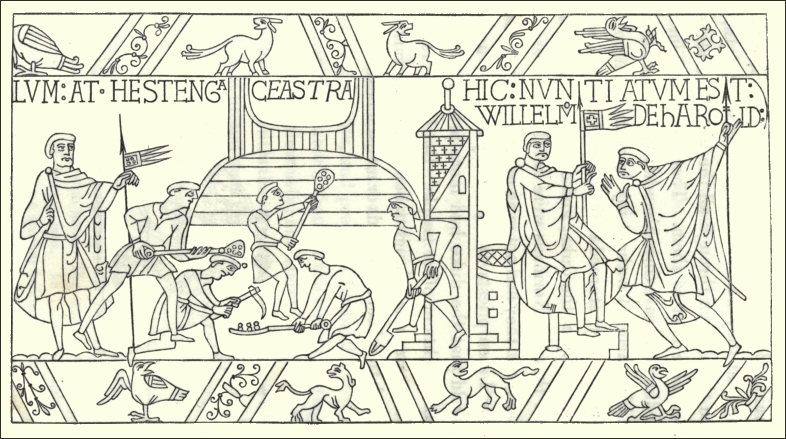


LES NONS DE GRAUNTZ DELA LA MER
QUE VINDRENT OD LE CONQUEROUR
WILLIAM BASTARD DE GRAUNT VIGOURE[222].


OF
ADDITIONAL NOTES AND CORRECTIONS.
Inferiusque jacent quatuor atque decem:
Quos agitant validi septuaginta viri,
Brachia versantes, multo et sudore madentes.
Certatimque suos quisque movet socios,
Viribus ut totis impellant flamina sursum,
Et rugiat pleno capsa referta sinu,
Sola quadragintas quae sustinet ordine musas.
Ce sui lisant, a Bone vile.
La fu li serremenz jurez,
Que Heraut meisme a devisez,
Que tant cum Ewart vivreit mais
Le regne li tendreit en pais,
Selon sa force, au suen poeir,
Senz fausser et senz deceveir;
E apres qu'il sereit feniz,
Ci que del regne fust saisiz,
Li tendreit vers toz homes nez
De ci qu'il i fust coronez;
E des ceu jor en avant
L'en sera mais partot aidant;
Douvre, la tor e le chastel,
Si fort cum il est e si bel,
Baillera sempres bien garniz
E de vitaille repleniz
A ceus des suens qui lui plaira,
Qu'il a garder i trametra;
E s'aillors vout chasteaus fermer
Desus le rivage de mer,
Despense e vivre e estoveir,
Trovera tot de son aveir.
Eissi sor tot le saintuaire
Qu'om li vout aporter ne traire
Jura de sa main a tenir,
Senz rien fausser e senz guenchir.
E li dux, por lui mieuz aveir
Senz fausser e senz deceveir
E senz muer vers lui corage,
Aeliz la proz e la sage,
Sa fille, li ottreie e done,
Quant saisiz ert de la corone,
E del regne une meitie.
Mult en vout cil baisier le pie.
Iteux furent lor covenanz.
Vaillanz e bien apris e sages;
Si li manda qu'il aveit fait,
Kar ce li ert dit e retrait
Que la corone aveit saisie;
Mais ne feist teu felonie,
Car tote genz saveit assez
Cum li regnes li ert donez.
II meesmes tot premerain
Li asseura de sa main.
Ne se parjurt ne se desleit;
Mais rende-li, si cum il deit,
L'onor, le regne e la corone
Que dreitore e raison li done;
Kar sache bien, si n'en dot mie,
Tant cum li seit eu cors la vie,
N'aura repos mais ne sejor
Ci que saisiz seit del honor.
Icist messages li fu faiz
E diz e contez e retraiz;
Mais mult li respondi petit
Fors orguil, contraire e despit;
Ainz ceus qui od lui se tenissent
E voluntiers li recoillissent,
Coveneit doner seurtances
E fers ostages e tenances.
A ses evesques hauz letrez,
E a ses chers barons privez,
Que li furent ami feeil,
E que il sout de haut conseil.
Roberz, li quens de Moretoin,
Qui unt de malveiste n'out soing,
Sis bons freres verais e cerz,
E li quens d'Ou, li proz Roberz,
Li quens d'Evereus, li sachanz,
Richarz li proz e li vaillanz,
E de Beaumunt li quens Rogers,
Qui mult ert saives chevaliers,
E Roger de Mungumeri,
N'est dreiz que lui vos en obli,
E Guillaume le fiz Osber,
Qui puis li out maint grant mester,
E Huges, li vesquens, li proz.
Icist, si cum je's vos nom toz,
Li conseillierent e loerent,
E tuit enfin s'i accord erent,
Que il feist Heraut fequerre
De la corone e de la terre,
Saveir e aprendre e oir
Cum il s'en voudra contenir;
E, son ce qu'il en respond ra,
Solom ice se contendra;
Ses messages tost li tramete
E taut dementres s'entremete
De faire assembler la navie
De par trestote Nor mend ie;
Semunge veisins e amis
E ecus qui a lui sunt sozmis,
Que teus apareiz e si granz
Ne fu jostez mais par Normanz,
N'ovre el siecle si envai'e
Que ci seit lor morz ou lor vie.
Dunt si s'esteit humiliez;
Apostolial ottreiance,
Son le poeir de sa puissance,
L'en comanda e vout e dist
E par ses lettres li escrist
Que del conquerre ne se feigne;
Od tot li tramist une enseigne
De saint Pere, por demostrer
Qu'a ce li volent ajuer.
Autorite sera e feiz
Que c'est sa corone e sis dreiz
Qu'il vout conquerre: si'n auront
Tuit cil qui oue lui seront
Partot mult maire seurtance
Que ne lor vienge meschaance.
Une esteile grant apparut,
E quatorze jors resplendi.
Od tres Ions rais deverz midi;
Tele esteile solt l'en veir
Quant novel rei deit regne aveir.
Asez vi homes ki la virent,
Ki ainz e poiz lunges veskirent:
Cometc la deit apeler
Ki des estciles volt parler.
Aparut sus el firmament,
Une clartez e un planete,
Une resplendisanz comete,
Dunt en eisseient trei grant rai.
Ce lis e truis e vei e sai
Que quinze nuiz durerent bien.
Si distrent astrenomien
Que c'ert de regnes muemenz
Ou de reis ou de hautes genz.
Une estoille, dont li prophete
Et li bon astronomien,
Sievent q'espeant mal ou bien,
Se demustra el firmament;
Assez la virent meinte gent.
La nuit de Letanie majour
Fist tel clarte cum se fust jour.
Moult plusours homes l'esgarderent:
Chascuns disoit sa divinaille;
Mes tost seurent la grant contraille,
E la grant tribulacion
Qe prius avint a la region.
Dunt ci vos di e dunt je vos cont,
Robert fiz Roger de Beaumunt
Vos di qui fu teus chevaliers,
Si proz, si hardiz e si fiers
E si aidanz que ceste istoire
Me fait de lui mult grant memoire.
Mult redelivrent forz les places
II e ses genz quens Eustaces.
Si n'a duree acer ne fer
Vers Guillaume le fiz Osber,
Qu'Engleis ateigne si garniz
De la mort ne puisse estre fiz.
Chevaliers i est forz e durs
E sage e sofranz e seurs;
E li bons visquens de Toarz
N'i est ne mauvais ne coarz,
Qui ert apele Eimeris;
Mult i recut le jor grant pris.
Gauter Gifart, savum de veir,
Qui out le jor grant estoveir,
Qu'abatuz fu de son destrier
Eissi que cine cenz chevalier
Des lor l'aveient ja outre,
Toz ert li secors oublie,
Quant li bons dux de Normendie
Od l'espee d'acer forbie
L'ala secorre e delivrer
E faire sempres remonter.
En si fait lieu n'iert mais retrait
Que tel esforz cum ceu seit fait
Par un prince qui au munt vive.
Nus ne content ne nus n'estrive
Que le pris n'en fust suens le jor
De la bataille e del estor;
Poi out de mort crieme e regart
A rescorre Gauter Gifart.
N'en i r'out gaires de plus buens
Qui fu le jor Hues li quens,
E Guillaume cil de Warenne
R'ida a conquerre le regne
Cum buens chevalers e hardiz.
Qui Tostis esteit apelez.
Ne truis pas bien apertement
For qu'il erent si malement.
Au due s'en ert Tostis venu,
Qui mult Taveit gent receu
E chers tenuz e honorez
E ses riches aveirs donez.
Chevaliers ert e bons vassaus,
Prozdom e entiers e leiaus;
Merveilles out grant desier
D'aler son frere guerreier,
De tolir chasteaus e citez;
Kar trop s'ert vers lui maumenez,
Mult volentiers e bonement,
Od le haut conseil de sa gent,
Li quist li dux tot estoveir,
Nefs, gens, armes a son voleir.
Eissi corut a grant esforz
Vers Engleterre dreit as porz.
Qui de Normendie esteit nez,
Mais en cele terre maneit,
Ou richement se conteneit;
Certainement, de veir, senz faille,
Sout cum il ert de la bataille
On Heraut out son frere occis.
Un mult seur messages a pris,
Si'l tramist au due erraument.
A desseu de tote gent,
Dist-li qu'il ert e dunt veneit
E qui a lui le trameteit;
Apres li a 1'ovre contee
Que sis sire li out mandee,
Coment Heraut s'ert combatuz
Qui ceus de Norwege out vencuz,
E ocis son frere e le rei
E ceus qu'il amena od sei,
Ou plus aveit de vint milliers.
De la retorne forz e fiers,
Od plus a de cent mile armez.
Od poples teus ne fu jostez.
"De tei trover unt teu desir
Ja n'i cuident a tens venir.
Gart, pren conseil, ne t'asseure,
Kar perillose est l'ovre e dure.
Tant as eu honor e pris,
Gar qu'or ne seies entrepris,
Ne de haster pas de combatre
De metre ta gent ne d'embatre
En leu par trop fol ovre enprise
Ou ele seit morte e occise,
Ne tu abaissiez ne periz."
"Amis, fait li dux, granz merciz
Bien fist ton seignor del mander
E bien en fait a mercier;
Mais tant li di que je li mant.
Qui damne-Deu trait a garant,
Qui il conduit e tient e maine,
Qui juste cause a dreite e saine,
En liu d'aveir, honor e gloire,
Valor e puissance e victoire,
Deit bien aveir, s'en lui a fei.
Tot eissi le quit-je de mei,
Kar j'ai dreit e mun dreit demant
E lui trai partot a garant.
Si'l conquerra; kar contre lui
N'a nus ne force ne refui,
Valor, defense ne poeir.
Or seit del tot au suen voleir.
version, however, of the story ought obviously to lay the scene at Waltham, and consequently at an earlier date. It is so told, in fact, in the Waltham legends,—Cott MSS. Jul. D. vi. and Harleian, No. 3776.
La nuit se est repose;
Par matin se est leve,
Sa messe oir est ale,
Assez pres a un moster
Son chapelain fist chanter.
Quant li prestres out sacre
E la PATER NOSTER chante,
Este-vus ke vient la crie:
"Le dux sur nus vient arme!"
Li rois, ki oi la crie,
Durement estoit affrae;
De la messe tantost se mist,
As armes corut sanz respit.
Si le AGNUS DEI eust atendu
E la PAIS eust receu,
Par pais eust la terre tenu,
U par bataille le dux vencu.
Quant il issit del moster,
La croiz, ke fu fait de pere,
Apres le rois ad encline
C'onques puis la teste leve.
Ki ke volt ceo saver,
A Walteham, ultre le halt auter,
Meimes eel croiz purra trover
E roi Haraud gisant en quer.
I aveit mult grant pris conquis;
Mais il i fu morz e occis.
Tant esteit grant sis hardemenz
Qu'en mi les presses de lor genz
Se colout autresi seur
Cume s'il i fust clos de mur;
E puis qu'il out plaies mortex,
Puis i fu-il si proz e teus
Que chevalier de nul parage
N'i fist le jor d'eus teu damage.
Et de ferir apparaillees,
Mult i out genz d'ambes dous parz;
De hardement semblent leoparz.
Un des Francois done se hasta,
Devant les autres chevaucha.
Talifer ert cil appellez,
Juglere hardi estait assez;
Armes avoit et bon cheval,
Si ert hardiz et noble vassal.
Devant les autres cil se mist,
Devant Englois merveilles fist;
Sa lance prist par le tuet
Si com ceo fust un bastonet,
Encontremont halt l'engetta
Et par le fer receue l'a.
.Iij. fois issi getta sa lance,
La quarte foiz puis s'avance,
Entre les Englois la launca,
Par mi le cors un en navera,
Puis trest s'espee, arere vint,
Et getta l'espee qu'il tint,
Encontremont haut le receit.
L'un dit al autre, qi ceo veil,
Qe ceo estoit enchantement.
Cil se fiert devant la gent
Quant .iij. foiz out gette l'espee.
Le cheval ad la goule baee,
Vers les Englois vint eslesse.
Auquanz quident estre mange
Pur le cheval q'issi baout.
Li jugleour enpres venout,
Del espee fiert un Engleis,
Le poign li fet voler maneis;
Un autre ferit taut cum il pout,
Mau guerdon le jour en out;
Car li Englois de totes parz
Li launcent gavelocs et darz,
Si l'occistrent et son destrer:
Mar demanda le coup primer.
The CROSS generally appears on its Norman gonfanons. It be here noticed that Wace, vol. i. p. 201, mentions that the gonfanon borne by the baron appointed to lead the Normans in 945 under Richard I. was 'vermeille d'Espagne.'
Fu reis Heraut morz abatuz,
Par mi les deus costez feruz
De treis granz lances acerees,
E par le chef de dous espees
Qui entrerent jusqu'as oreilles
Que les plantes en out vermeilles.
Chet e tost est defulez,
Periz, ocist e adirez;
E sun estandart abatuz,
E li ostz d'Engleiz vencuz;
E murut i quens Gruith si frere,
E quens Leuwine.
E si me retrait li escriz
Que sa mere por lui aveir
Vout au due doner grant aveir;
Mais n'en vout unques dener prendre
Ne por riens nule le cors rendre;
Mais a un Guillaume Malet,
Qui n'ert tosel pas ne vaslet,
Mais chevaliers durs e vaillanz.
I cist Ten fu tant depreianz
Qu'il li dona a enfo'ir
La ou li vendreit a plaisir.
A Waltehara, ultre le haul auter,
Meimes eel croiz purra trover,
E roi Harau gisant en quer;
Ilokes gist enterre.
E truve entre les ocis;
E pur co ke il rois esteit,
Grante est k'enterrez seit.
Par la priere sa mere,
Porte fu le cors en bere,
A Wautham est mis en carcu;
Kar de la maisun fundur fu.Footnotes
Tote rien se torne en declin;
Tot chiet, tot muert, tot vait a fin;
Hom muert, fer use, fust porrist,
Tur font, mur chiet, rose flaistrit;
Cheval tresbuche, drap viesist,
Tot ovre fet od mainz perist.
'Hie vor do was diu welt so schone,
Nu ist si worden also hone.'
The world was once so beautiful,
And now so desolate and dull.
See notice of his life and works in Lays of the Minnesingers, London, 1825. At the conclusion of his Chronicle, Wace mentions Maistre Beneit (de Sainte-More) as commissioned to undertake a similar task, and expresses himself by no means satisfied with his patron, Henry II.
Mult me duna, plus me pramist:
E se il tot dune m'eust
Co k'il me pramist, mielx me fut.
Et en totes guimples fermees.
M. Pluquet in his notes interprets guimples as 'cornettes de taffetas attachees a la lance:' for which purpose the knights may have already learned to adopt the colours or tokens of their ladies.
De plusors guises escuz painz.
Ki abati le rei de France.
E co alouent la gent, disant
Ki charnelment od li ne jut,
Ni charnelment ne la conut:
Maiz unkes horn ne l'aparcut,
Ne mal talent entrels ne fut.
Ki mult est errant et isnele,
E ki bone novele porte
Seurement bute a la porte.
Reveillez vous et vous levez,
Francois, qui trop dormi avez!
Allez bientot voir vos amys,
Que les Normans ont a mort mys,
Entre Ecouys et Mortemer!
La vous convient les inhumer.
But it seems admitted that the battle nevertheless was not at Mortemer-en-Lyons near Ecouys, where the abbey was, but at Mortemer-sur-Eaulne, in the arrondissement of Neufchatel. Wace's account of the proclamation by the varlet—or herald, as others call him—(William of Jumieges naming him Ralf de Toeny), runs in the original thus:
La u li reis fu herbergiez,
Ki en sun liet ert ja cochiez,
Fist un home tost enveier,
Ne sai varlet u esquier;
En un arbre le fist munter
E tute nuit en haut crier—
'Franceiz! Franceiz! levez! levez!
'Tenez vos veies, trop dormez!
'Alez vos amiz enterrer,
'Ki sunt occiz a Mortemer!'
Li reis oi ke cil cria,
Merveilla sei, mult s'esmaia;
Par eels ke li plout enveia,
Demanda lor e conjura
S'il unt nule novele oie,
De co ke cil en l'arbre crie.
Endementres k'al rei parloent,
E des noveles demandoent,
Eis vus! la novele venue
E par tute terre espandue,
Ke tut li mielx de lor amiz
Esteit a Mortemer occiz;
E cil ki erent remez vif
En Normendie erent chetif,
Miz en anels et en gaoles.
Ceste Malde de Flandres fu nee,
Meis de Escoce fu appelee,
Pur sa mere ke fu espuse
Al roi de Escoce ki Tout rove;
Laquele jadis, quant fu pucele,
Ama un conte d'Engleterre.
Brictrich-Mau le oi nomer,
Apres le rois ki fu riche her.
A lui la pucele enveia messager
Pur sa amur a lui procurer:
Meis Brictrich Maude refusa,
Dunt ele mult se coruca.
Hastivement mer passa
E a Willam bastard se maria.
He then relates that after the conquest, Matilda revenged herself on this Brictrich-Mau, by seizing him 'a Hanelye, a sun maner,' and carrying him to Winchester, where he died 'par treison.' See, as to this Brictrich, Dugdale, Monasticon, title TEWKESBURY; and Palgrave, English Commonwealth, vol. i. ccxciv.
Ewart li juz e li verais,
Qui Engleterre tint en pais,
Cume hauz reis, veirs crestiens,
Pleins de ducur et de toz biens.
I but tell the tale as 'twas told to me.'
Benoit de Sainte-More sends the archbishop of Canterbury to William, at Edward's desire, to convey his intention of leaving to the duke the inheritance of the English crown.
L'arcevesque de Cantorbire,
Li plus hauz horn de son empire,
Out en Normendie tramis,
Les anz avant, si cum je vos dis,
For afermer ce qu'il li done,
Tot le reaume e la corone.
And Harold's mission is described as being expressly intended, in the following year, to confirm the same bequest:
Por estre plus certains e meres,
E qu'il n'i sorsist encombrier,
Resout l'ovre plus esforcier.
Heraut, qui quens ert del pais,
Trestot li plus poesteis
Que nul des autres del reiaume,
Ce lui tramist al due Guillaume,
Que del regne enterinement
Tot qui a la corone apent
Li feist feute juree,
Eissi cum ele ert devisee:
Veut qu'il Ten face serrement
Et qu'il l'en donge tenement . . .
—trop lor fu la mer sauvage:
Kar granz tempers e fort orage
Ne les i laissa ariver:
Ainceis les covint devaler
Dreit en Pontif. La pristrent port,
Eissi ateint e eissi mort;
Mieux vousissent estre en sezile.
. . . . . manda li dux ses genz
Sempres, a milliers e a cenz;
Vers Ou chevaucha irascuz
Dunt Heraut ne li ert renduz.
Od que li Dux out jostees,
Mult granz e mult desmesurees:
For aller essilier Bretons,
Vers lui torcenos e felons
Qui n'el deignoient sopleier,
Le mena od sei osteier;
La fist de lui si grant cherte
C'unc tant n'out de sa volunte,
Ne fu nul leu mais tant joiz
Qu'il cil afaires fu feniz.
Heraut de coveitise espris,
Senz autre conseil qui'n fust pris,
Saisi le reigne demaneis;
Parjurez e faus se fist reis,
Eissi, senz icele unction,
E senz cele sacration,
Qu'en deit faire a rei saintement
Le jor de son coronement.
In this part of his chronicle he relates an expedition by Harold against 'li Galeis' and 'reis Griffins, qui d'eus ert sire.'
————Heraut l'ocist,
Sa femme Aldit saisi e prist,
Qui fille ert del bon conte Algar.
Gentil furent li capelain,
Gentil furent li escrivain,
Gentil furent li cunestable,
E bien poessanz e bien aidable;
Gentil furent li senescal,
Gentil furent li marescal,
Gentil furent li buteillier,
Gentil furent li despensier;
Li chamberlenc e li uissier
Furent tuit noble chevalier.
William became earl of Hereford, and was killed in 1070. Ordericus Vitalis,536, exclaims, 'Ubi est Guillelmus Osberni films, Herfordensis comes, et regis vicarius, Normanniae dapifer, et magister militum bellicosus? Hie nimirum primus et maximus oppressor Anglorum fuit, et enormem causam per temeritatem suam enutrivit, per quam multis millibus ruina miserae mortis incubuit.' His family were soon involved in rebellion, and disappeared in England. The Osbernus episcopus—of Exeter—in Domesday, was his brother. See Ellis's Introduction to Domesday, i. 460-511.
E a si tres feeus amis,
A sa femme, la proz, la sage,
Que n'el en pot venir damage.
Benoit de Sainte-More.
Li conte de Flandres requist,
K'en sa busuigne a li venist,
Cum od serorge et od ami.
The meaning may be that the reigning count of Flanders was requested to come to William with the latter's brother-in-law, i.e. bringing with him his, the then count's, son. But the succeeding speech of the varlet directly addresses the count as himself the brother-in-law; and most likely the sentence is elliptic, and what is meant is, that the count should come to him, and go on the expedition with him, as with a brother-in-law and friend. If this, however, be Wace's meaning, he is historically wrong; as Baldwin V. William's father-in-law, did not die till the succeeding year; and the application, therefore, must have been to him, not to the brother-in-law, afterwards Baldwin VI. Wace's account of the count's feelings and conduct is at variance with the received historical opinion, that he assisted William zealously; particularly by using his influence in restraining any opposition from the young French king his ward. According to Sismondi, however, Baldwin did not interfere in French affairs; and the course pursued by the king does not appear to have been friendly, but as hostile as the weakness attendant on a minority allowed. As to the policy of the court of Flanders, a variance in the accounts may possibly have arisen from confusion between the different counts, who succeeded each other quickly, and perhaps had opposite views: so that what is said by historians as to William's transactions with Baldwin V. may apply to a later period and another person. Though there were many adventurers from Flanders in William's service, we are not aware of any decisive proof that the count avowedly sent a force to aid the expedition in 1066. Gilbert de Gant is not heard of before 1069. He and such captains as Gherbod of Chester, Walter Flandrensis and Drogo de Bevrere may have been only volunteers, assisting for personal rewards. It may be added that Wace's account of the course pursued by France and Flanders is at any rate consistent; and it is probable, as being dictated by motives of obvious policy.
A Rome ert done Pape Alixandre
Jusz hoem, saintismes e verais.
See his report concerning the apostolic grant in our appendix.
Asez vi homes ki la virent,
Ki ainz e poiz lunges veskirent.
Ke seit sor l'ewe d'Ou mult bel.
Fol i alai, fol m'en revins,
Folie quis, por fol me tins.
Ci receveront les granz loiers
Qu'aveir deivent bons chevaliers;
Les terres, les fieus, les honors,
Plus c'unc n'orent lor anceisors;
Par lor valor, par lor proeces,
Auront des or les granz richesces,
Les granz tenures e les fieus.
Si out treis mile nefs au meins,
De ce nos fait l'autor certains.
D'entrer es nefs e de charger
Ne sorst esmai ne destorbier,
Kar l'aure venta duce e queie
Eissi que li mers trop n'ondeie.
Enz l'anuitant furent tuit enz;
Od ce que mult fu dreiz li venz,
Traistrent les veiles, si siglerent,
Au rei des ceus se comanderent
Od joie e od tens duz e bel
Arrivent a Pevenesel.
Hoc sempres desus le port
Ferment un chastel bel e fort.
Chevalers bons des sues genz
Laissa li dux assez dedenz
For tenir le deus anz garniz,
Apres, ce conte li escriz,
Vint a Hastinges senz demore,
Ou maintenant e en poi d'ore
En r'a un autre fait fermer.
Tant entendirent al ovrer
Que li mur i furent si haut
De nule part ne dote assant.
La remist gardes seguraines
E de lui fei porter certaines.
Pros ert Heraut e virtuos,
E empernanz e corajoz:
N'estoveit pas en nule terre
Sos ciel meillor chevaler querre:
Beaus esteit trop, e beaus parlers,
Donierre e larges viandiers.
His mother, according to the same authority, dissuaded him from the enterprise, equally with his brother; who, besides the reasons urged in Wace, presses the army's need of repose after the late campaign.
La nuit que li ceus fu teniegres,
Soprendre quidout l'ost Normant
En la pointe del ajornant,
Si qu'el champ out ses gens armees
E ses batailles devisees:
Enz la mer out fait genz entrer
For ceus prendre, por ceus garder
Qui de la bataille fuireient,
E qui as nefs revertireient.
Treis cenz en i orent e plus.
Des ore ne quident que li dux
Lor puisse eschaper, ne seit pris,
Ou en la grant bataille occis.
This is ther custom and ther gest
Whan thei are at the ale or fest;
Ilk man that loves where him think
Sail say wassail, and to him drink.
He that bids sail say wassail;
The tother sail say again drinkhail;
That said wassail drinkes of the cup,
Kissand his felow he gives it up;
Drinkhail, HE says, and drinkes thereof,
Kissand him in bord and skof.
The king said, as the knight gan ken,
Drinkhail, smiland on Rouwen;
Rouwen drank as hire list,
And gave the king, sine him kist.
Ther was the first wassail in dede,
And that first of fame gede;
Of that wassail men told grete tale, &c.
Et encore plus dire voleit,
Vint Willame li filz Osber,
Son cheval tot covert de fer;
"Sire," dist-il, "trop demoron,
"Armons nos tuit; allon! allon!"
Issi sunt as tentes ale, &c.
See the observations of M. Deville on this description, in Mem. Ant. Norm. v. 81. Such an equipment of a horse at so early a period has no other authority, and is probably an anachronism. But it may be observed that Wace's description at least shows that the practice was already in existence in his day, which we believe could not be otherwise proved.
Li dues, ki s'arma tost apres,
Sun hauberc endosse envers.
Dist ki l'arrna, "Seit tort u dreit
Verruns ke li dues rois seit."
Li dues, ki la raisun ot,
Un petit surrist au mot,
Dist, "Ore seit a la devise
Celui ki le mund justise!"
Jura par la resplendor De,
Co ert suvent sun serement.
Hache noresche out mult bele,
Plus de plain pie out l'aleraele.
Un helme aveit tot fait de fust,
Ke colp el chief ne receust;
A sez dras l'aveit atachie,
Et envirun son col lacie.
But the text is often so imperfect, and at such variance from the ordinary rules of Norman French grammar, that it is frequently hard to be certain as to the fidelity of a translation. 9 Ordericus Vitalis states that the spot where the battle was fought was anciently called SEN LAC. That word certainly sounds very like French, and as originating in the blood which flowed there: but his expression has been thought to carry the antiquity of the name, in his opinion at least, much earlier than the date of the battle. We think it right to subjoin Wace's original record of the privileges of the men of Kent and London; as to which see Palgrave's Rise and progress of the English Common-wealthy I. ccclxxii.
Kar co dient ke cil de Kent
Deivent ferir primierement;
U ke li reis auge en estor,
Li premier colp deit estre lor.
Cil de Lundres, par dreite fei,
Deivent garder li cors li rei;
Tut entur li deivent ester,
E l'estandart deivent garder.
'INCISOR FERRI mimus cognomine dictus.'
He is there also called 'histrio,' but his singing is not mentioned.
'Hortatur Gallos verbis, et irritat Anglos;
Alte projiciens ludit et ense suo.'
An Englishman starts out of the ranks to attack him, but is slain by the 'incisor ferri,' who thus
'—belli principium monstrat et esse suum.'
Nothing is said as to his fate, which Wace also passes over.
Cou est l'ensegne que jou di
Quant Engles saient hors a cri.
Son chef desarme en la bataille
E del heaume e de la ventaille.
Count Eustace is here introduced by Benoit as strongly exhorting the duke to escape from the field, considering the battle as lost beyond recovery. He however rallies his men, and triumphs over the English, whose ranks had broken in the pursuit. No stratagem in this respect is noticed by Benoit.
La bataille ad bien dure
De prime dekes a la vespre:
Unkes home ne saveit
Ki serreit vencu, ne ki vencreit.
Ne grosse mouske, ne wibet,
Ne longe wespe, ne cornet.
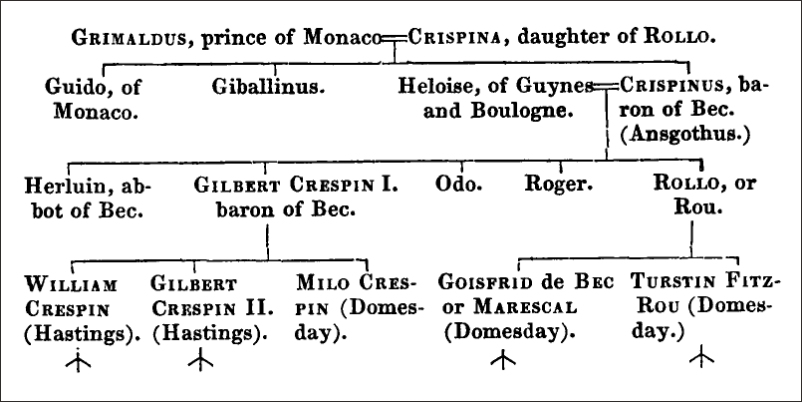
This pedigree differs, it will be seen, from the usually received accounts, and in some respects from the genealogy in the appendix to Lanfranci opera by D'Achery. Whether the latter is entitled to more weight than most of these monastic genealogies we do not pretend to decide. According to that authority, however ,William Crespin had a sister Hesilia, who was mother of William Malet, who, it states, died an old man at Bec[Note 18]. She would thus appear to be the wife of Turstin Fitz-Rou, the grandfather of Vauquelin Malet.
Il les tenoit ne sai pur quoi
Car nule guerre il n'avoit,
Ne de nul horn ne se cremoit:
Mes par sa grant nobilite
Avoit cele gent od soi mene.
Qe dirroie de ses barons?
Quieus horns estoit li quens Huons!
L'empereur de Lumbardie
Ne menoit pas tiele compaignie
Come il fesoit de gent privee.
Ja sa [tiel] meson ne fut vee
A gentil home ne a franc.
Ewe en viver u en estanc
Ert plus legier a espucher
Que n'iert son beivre ne son manger.
Touz tens avoit richesce assez;
Ja tant n'eust le jor donez
Qe lendemain li sovenist,
E q'autretant ne departist.
Conte de Cestre estoit clame;
Od grant gent est au roi ale.

En treis quaers [cahiers] de parchemin
N'en venisse je pas a fin. [Note 29]
Li quiens Alain de Bretaigne
Bien i ferit od sa compaigne.
Cil i ferit come baron:
Mult bien le firent Breton.
Od le roi vint en ceste terre
Pur lui aider de sa guerre;
Son cosin ert, de son lignage,
Gentil home de grant parage;
Le roi servit et ama,
Et il bien le guerdona;
Richement[mont?] li dona el north
Bon chastel et bel et fort.
En plusurs lius en Engleterre
Li rois li donna de sa terre.
Lunges la tint et puis finit:
A Seint-Edmon l'om l'enfouit.
Ore ai dit de eel baron
Repairer voil a ma raison.
Ke put estre, dist-il, ceste
Cuardie, segnurs Normantz,
Ki ancesurs avez si grantz?
Rois Rou, ki as coups de lance
Descumfist le rei de France,
E le mata en mi sa terre,
Par force de bataille e guerre;
E dues Richard k'apres li vint,
Ki li diable ateint e tint,
E le venquit e le lia.
E vus failliz, forlignez ja!
Sivet moi, ma gent demeine!
Cele occise, cele dolor
Tint tant cum point i out deu jor,
Ne la nuit ne failli la paine
Ci que parut le Diemaine.
—si quide Pom bien e creit
Qu'a cine milliers furent esme
Cil des lor qui furent trove,
Sol eu grant champ del fereiz,
Quant qu'il fussent desconfiz
Estre l'occise e la martire
Qui fu tute la nuit a tire.
N'i aveit gaires fortelesce,
Ne tur de pierre ne bretesce,
Se n'esteit en vieille cite,
Ki close fust d'antiquite.
Maiz li barunz de Normendie,
Quant il orent la seignorie,
Firent chastels e fermetez,
Turs de pierre, murs e fossez.
Dona chastels, dona citez,
Dona maneirs, dona comtez,
Dona terres, as vavassors
Dona altres rentes plusors.
And slayn also through him in the battaile biforne;
And ther as the bataile was, an abbey he let rere
Of Seint Martin, for the soules that there slayn were;
And the monkes well ynough feffed without fayle,
That is called in Englonde ABBEY OF BATAILE.

So far ROBERT OF GLOCESTER. William, speaking for himself in his foundation charter in Dugdale's Monasticon, (where see all the details of the foundation), gives the following account of his motives and proceedings. 'Notum facio omnibus, &c.—quod cum in Angliam venissem, et in finibus Hastingiae, cum exercitu applicuissem contra hostes meos, qui mihi regnum Anglise injuste conabantur auferre, in procinctu belli, jam armatus, coram baronibus et militibus meis, cum favore omnium, ad eorum corda roboranda, votum feci, ecclesiam quandam ad honorem Dei construere, pro communi salute, si per Dei gratiam obtinere possem victoriam. Quam cum essemus adepti, votum Deo solvens, in honorem Sanctae Trinitatis, et beati Martini, confessoris Christi, ecclesiam construxi; pro salute animae meae et antecessoris mei regis Eadwardi, et uxoris meae Mathildis reginae, et successorum meorum in regno; et pro salute omnium quorum labore et auxilio regnum obtinui; et illorum maxime qui in ipso bello occubuerunt.' The Chronicle of Battle Abbey (Cott. MS. Dom. A. ii.) is precise as to the localities of the battle. It states that Harold came 'ad locum qui nunc BELLUM nuncupatur,'—and that William arrayed himself to oppose him, 'equitum cuneis circum septus'—'ad locum collis qui HETHELANDE dicitur, a parte Hastingarum situm,' Hethelande is afterwards mentioned as part of the abbey's possessions. In this Chronicle is contained one of the most curious historical and legal relics of the twelfth century; the record of a suit, as to jurisdiction, between the bishop of Chichester and the abbot of Battle, which has been printed in Palgrave's Rise and Progress of the English Commonwealth. One of the barons present observes of the battle, that William obtained his crown by it, 'nosque omnes opulentia maxima ditati sumus.'
Si Dex, ki est tuit puissant,
De vus eust fait oisel volant,
De tuz icels ki pount voler
Laquelle voldriez resembler?
Robert selects the esperver, and William the eagle, but Henry, 'k'en clergie esteit funde'—' mult sagement ad parle,' and chose the estornele. The whole story forms a curious and interesting apologue. The 'grantz clers de phylosophie, e los mestres de grant clergie, e les sages homes de son poer,' are described as assembled on this occasion, 'a un parlement;' and the king opens the session with a royal speech, perhaps the earliest of the sort on record:
Seignors! dist il, ki estes ici,
De vostre venue mult vus merci.
De voz sens et vostre saver
Ore endreit en ai mester;
Pur ceo vus pri e requer
K'entre vus voillez trailer, &c.
The story forms a distinct fabliau in the MSS. Cotton. Cleop. A. xii.
'Engleterre ai cunquise a dreit.'
Orderic gives the confession, but less explicitly, thus: 'Neminem Anglici regni constituo haeredem . . . . Fasces igitur hujus regni, quod cum tot peccatis obtinui, nulli audeo tradere nisi Deo solo.' See the note on this passage in Lytlleton's Hen. II. vol. i. 397. Possibly William's admission would not, in his day, be understood as being at variance with any of the details given by Wace and other Norman historians. Harold, as we have seen, is treated as assuming with his brother Gurth the perfect moral and legal validity of his title as against William, and yet as shrinking from a personal contest with one to whom he had de facto, though by stratagem, become bound in allegiance. And William might, in a similar train of reasoning, maintain all the facts asserted by the Normans, bearing on the moral justice of the case as between him and Harold, and his personal right to punish treason in his man, and yet admit that Harold, having obtained by the gift of Edward, and by election and consecration, a strictly legal title, his eviction was tortuous, and could give his conqueror no right except that of force—none that he could lawfully transmit. Benoit states his title by conquest, not in the mitigated sense in which that word has been used by some of our legal antiquaries, but in its harshest application:
Deu regne est mais la seignorie
As eirs estraiz de Normendie:
CUNQUISE l'unt cum chevalier
Au FER TRENCHANT e al acier.
His account of William's speech is in our appendix.
—volenters voleit saver
D'Engletere la tenor,
E la laise e la longnur,
Toz les feez e les tenemenz
E les servises de tote genz,
Quant de conteez i stint trove
E quant de viles en chascon conte,
Quant de barons la terre avoit
E cumbien de terre chascon tenoit,
Quanz de feez de chevaliers
E cumbien de franc-fermers,
Les serganties e les sokages,
Les petiz sokemen e les vilenages;
Cumbien des charues en chascon vile,
E kant de boueez en la charue;
Cumbien de terre chascon home avoit,
E en quele manere il la tenoit,
E quel servise faire devoit,
E quei sa terre valer purreit.
Tuit ensemble fist enquerre
Par serement par mie la terre,
Od grant diligenz ceo fist escrivre
E de ceo en fist un grant livre.
Le livre est Domesday apele
E en la tresorie le roi uncore guarde.
FINIS.